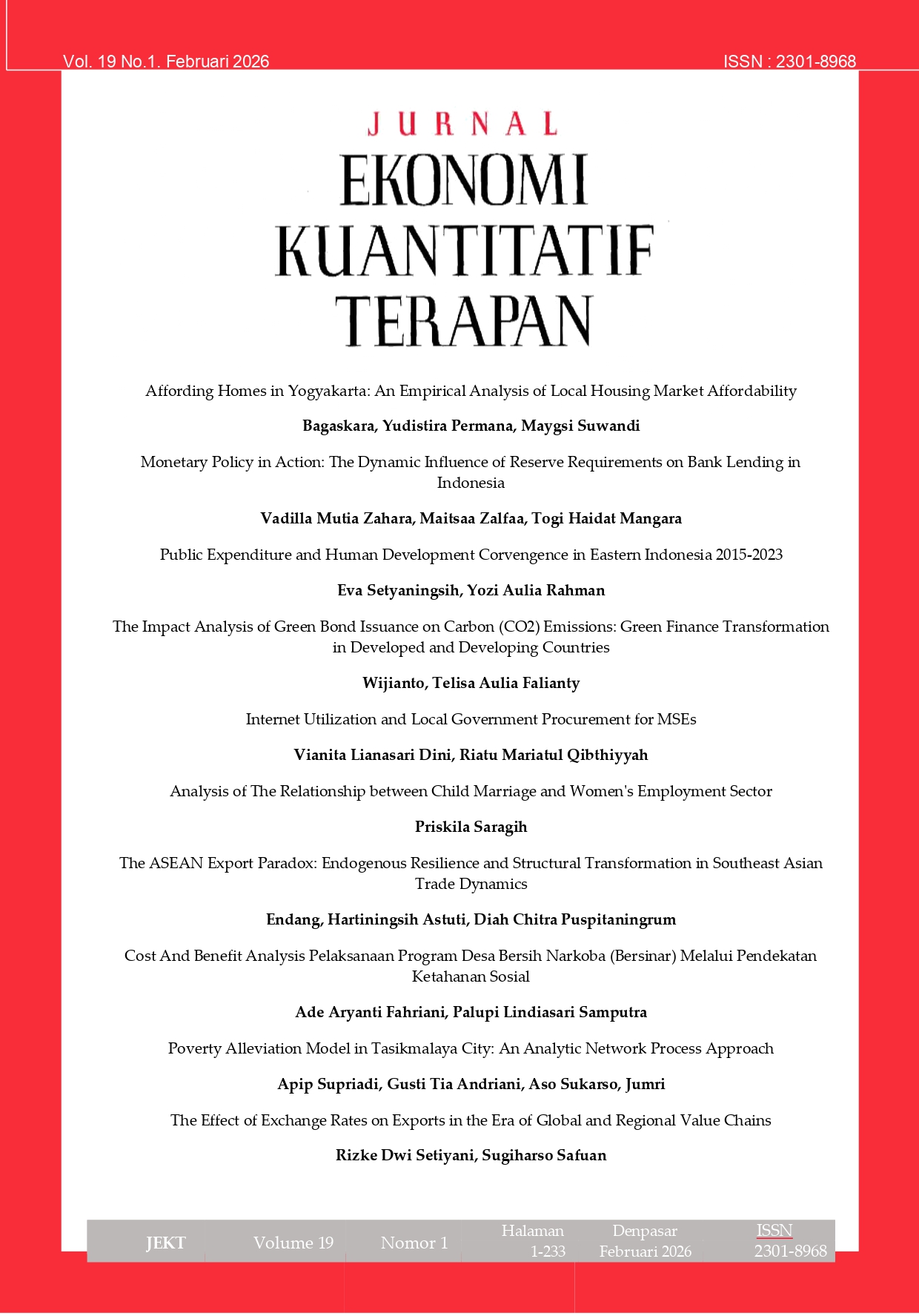
Public Expenditure and Human Development Convergence in Eastern Indonesia 2015-2023
DOI:
https://doi.org/10.24843/JEKT.2026.v19.i01.p03Keywords:
GMM, Human Development Index, Government Expenditure, ConvergenceAbstract
Penelitian ini bertujuan untuk menganalisis pengaruh belanja pemerintah di sektor pendidikan, kesehatan, dan perlindungan sosial serta faktor-faktor sosial ekonomi seperti tingkat kemiskinan dan tingkat kemiskinan terbuka terhadap Indeks Pembangunan Manusia (IPM) di Indonesia Timur. Lebih jauh lagi, penelitian ini juga menguji konvergensi pembangunan manusia antarprovinsi untuk melihat apakah gas antarwilayah semakin menyempit seiring berjalannya waktu. Studi ini menggunakan data panel provinsi untuk periode 2015–2023 dengan menggunakan Metode Momen Umum (GMM) untuk mengatasi potensi endogenitas dan bias model dinamis. Hasilnya menunjukkan konvergensi β, di mana provinsi dengan IPM rendah tumbuh lebih cepat daripada provinsi dengan IPM tinggi, meskipun dengan laju yang lebih lambat. Secara parsial belanja pendidikan memiliki dampak positif namun tidak signifikan, belanja kesehatan memiliki dampak negatif yang signifikan, sedangkan belanja perlindungan sosial memiliki dampak positif yang cukup besar. Tingkat kemiskinan dan kemiskinan terbuka mempunyai dampak negatif yang besar terhadap IPM. Temuan ini menekankan pentingnya belanja publik yang efektif dan kebijakan sosial yang tepat sasaran dalam mempercepat konvergensi pembangunan manusia di Indonesia Timur.
References
Amalia, F. and Fitrijanto, A. (2022) ‘Regional Disparity and Social-Economic Convergence in New Autonomous Regions in Banten Province’, The Indonesian Journal of Planning and Development, 7(2), pp. 60–68. Available at: https://doi.org/10.14710/ijpd.7.2.60-68.
Ann, D. et al. (2023) ‘Assessing the Relationship of Human Development Index (HDI) and Government Expenditure on Health and Education in Selected ASEAN Countries’, International Journal of Social and Management Studies (Ijosmas), 4(6), pp. 13–26. Available at: http://www.ijosmas.org.
Apriska, L. et al. (2024) ‘Pengaruh Pengeluaran Pemerintah Sektor Kesehatan, Pertumbuhan Ekonomi, Dan Kemiskinan Terhadap Indeks Pembangunan Manusia (Kabupaten/Kota Di Provinsi NTB)’, Jurnal Sosial Ekonomi Dan Humaniora, 10(1), pp. 1–11. Available at: https://doi.org/10.29303/jseh.v10i1.451.
Badan Pusat Statistik (2024) ‘Bps Ipm 2024’, Bps, (Indeks Pembangunan Manusia), pp. 1–12.
Balighoh, K. and Tsani, L.I. (2025) ‘Analisis Determinan Indeks Pembangunan Manusia di Jawa Tengah Tahun 2014-2022 Menggunakan Metode System Generalized Method of Moments’, Jurnal EMT KITA, 9(3), pp. 1109–1122. Available at: https://doi.org/10.35870/emt.v9i3.4373.
Banase, M.A.D.D. and Purwono, R. (2024) ‘The Influence of Government Expenditure on the Human Development Index in NTT Province’, Jurnal Ilmu Ekonomi Terapan, 9(1), pp. 109–119. Available at: https://doi.org/10.20473/jiet.v9i1.57397.
Barro, R. J., & Xavier Sala-i-Martin (1992). Convergence. The Journal of Political Economy. 100. 223-251.
Barro, R. J., & Sala-i-Martin, X. (2004). Economic Growth. New York: McGraw-Hill.
Bird, R.M. and Vaillancourt, F. (2019) Fiscal decentralization in developing countries: an overview, Fiscal Decentralization in Developing Countries. Available at: https://doi.org/10.1017/cbo9780511559815.002.
Becker, G. S. (1964). Human Capital: A Theoretical and Empirical Analysis, With Special Rreference to Education. University of Chicago Press.
Esping-Andersen, G. 1990. The Three Worlds of Welfare Capitalism. United Kingdom:Polity Press.
Fauziana, H. and Ratnasari, R.T. (2023) ‘The Effect of Health, Education, and Labor Force with Urban Population As Moderating Variables on Human Development Index in Oic Member Countries.’, Jurnal Ekonomi Syariah Teori Dan Terapan, 10(1).
Firdaus, M. and Yusop, Z. (2009) ‘Dynamic analysis of regional convergence in Indonesia’, International Journal of Economics and Management, 3(1), pp. 73–86.
Gebregziabher, F. and Niio-Zarazza, M. (2014) Social Spending and Aggregate Welfare in Developing and Transition Economies, SSRN Electronic Journal. Available at: https://doi.org/10.2139/ssrn.2431213.
Ginanjar, R.A.F. et al. (2024) ‘A Theil Decomposition of Regional Grouping in Indonesia’s Human Development Index’, Economics Development Analysis Journal, 13(3), pp. 338–354. Available at: https://doi.org/10.15294/edaj.v13i3.13802.
Gömleksiz, M., Şahbaz, A. and Mercan, B. (2017) ‘Regional economic convergence in Turkey: Does the government really matter for?’, Economies, 5(3). Available at: https://doi.org/10.3390/economies5030027.
Haile, F. and Niño-Zarazúa, M. (2018) ‘Does Social Spending Improve Welfare in Low-income and Middle-income Countries?’, Journal of International Development, 30(3), pp. 367–398. Available at: https://doi.org/10.1002/jid.3326.
Hasibuan, S.A. and Syahbudi, M. (2022) ‘Pengaruh pengeluaran pemerintah bidang pendidikan terhadap indeks pembangunan manusia’, Jurnal Masharif Al-Syariah: Jurnal Ekonomi Dan Perbankan Syariah, 7(4).
John Maynard Keynes, The General Theory of Employment, Interest and Money, (London: Macmillan, 1936).
Kawashita, I.W.R. and Marseto, M. (2024) ‘Analysis of the Influence of Open Unemployment Rate, Poverty Rate, and Economic Growth on the Human Development Index in Sleman Regency’, East Asian Journal of Multidisciplinary Research, 2(12), pp. 5069–5078. Available at: https://doi.org/10.55927/eajmr.v2i12.7320.
Khairina, N. and Wijaya, A. (2023) ‘The Determinant of Human Development in Eastern Part of Indonesia during 2012-2020’, Signifikan: Jurnal Ilmu Ekonomi, 12(1), pp. 83–96. Available at: https://doi.org/10.15408/sjie.v12i1.29496.
Kwan, C.Y. and Malki, I. (2025) ‘Long‐Run Convergence Trends in the Association of Southeast Asian Nations’, Economics of Transition and Institutional Change [Preprint].
Linhartová, V. (2020) ‘The effect of government expenditure on human capital in the Czech Republic’.
Lubin, D. (1992). Human development report 1991. In International Affairs (Vol. 68, Issue 1). https://doi.org/10.2307/2620504
Lumi, A.N.M., Kindangen, P. and Rorong, I.P. (2022) ‘Pengaruh Pengeluaran Pemerintah, Pertumbuhan Ekonomi dan Tingkat Kemiskinan terhadap Indeks Pembangunan Manusia di Provinsi Sulawesi Utara (Studi Pada 8 Kabupaten di Sulawesi Utara)’, Jurnal Pembangunan Ekonomi dan Keuangan Daerah, 23(2), pp. 220–244.
Musgrave, R.A., & Musgrave, P.B. (1989). Public Finance in Theory and Practice. New York: McGraw-Hill.
Nafi’Hasbi, M.Z. and Makhrus Munajat, A.Q. (2023) ‘Human Development Index from the Islamic Perspective: Roles of Taxation, Zakah, and Health and Education Expenditures’, JEM (Jurnal Ekonomi), 8(17), pp. 78–90.
Nasrudin, Nurhidayah, S. and Rahwana, K.A. (2021) ‘Diseminasi teknologi surjan pada budidaya padi di sawah berkadar garam tinggi’, Community Empowerment, 6(11), pp. 2033–2040.
Nizhamul, D.L., Istighfarah, V. and Damayanti, N.D. (2023) ‘The Influence of Factors on the Human Development Index ( HDI ) in Hongkong and Singapore’, Jurnal Edukasi, 11(1), pp. 99–106.
Nurhamidah, R. and Suhartini, A.M. (2014) ‘Determinan Konvergensi Pendapatan di Provinsi Sumatra Selatan’, Jurnal Ekonomi dan Pembangunan Indonesia, 15(1), pp. 70–90. Available at: https://doi.org/10.21002/jepi.v15i1.04.
Nurvita, D. et al. (2022) ‘The role of public spending on education, health, and economic growth toward human development index in the local economy’, Sriwijaya International Journal of Dynamic Economics and Business, pp. 197–210.
Nurkse, Ragnar. (1953). Problems of Capital Formation in Underdeveloped Countries. New York: Oxford University Press.
OECD (2021) (2021) Government at a Glance 2021, Oecd. Available at: https://doi.org/10.1787/1c258f55-en.
Pebriani, K.A. and Sukadana, I.W. (2010) ‘Konvergensi Pendaoatan Per Kapita Studi Kasus Antarkabupaten di Indonesia pada Era Otonomi Daerah’, E-journal EP Unud, 2, pp. 152–163.
Ragdad Cani, M. and Mendez, C. (2020) ‘Human Development Dynamics across Districts of Indonesia: A Study of Regional Convergence and Spatial Approach’, SSRN Electronic Journal [Preprint], (100479). Available at: https://doi.org/10.2139/ssrn.3596894.
Riana, A. and Khafid, M. (2022) ‘Analysis of Government Spending on Education on the HDI’, Jejak, 15(2), pp. 324–335. Available at: https://doi.org/10.15294/jejak.v15i2.38263.
Rusydi, B.U. (2024) ‘Determinan konvergensi daerah di Sulawesi Selatan: Apakah variabel sosial-ekonomi berpengaruh?’, Journal of Economics Research and Policy Studies, 4(2), pp. 196–211. Available at: https://doi.org/10.53088/jerps.v4i2.1112.
Septian, M.R. (2018) ‘Kecenderungan Konvergensi Ekonomi Antardaerah di Provinsi Sumatera Utara’, Journal of Regional and Rural Development Planning, 2(1), p. 90. Available at: https://doi.org/10.29244/jp2wd.2018.2.1.90-103.
Sofilda, E., Hamzah, M.Z. and Sholeh, S. (2013) ‘Human Development and Poverty in Papua Province (An Analysis of Simultaneous Approach on Panel Data Regression)’, OIDA International Journal of Sustainable Development, 6(6), pp. 51–62.
Sumiyarti, S. and Lazuardy Pratama, C. (2024) ‘Pengaruh Belanja Kesehatan, Belanja Pendidikan, Dan Pertumbuhan Ekonomi Terhadap Ipm Di Provinsi Jawa Barat’, Media Ekonomi, 31(2), pp. 181–194. Available at: https://doi.org/10.25105/me.v31i2.18510.
Sen, Amartya. (1999). Development as Freedom. New York: Oxford University Press.
Schultz, T. W. (1961). Investment in Human Capital. The American Economic Review, 51(1), 1–17
Todaro, M. P., & Smith, S. C. (2015). Economic Development (12th Editi). Pearson.
Todaro, M. P. and, & Smith, S. C. (2011). Pembangunan Ekonomi Jilid 2 (11th ed.). Erlangga.
Wahyuni, K.T. (2010) ‘Konvergensi dan faktor-faktor yang memengaruhi ketimpangan Wilayah Kabupaten/Kota di Pulau Jawa’.
Wandirah, A. and Setyono, J. (2024) ‘Determinan Indeks Pembangunan Manusia Kawasan Timur Indonesia (KTI)’, Jurnal Magister Ekonomi Syariah, 3(1 Juni), pp. 61–77.
Wiratmoko, A. and Purwanti, L. (2023) ‘Impact Of Government Expenditure On Human Development Index In Indonesia By Functions’, The EUrASEANs: Journal on Global Socio-Economic Dynamics,(6 (43), 191-201. https://doi. org/10.35678/2539-5645.6 (43). 2023.191-201 [Preprint].
UNDP. (1990). Human Development Report 1990. UNDP
Downloads
Published
Issue
Section
License
Copyright (c) 2026 Jurnal Ekonomi Kuantitatif Terapan

This work is licensed under a Creative Commons Attribution-NonCommercial 4.0 International License.

This work is licensed under a Creative Commons Attribution 4.0 International License.