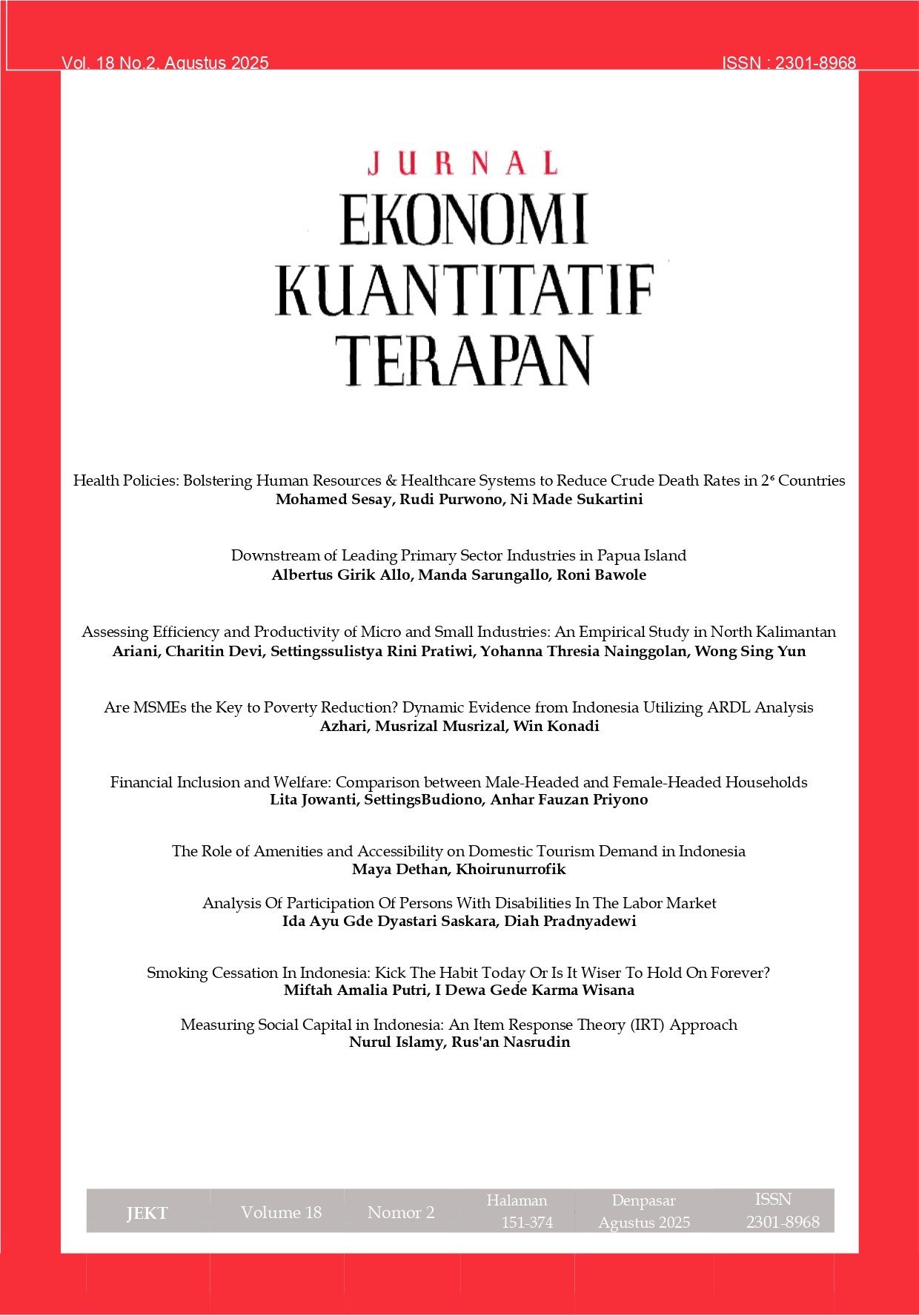
Health Policies: Bolstering Human Resources & Healthcare Systems to Reduce Crude Death Rates in 2⁶ Countries
DOI:
https://doi.org/10.24843/JEKT.2025.v18.i02.p01Keywords:
Crude Death Rate (CDR), Health Policy, Healthcare Expenditure, Economic Growth, Labour Force Participation, Access to Drinking Water, Mortality TrendsAbstract
This study examines the key determinants of crude death rates (CDR) in selected Countries within Africa, Asia, Europe, and Latin America, emphasising statistical correlations, policy implications, and regional disparities. Using econometric analysis, the study finds that increased life expectancy, higher government healthcare expenditure, and GDP per capita growth significantly reduce mortality rates. Labour force participation and access to potable water further influence mortality trends. However, African and some Asian nations experience higher CDRs due to weak healthcare infrastructure and economic constraints. The findings underscore the need for sustained investment in healthcare systems, human capital development, and policy-driven interventions to mitigate mortality risks and improve public health. This study provides empirical evidence to guide policymakers in designing targeted health policies that enhance healthcare equity and long-term health outcomes.
References
Adebisi, Y. A. and Umah2, J. O. (2020) ‘Assessment of Health Budgetary Allocation and Expenditure Toward Achieving Universal Health Coverage in Nigeria’. doi: 10.5812/ijhls.102552.
Adhikari, R. et al. (2018) ‘New forms of development: branding innovative ideas and bidding for foreign aid in the maternal and child health service in Nepal’, Globalization and Health, 14(1), p. 33. doi: 10.1186/s12992-018-0350-0.
Alawa, J., Zarei, P. and Khoshnood, K. (2019) ‘Evaluating the Provision of Health Services and Barriers to Treatment for Chronic Diseases among Syrian Refugees in Turkey: A Review of Literature and Stakeholder Interviews’, International Journal of Environmental Research and Public Health, 16(15), p. 2660. doi: 10.3390/ijerph16152660.
Alkire, B. C. et al. (2018) ‘The Economic Consequences Of Mortality Amenable To High-Quality Health Care In Low- And Middle-Income Countries’, Health Affairs, 37(6), pp. 988–996. doi: 10.1377/hlthaff.2017.1233.
Allel, K. et al. (2021) ‘The contributions of public health policies and healthcare quality to gender gap and country differences in life expectancy in the UK’, Population Health Metrics, 19(1), p. 40. doi: 10.1186/s12963-021-00271-2.
Allen, H. and Katz, R. (2010) ‘Demography and Public Health Emergency Preparedness: Making the Connection’, Population Research and Policy Review, 29(4), pp. 527–539. doi: 10.1007/s11113-009-9158-1.
Alshaabi, T. et al. (2021) ‘The sociospatial factors of death: Analyzing effects of geospatially-distributed variables in a Bayesian mortality model for Hong Kong’, PLOS ONE, 16(3), p. e0247795. doi: 10.1371/journal.pone.0247795.
Antonisse, L. and Garfield, R. (2018) ‘The Relationship Between Work and Health: Findings from a Literature Review’.
Antonovsky, A. (1967) ‘Social Class, Life Expectancy and Overall Mortality’, The Milbank Memorial Fund Quarterly, 45(2), p. 31. doi: 10.2307/3348839.
Anwar, A. et al. (2023) ‘Government health expenditures and health outcome nexus: a study on OECD countries’, Frontiers in Public Health, 11, p. 1123759. doi: 10.3389/fpubh.2023.1123759.
Arize, A. et al. (2024) ‘Public Health Expenditure and Sustainable Health Outcomes in 45 Sub-Saharan African Countries: Does Government Effectiveness Matter?’, Economies, 12(6), p. 129. doi: 10.3390/economies12060129.
Askildsen, J. E., Bratberg, E. and Nilsen, O. A. (2002) ‘Unemployment, Labour Force Composition and Sickness Absence: A Panel Data Study’, SSRN Electronic Journal. doi: 10.2139/ssrn.310074.
Aytemiz, L. (2024) ‘The long-term effect of social, educational, and health expenditures on indicators of life expectancy: an empirical analysis for the OECD countries. doi: 10.3389/fpubh.2024.1497794.
Bain, R. et al. (2018) ‘Establishing Sustainable Development Goal Baselines for Household Drinking Water, Sanitation and Hygiene Services’, Water, 10(12), p. 1711. doi: 10.3390/w10121711.
Bain, R. E. S. et al. (2014) ‘Rural:urban inequalities in post 2015 targets and indicators for drinking-water’, Science of The Total Environment, 490, pp. 509–513. doi: 10.1016/j.scitotenv.2014.05.007.
Balgrosky, J. A. (2020) Understanding health information systems for the health professions. Burlington, MA: Jones & Bartlett Learning.
Balk, D. L. et al. (2006) ‘Determining Global Population Distribution: Methods, Applications and Data’, in Advances in Parasitology. Elsevier, pp. 119–156. doi: 10.1016/S0065-308X(05)62004-0.
Bardhan, P. K. (2025) ‘On Life and Death Questions’. Available at: https://www.jstor.org/stable/4363909.
Barro, R. J. (1996) ‘Health and Economic Growth’.
BATINI, C. and CAPPIELLO, C. (2014) ‘Methodologies for Data Quality Assessment and Improvement’.
Berge, L. R. (2011) ‘Health Care Emergency Management: Principles and Practice’, JAMA, 305(2), p. 200. doi: 10.1001/jama.2010.1982.
Bergh, J. C. J. M. V. D. (2009) ‘The GDP paradox’, Journal of Economic Psychology, 30(2), pp. 117–135. doi: 10.1016/j.joep.2008.12.001.
Berkowitz, M. and Johnson, W. G. (1974) ‘Health and Labor Force Participation’, The Journal of Human Resources, 9(1), p. 117. doi: 10.2307/145048.
Bhattacharya, P. et al. (2023) ‘Estimation of non-health gross domestic product (NHGDP) loss due to COVID-19 deaths in West Bengal, India’, BMJ Open, 13(10), p. e072559. doi: 10.1136/bmjopen-2023-072559.
Biddle, J. E. (2020) Progress through Regression: The Life Story of the Empirical Cobb-Douglas Production Function. 1st edn. Cambridge University Press. doi: 10.1017/9781108679312.
Bilas, V., Franc, S. and Bo, M. (2014) ‘Determinant Factors of Life Expectancy at Birth in the European Union Countries’, Coll. Antropol.
Bongaarts, J. (2002) The end of the fertility transition in the developing world. Population Council. doi: 10.31899/pgy6.1063.
Boonen, T. J. and Li, H. (2017) ‘Modeling and Forecasting Mortality With Economic Growth: A Multipopulation Approach’, Demography, 54(5), pp. 1921–1946. doi: 10.1007/s13524-017-0610-2.
Brenner, H. (2003) ‘On crude and age-adjusted relative survival rates’, Journal of Clinical Epidemiology, 56(12), pp. 1185–1191. doi: 10.1016/S0895-4356(03)00209-9.
Carrin, G. (ed.) (2009) Health systems policy, finance, and organization. Amsterdam: Academic Pr.
Case, A. and Deaton, A. (2017) ‘Mortality and Morbidity in the 21st Century’, Brookings Papers on Economic Activity, 2017(1), pp. 397–476. doi: 10.1353/eca.2017.0005.
Catillon, M., Cutler, D. and Getzen, T. (2018) Two Hundred Years of Health and Medical Care: The Importance of Medical Care for Life Expectancy Gains. w25330. Cambridge, MA: National Bureau of Economic Research, p. w25330. doi: 10.3386/w25330.
Chan, E. Y. Y. et al. (2021) ‘Narrative Review of Primary Preventive Interventions against Water-Borne Diseases: Scientific Evidence of Health-EDRM in Contexts with Inadequate Safe Drinking Water’, International Journal of Environmental Research and Public Health, 18(23), p. 12268. doi: 10.3390/ijerph182312268.
Cheng, H. et al. (2022) ‘Global trends in total fertility rate and its relation to national wealth, life expectancy and female education’, BMC Public Health, 22(1), p. 1346. doi: 10.1186/s12889-022-13656-1.
Chetty, R. et al. (2016) ‘The Association Between Income and Life Expectancy in the United States, 2001-2014’, JAMA, 315(16), p. 1750. doi: 10.1001/jama.2016.4226.
Christopher, J. B. et al. (2011) ‘Thirty years after Alma-Ata: a systematic review of the impact of community health workers delivering curative interventions against malaria, pneumonia and diarrhoea on child mortality and morbidity in sub-Saharan Africa’, Human Resources for Health, 9(1), p. 27. doi: 10.1186/1478-4491-9-27.
Correia, S., Luck, S. and Verner, E. (2022) ‘Pandemics Depress the Economy, Public Health Interventions Do Not: Evidence from the 1918 Flu’, The Journal of Economic History, 82(4), pp. 917–957. doi: 10.1017/S0022050722000407.
Croix, D. D. L. and Michel, P. (2004) ‘A Theory of Economic Growth Dynamics and Policy in Overlapping Generations’.
Cutler, D. and Deaton, A. (2006) ‘The Determinants of Mortality’.
Davis, K. (2025) ‘The Amazing Decline of Mortality in Underdeveloped Areas’. Available at: https://www.jstor.org/stable/1910683.
‘Development Co‑operation Report 2023 DEBATING THE AID SYSTEM’ (2023). Available at: https://doi.org/10.1787/f6edc3c2-en.
Dhrifi, A. (2019) ‘Health-care expenditures, economic growth and infant mortality: Evidence from developed and developing countries’, CEPAL Review, 2018(125), pp. 69–91. doi: 10.18356/02c1a26c-en.
Dieleman, J. L. and Hanlon, M. (2014) ‘MEASURING THE DISPLACEMENT AND REPLACEMENT OF GOVERNMENT HEALTH EXPENDITURE’, Health Economics, 23(2), pp. 129–140. doi: 10.1002/hec.3016.
Ding, Y. et al. (2022) ‘How Does Government Efficiency Affect Health Outcomes? The Empirical Evidence from 156 Countries’, International Journal of Environmental Research and Public Health, 19(15), p. 9436. doi: 10.3390/ijerph19159436.
Dorothy, K., Kadir, A. and Rita, K. (2022) ‘Analyzing Patient Medical Resume Coding’s Completeness and Accuracy on the Amount of INA-CBG’s Claims’, Interdisciplinary Social Studies, 1(9), pp. 1166–1177. doi: 10.55324/iss.v1i9.220.
DOTSEY, M. (2020) ‘Where Is Everybody? The Shrinking Labor Force Participation Rate’.
Dykas, P., Tokarski, T. and Wisła, R. (2022) The Solow Model of Economic Growth: Application to Contemporary Macroeconomic Issues. 1st edn. London: Routledge. doi: 10.4324/9781003323792.
Effa, E. et al. (2021) ‘Human resources for health governance and leadership strategies for improving health outcomes in low- and middle-income countries: a narrative review’, Journal of Public Health, 43(Supplement_1), pp. i67–i85. doi: 10.1093/pubmed/fdaa264.
Endalamaw, A. et al. (2024) ‘Barriers and strategies for primary health care workforce development: synthesis of evidence’, BMC Primary Care, 25(1), p. 99. doi: 10.1186/s12875-024-02336-1.
Erhuanga, E. (2021) ‘Potential of ceramic and biosand water filters as low-cost point-of-use water treatment options for household use in Nigeria’. doi: 10.2166/washdev.2020.096.
Erondu, N. A. et al. (2018) ‘Building the case for embedding global health security into universal health coverage: a proposal for a unified health system that includes public health’, The Lancet, 392(10156), pp. 1482–1486. doi: 10.1016/S0140-6736(18)32332-8.
Fauser, B. C. J. M. et al. (2024) ‘Declining global fertility rates and the implications for family planning and family building: an IFFS consensus document based on a narrative review of the literature’, Human Reproduction Update, 30(2), pp. 153–173. doi: 10.1093/humupd/dmad028.
Fogel, R. W. (1994) ‘The relevance of Mortality today: Long-Run Influences on Health, Mortality, Labour force Participation and Population Growth.’
Fried, B., Fottler, M. D. and Johnson, J. A. (eds) (2010) Human resources in healthcare: managing for success. 2nd ed. Chicago Washington, DC: Health Administration Press.
Gaffan, N. et al. (2022) ‘Household access to basic drinking water, sanitation and hygiene facilities: secondary analysis of data from the demographic and health survey V, 2017–2018’, BMC Public Health, 22(1), p. 1345. doi: 10.1186/s12889-022-13665-0.
Gao, Y. et al. (2017) ‘Progress and challenges in maternal health in western China: a Countdown to 2015 national case study’, The Lancet Global Health, 5(5), pp. e523–e536. doi: 10.1016/S2214-109X(17)30100-6.
Gebel, K. et al. (2015) ‘Effect of Moderate to Vigorous Physical Activity on All-Cause Mortality in Middle-aged and Older Australians’, JAMA Internal Medicine, 175(6), p. 970. doi: 10.1001/jamainternmed.2015.0541.
Ghebreyesus, T. A. (2024) ‘Global Health Gets a Checkup: A Conversation With Tedros Adhanom Ghebreyesus’, 96, No. 5 (SEPTEMBER/OCTOBER 2017),.
Ginter, P. M., Duncan, W. J. and Swayne, L. E. (2013) Strategic management of health care organizations. 7th ed. San Francisco, CA: Jossey-Bass, Wiley.
Gleick, P. H. (1996) ‘Basic Water Requirements for Human Activities: Meeting Basic Needs’, Water International, 21(2), pp. 83–92. doi: 10.1080/02508069608686494.
Greenberg, N. et al. (2020) ‘Managing mental health challenges faced by healthcare workers during covid-19 pandemic’, BMJ, p. m1211. doi: 10.1136/bmj.m1211.
Günther, I. and Harttgen, K. (2016) ‘Desired Fertility and Number of Children Born Across Time and Space’, Demography, 53(1), pp. 55–83. doi: 10.1007/s13524-015-0451-9.
Han, K.-T., Park, E.-C. and Kim, S. J. (2016) ‘Unmet healthcare needs and community health center utilization among the low-income population based on a nationwide community health survey’, Health Policy, 120(6), pp. 630–637. doi: 10.1016/j.healthpol.2016.04.004.
Harford, J. et al. (2008) ‘Guideline implementation for breast healthcare in low- and middle-income countries: Breast healthcare program resource allocation’, Cancer, 113(S8), pp. 2282–2296. doi: 10.1002/cncr.23841.
Harwood, R. H., Sayer, A. A. and Hirschfeld, M. (2004) ‘Current and future worldwide prevalence of dependency, its relationship to total population, and dependency ratios’, Bulletin of the World Health Organization.
Hopewell, M. R. and Graham, J. P. (2014) ‘Trends in access to water supply and sanitation in 31 major sub-Saharan African cities: an analysis of DHS data from 2000 to 2012’, BMC Public Health, 14(1), p. 208. doi: 10.1186/1471-2458-14-208.
Hou, J. et al. (2020) ‘Study of influential factors of provincial health expenditure -analysis of panel data after the 2009 healthcare reform in China’, BMC Health Services Research, 20(1), p. 606. doi: 10.1186/s12913-020-05474-1.
Howard (2003) ‘Domestic Water Quantity, Service Level and Health’.
HPSR HRH reader collaborators et al. (2018) ‘Advancing the science behind human resources for health: highlights from the Health Policy and Systems Research Reader on Human Resources for Health’, Health Research Policy and Systems, 16(1), p. 80. doi: 10.1186/s12961-018-0346-5.
‘Human Resources for Health in 2030 in Indonesia’ (2021).
Iuga, I. C., Nerişanu, R. A. and Iuga, H. (2024) ‘The impact of healthcare system quality and economic factors on the older adult population: a health economics perspective’, Frontiers in Public Health, 12, p. 1454699. doi: 10.3389/fpubh.2024.1454699.
Jaba, E., Balan, C. B. and Robu, I.-B. (2014) ‘The Relationship between Life Expectancy at Birth and Health Expenditures Estimated by a Cross-country and Time-series Analysis’, Procedia Economics and Finance, 15, pp. 108–114. doi: 10.1016/S2212-5671(14)00454-7.
Jacobsen, K. H. (2019) Introduction to global health. Third edition. Burlington, MA: Jones & Bartlett Learning.
Jalali, F. S., Bikineh, P. and Delavari, S. (2021) ‘Strategies for reducing out of pocket payments in the health system: a scoping review’, Cost Effectiveness and Resource Allocation, 19(1), p. 47. doi: 10.1186/s12962-021-00301-8.
Jalali, M. S. et al. (2019) ‘Dynamics of intervention adoption, implementation, and maintenance inside organizations: The case of an obesity prevention initiative’, Social Science & Medicine, 224, pp. 67–76. doi: 10.1016/j.socscimed.2018.12.021.
Jamison, D. T. and Gelband, H. (2018) ‘Disease Control Priorities: Improving Health and Reducing Poverty’.
Ji, X. et al. (2022) ‘Does public health policy quality foster state innovation capacity? Evidence from a global panel data’, Frontiers in Public Health, 10, p. 952842. doi: 10.3389/fpubh.2022.952842.
Judge, K. (1995) ‘Income distribution and life expectancy: a critical appraisal’, BMJ, 311(7015), pp. 1282–1285. doi: 10.1136/bmj.311.7015.1282.
Kotzian, P. (2008) ‘Control and performance of health care systems. A comparative analysis of 19 OECD countries’, The International Journal of Health Planning and Management, 23(3), pp. 235–257. doi: 10.1002/hpm.946.
Kruk, M. E. et al. (2018) ‘High-quality health systems in the Sustainable Development Goals era: time for a revolution’, The Lancet Global Health, 6(11), pp. e1196–e1252. doi: 10.1016/S2214-109X(18)30386-3.
Lange, S. and Vollmer, S. (2017) ‘The effect of economic development on population health: a review of the empirical evidence’, British Medical Bulletin, 121(1), pp. 47–60. doi: 10.1093/bmb/ldw052.
Laplante, B. and Fostik, A. L. (2015) ‘Two period measures for comparing the fertility of marriage and cohabitation’, Demographic Research, 32, pp. 421–442. doi: 10.4054/DemRes.2015.32.14.
Le Gallo, J. and Ertur, C. (2003) ‘Exploratory spatial data analysis of the distribution of regional per capita GDP in Europe, 1980–1995’, Papers in Regional Science, 82(2), pp. 175–201. doi: 10.1111/j.1435-5597.2003.tb00010.x.
Lee, L. et al. (2019) ‘Reducing Health Care Disparities in Sickle Cell Disease: A Review’, Public Health Reports®, 134(6), pp. 599–607. doi: 10.1177/0033354919881438.
Leimbach, M. et al. (2017) ‘Future growth patterns of world regions – A GDP scenario approach’, Global Environmental Change, 42, pp. 215–225. doi: 10.1016/j.gloenvcha.2015.02.005.
Liang, H., Guo, Z. and Tuljapurkar, S. (2023a) ‘Why life expectancy over-predicts crude death rate’, Genus, 79(1), p. 9. doi: 10.1186/s41118-023-00188-8.
Liang, H., Guo, Z. and Tuljapurkar, S. (2023b) ‘Why life expectancy over-predicts crude death rate’, Genus, 79(1), p. 9. doi: 10.1186/s41118-023-00188-8.
Liu, J. and Eggleston, K. (2022) ‘The Association between Health Workforce and Health Outcomes: A Cross-Country Econometric Study’, Social Indicators Research, 163(2), pp. 609–632. doi: 10.1007/s11205-022-02910-z.
Liu, J. X. et al. (2017) ‘Global Health Workforce Labor Market Projections for 2030’, Human Resources for Health, 15(1), p. 11. doi: 10.1186/s12960-017-0187-2.
Liu, Y. (2004) ‘China’s public health-care system: facing the challenges’, Bulletin of the World Health Organization.
Lluís Carrion‐i‐Silvestre, J., Del Barrio‐Castro, T. and López‐Bazo, E. (2005) ‘Breaking the panels: An application to the GDP per capita’, The Econometrics Journal, 8(2), pp. 159–175. doi: 10.1111/j.1368-423X.2005.00158. x.
Lopes, M. A., Almeida, Á. S. and Almada-Lobo, B. (2015) ‘Handling healthcare workforce planning with care: where do we stand?’, Human Resources for Health, 13(1), p. 38. doi: 10.1186/s12960-015-0028-0.
Lorentzen, P., McMillan, J. and Wacziarg, R. (2008) ‘Death and development’, Journal of Economic Growth, 13(2), pp. 81–124. doi: 10.1007/s10887-008-9029-3.
Lu, K. et al. (2022) ‘Impact of financial barriers on health status, healthcare utilisation and economic burden among individuals with cognitive impairment: a national cross-sectional survey’, BMJ Open, 12(5), p. e056466. doi: 10.1136/bmjopen-2021-056466.
Ludvigsson, J. F. et al. (2016) ‘Registers of the Swedish total population and their use in medical research’, European Journal of Epidemiology, 31(2), pp. 125–136. doi: 10.1007/s10654-016-0117-y.
Maitra, P. (2004) ‘Effect of Socioeconomic Characteristics on Age at Marriage and Total Fertility in Nepal’.
Malakoane, B. et al. (2020) ‘Public health system challenges in the Free State, South Africa: a situation appraisal to inform health system strengthening’, BMC Health Services Research, 20(1), p. 58. doi: 10.1186/s12913-019-4862-y.
Mallick, L. M. and Amo-Adjei, J. (2021) ‘A Call to Action: Reinvigorating Interest and Investments in Health Infrastructure’, Global Health: Science and Practice, 9(4), pp. 711–715. doi: 10.9745/GHSP-D-21-00674.
Martín Cervantes, P. A., Rueda López, N. and Cruz Rambaud, S. (2019) ‘A Causal Analysis of Life Expectancy at Birth. Evidence from Spain’, International Journal of Environmental Research and Public Health, 16(13), p. 2367. doi: 10.3390/ijerph16132367.
Martínez-Santos, P. (2017) ‘Does 91% of the world’s population really have “sustainable access to safe drinking water”?’, International Journal of Water Resources Development, 33(4), pp. 514–533. doi: 10.1080/07900627.2017.1298517.
Mazurek, A. P. (2015) ‘Acta Poloniae Pharmaceutica ñ Drug Research’.
McCracken, K. and Phillips, D. R. (2017) Global Health: An Introduction to Current and Future Trends. 2nd edn. 2nd edition. | Abingdon, Oxon ; New York, NY : Routledge, 2017.: Routledge. doi: 10.4324/9781315691800.
McIntyre, D. et al. (2018) ‘Challenges in Financing Universal Health Coverage in Sub-Saharan Africa’, in McIntyre, D. et al., Oxford Research Encyclopedia of Economics and Finance. Oxford University Press. doi: 10.1093/acrefore/9780190625979.013.28.
Mcintyre, D., Meheus, F. and Røttingen, J.-A. (2017) ‘What level of domestic government health expenditure should we aspire to for universal health coverage?’, Health Economics, Policy and Law, 12(2), pp. 125–137. doi: 10.1017/S1744133116000414.
McIsaac, M. et al. (2024) ‘Global Strategy on Human Resources for Health: Workforce 2030—A Five-Year Check-In’, Human Resources for Health, 22(1), pp. 68, s12960-024-00940–x. doi: 10.1186/s12960-024-00940-x.
McNicoll, G. et al. (1995) ‘The Determinants of Reproductive Change in Bangladesh: Success in a Challenging Environment.’, Population and Development Review, 21(2), p. 429. doi: 10.2307/2137507.
Mesev, V. (ed.) (2003) ‘LandScan: a global population database for estimating populations at risk’, in Remotely-Sensed Cities. 0 edn. CRC Press, pp. 301–314. doi: 10.1201/9781482264678-24.
Miladinov, G. (2020) ‘Socioeconomic development and life expectancy relationship: evidence from the EU accession candidate countries’, Genus, 76(1), p. 2. doi: 10.1186/s41118-019-0071-0.
Moeti, M. (2017) in WHO Country Cooperation Strategy Sierra Leone. World Health Organization Regional Office for Africa.
Morganstein, J. C. et al. (2017) ‘Pandemics: Health Care Emergencies’, in Ursano, R. J. et al. (eds) Textbook of Disaster Psychiatry. 2nd edn. Cambridge University Press, pp. 270–284. doi: 10.1017/9781316481424.019.
Moriarty, P. (2011) ‘Ladders for assessing and costing water service delivery’.
Murphy, S. and Kochanek, K. D. (2010) ‘National Vital Statistics Reports’.
Musgrove, P., Zeramdini, R. and Carrin, G. (2002) ‘Basic patterns in national health expenditure’, Data quality, (15).
Mushkin, S. J. (1962) ‘Health as an Investment’, Journal of Political Economy, 70(5, Part 2), pp. 129–157. doi: 10.1086/258730.
Nash, D. B. et al. (2019) Healthcare Quality Book, Vision, Strategy, and Tools.
‘National Health Policy’ (2019).
Novignon, J., Olakojo, S. A. and Nonvignon, J. (2012) ‘The effects of public and private health care expenditure on health status in sub-Saharan Africa: new evidence from panel data analysis’, Health Economics Review, 2(1), p. 22. doi: 10.1186/2191-1991-2-22.
O’Neill, B. C. et al. (2010) ‘Global demographic trends and future carbon emissions’, Proceedings of the National Academy of Sciences, 107(41), pp. 17521–17526. doi: 10.1073/pnas.1004581107.
Onofrei, M. et al. (2021) ‘Government Health Expenditure and Public Health Outcomes: A Comparative Study among EU Developing Countries’, International Journal of Environmental Research and Public Health, 18(20), p. 10725. doi: 10.3390/ijerph182010725.
P R E S T O N, S. A. M. U. E. L. H. (2012) ‘MORTALITY PATTERNS IN NATIONAL POPULATIONS With special reference to recorded causes of death’.
Pellegrini, L. C., Rodriguez-Monguio, R. and Qian, J. (2014) ‘The US healthcare workforce and the labor market effect on healthcare spending and health outcomes’, International Journal of Health Care Finance and Economics, 14(2), pp. 127–141. doi: 10.1007/s10754-014-9142-0.
Pierce, G. et al. (2021) ‘Solutions to the problem of drinking water service affordability: A review of the evidence’, WIREs Water, 8(4), p. e1522. doi: 10.1002/wat2.1522.
Pilipiec, P., Groot, W. and Pavlova, M. (2021) ‘The Effect of an Increase of the Retirement Age on the Health, Well-Being, and Labor Force Participation of Older Workers: a Systematic Literature Review’, Journal of Population Ageing, 14(2), pp. 271–315. doi: 10.1007/s12062-020-09280-9.
Poston, Jr, D. L. and Bouvier, L. F. (2016) Population and Society: An Introduction to Demography. 2nd edn. Cambridge University Press. doi: 10.1017/9781107337237.
Quinlan, M. (2013) ‘Precarious Employment, Ill Health, and Lessons from History: The Case of Casual (Temporary) Dockworkers 1880–1945’, International Journal of Health Services, 43(4), pp. 721–744. doi: 10.2190/HS.43.4.h.
Regan, P. B. L. (2023) ‘The Future of UK Global Health Policy’.
Rhodes, S. D. (2015) ‘Enhancement of a locally developed HIV prevention intervention for Hispanic/Latino MSM: A partnership of community-based organizations, a university, and the Centers for Disease Control and Prevention’. doi: 0.1521/aeap.2015.27.4.312.
Richards, C. L. (2017) ‘Advances in Public Health Surveillance and Information Dissemination at the Centers for Disease Control and Prevention’. doi: 10.1177/0033354917709542.
Ringheim, K. (1993) ‘Factors that Determine Prevalence of Use of Contraceptive Methods for Men’, Studies in Family Planning, 24(2). doi: 10.2307/2939202.
Rizkianti, A. et al. (2024) ‘Understanding the association between family planning and fertility reduction in Southeast Asia: a scoping review’, BMJ Open, 14(6), p. e083241. doi: 10.1136/bmjopen-2023-083241.
Robey, B., Rutstein, S. O. and Morris, L. (1993) ‘The Fertility Decline in Developing Countries’, Scientific American, 269(6), pp. 60–67. doi: 10.1038/scientificamerican1293-60.
Robine, J. M. and Ritchie, K. (1991) ‘Healthy life expectancy: evaluation of global indicator of change in population health.’, BMJ, 302(6774), pp. 457–460. doi: 10.1136/bmj.302.6774.457.
Roelfs, D. J. et al. (2011) ‘Losing life and livelihood: A systematic review and meta-analysis of unemployment and all-cause mortality’, Social Science & Medicine, 72(6), pp. 840–854. doi: 10.1016/j.socscimed.2011.01.005.
Roffia, P., Bucciol, A. and Hashlamoun, S. (2023) ‘Determinants of life expectancy at birth: a longitudinal study on OECD countries’, International Journal of Health Economics and Management, 23(2), pp. 189–212. doi: 10.1007/s10754-022-09338-5.
Rosskam, E. et al. (2013) ‘Increasing skilled birth attendance through midwifery workforce management’, The International Journal of Health Planning and Management, 28(1). doi: 10.1002/hpm.2131.
Ruger, J. P. (2012) Health and social justice. 1. publ. in paperback. Oxford: Oxford Univ. Press.
Russell, D. et al. (2021) ‘Interventions for health workforce retention in rural and remote areas: a systematic review’, Human Resources for Health, 19(1), p. 103. doi: 10.1186/s12960-021-00643-7.
Santos-Jaén, J. M. et al. (2022) ‘The Effect of Public Healthcare Expenditure on the Reduction in Mortality Rates Caused by Unhealthy Habits among the Population’, Healthcare, 10(11), p. 2253. doi: 10.3390/healthcare10112253.
Sardon, J.-P. (2025) ‘Coale’s Indices, Comparative Indices, Mean Generation, Total Fertility Rate and Components’. Available at: https://www.jstor.org/stable/2949164.
Shi, L. (2008) Health services research methods. 2nd ed. Clifton Park, NY: Thomson/Delmar Learning.
Shkolnikov, V. (2019) ‘Patterns in the relationship between life expectancy and gross domestic product in Russia in 2005–15: a cross-sectional analysis’.
Sibanda, A. et al. (2003) ‘The Proximate Determinants of the Decline to Below‐replacement Fertility in Addis Ababa, Ethiopia’, Studies in Family Planning, 34(1), pp. 1–7. doi: 10.1111/j.1728-4465.2003.00001.x.
Silver, S. R., Li, J. and Quay, B. (2022) ‘Employment status, unemployment duration, and health‐related metrics among US adults of prime working age: Behavioral Risk Factor Surveillance System, 2018–2019’, American Journal of Industrial Medicine, 65(1), pp. 59–71. doi: 10.1002/ajim.23308.
Sirag, A. and Mohamed Nor, N. (2021) ‘Out-of-Pocket Health Expenditure and Poverty: Evidence from a Dynamic Panel Threshold Analysis’, Healthcare, 9(5), p. 536. doi: 10.3390/healthcare9050536.
Skolnik, R. L. (2016) Global health 101. Third edition. Burlington, MA: Jones & Bartlett Learning.
Soares, L. C. R. et al. (2002) ‘Inequities in access to and use of drinking water services in Latin America and the Caribbean’, Revista Panamericana de Salud Pública, 11(5–6), pp. 386–396. doi: 10.1590/S1020-49892002000500013.
Sobsey, M. D. et al. (2008) ‘Point of Use Household Drinking Water Filtration: A Practical, Effective Solution for Providing Sustained Access to Safe Drinking Water in the Developing World’, Environmental Science & Technology, 42(12), pp. 4261–4267. doi: 10.1021/es702746n.
Ssengooba, F. et al. (2017) ‘Application of social network analysis in the assessment of organization infrastructure for service delivery: a three district case study from post-conflict northern Uganda’, Health Policy and Planning, 32(8), pp. 1193–1202. doi: 10.1093/heapol/czx071.
Sultana, S. et al. (2024) ‘Effects of healthcare spending on public health status: An empirical investigation from Bangladesh’, Heliyon, 10(1), p. e24268. doi: 10.1016/j.heliyon.2024.e24268.
Swift, R. (2011) ‘The relationship between health and GDP in OECD countries in the very long run’, Health Economics, 20(3), pp. 306–322. doi: 10.1002/hec.1590.
Syafinaz S, I. and Haslinda, N. (2016) ‘HEALTH CARE PROVISION AND EQUITY’.
Szklo, M. and Nieto, F. J. (2019) Epidemiology: beyond the basics. Fourth edition. Burlington, MA: Jones & Bartlett Learning.
Thomas, A. (2020) ‘The Impact of Health Expenditure on Life Expectancy and Mortality Rates’.
Turnock, B. J. (2016) Public health: what it is and how it works. Sixth edition. Burlington, Massachusetts: Jones & Bartlett Learning.
Tursunbayeva, A. et al. (2017) ‘Human resource information systems in health care: a systematic evidence review’, Journal of the American Medical Informatics Association, 24(3), pp. 633–654. doi: 10.1093/jamia/ocw141.
ViorelT, arcă, and arcă (2024) ‘Social and Economic Determinants of Life Expectancy at Birth in Eastern Europe’. doi: .org/10.3390/ healthcare12111148.
Walsh, J. E. (2020) ‘GENERALIZATION OF RATIO ESTIMATE FOR POPULATION TOTAL’.
Wang, H. et al. (2016) ‘Global, regional, and national life expectancy, all-cause mortality, and cause-specific mortality for 249 causes of death, 1980–2015: a systematic analysis for the Global Burden of Disease Study 2015’, The Lancet, 388(10053), pp. 1459–1544. doi: 10.1016/S0140-6736(16)31012-1.
Wei, J., Rahim, S. and Wang, S. (2022) ‘Role of Environmental Degradation, Institutional Quality, and Government Health Expenditures for Human Health: Evidence From Emerging Seven Countries’, Frontiers in Public Health, 10, p. 870767. doi: 10.3389/fpubh.2022.870767.
Whelpton, P. K. (1949) ‘Cohort Analysis of Fertility’, American Sociological Review, 14(6), p. 735. doi: 10.2307/2086675.
‘WHO Country Cooperation Strategy (CCS)’ (2023).
‘WHO methods and data sources for life tables 1990-2019’ (2020). Available at: http://www.who.int/gho/mortality_burden_disease/en/index.html.
‘Working For Health and Growth’ (2026). W.H.O. Available at: (www.who.int/about/licensing/copyright_form/en/index.html).
World Health Organization (2008) Guidelines for drinking-water quality [electronic resource]: incorporating 1st and 2nd addenda,Vol.1, recommendations. 3rd ed. Geneva: World Health Organization. Available at: https://iris.who.int/handle/10665/204411 (Accessed: 16 March 2025).
World Health Organization (2013) The economics of the social determinants of health and health inequalities: a resource book. Geneva: World Health Organization. Available at: https://iris.who.int/handle/10665/84213 (Accessed: 2 March 2025).
Wright, J. C. and Weinstein, M. C. (1998) ‘Gains in Life Expectancy from Medical Interventions — Standardizing Data on Outcomes’, New England Journal of Medicine, 339(6), pp. 380–386. doi: 10.1056/NEJM199808063390606.
Yan, W. et al. (2023) ‘Association between inequalities in human resources for health and all cause and cause specific mortality in 172 countries and territories, 1990-2019: observational study’, BMJ, p. e073043. doi: 10.1136/bmj-2022-073043.
Yaukey, D., Anderton, D. L. and Hickes Lundquist, J. (2015) Demography: the study of human population. 4. ed. Long Grove, Ill: Waveland Press.
Yip, P. S. and Li, B. Y. (2006) ‘An analysis of the Lowest Total Fertility Rate in Hong Kong SAR’.
Youssef, E.-R. and Meriem, M. (2024) ‘Evaluating the Financial Factors Influencing Maternal, Newborn, and Child Health in Africa’. Health Systems and Quality Improvement. doi: 10.1101/2024.02.22.24303217.
Downloads
Published
Issue
Section
License
Copyright (c) 2025 Jurnal Ekonomi Kuantitatif Terapan

This work is licensed under a Creative Commons Attribution-NonCommercial 4.0 International License.

This work is licensed under a Creative Commons Attribution 4.0 International License.