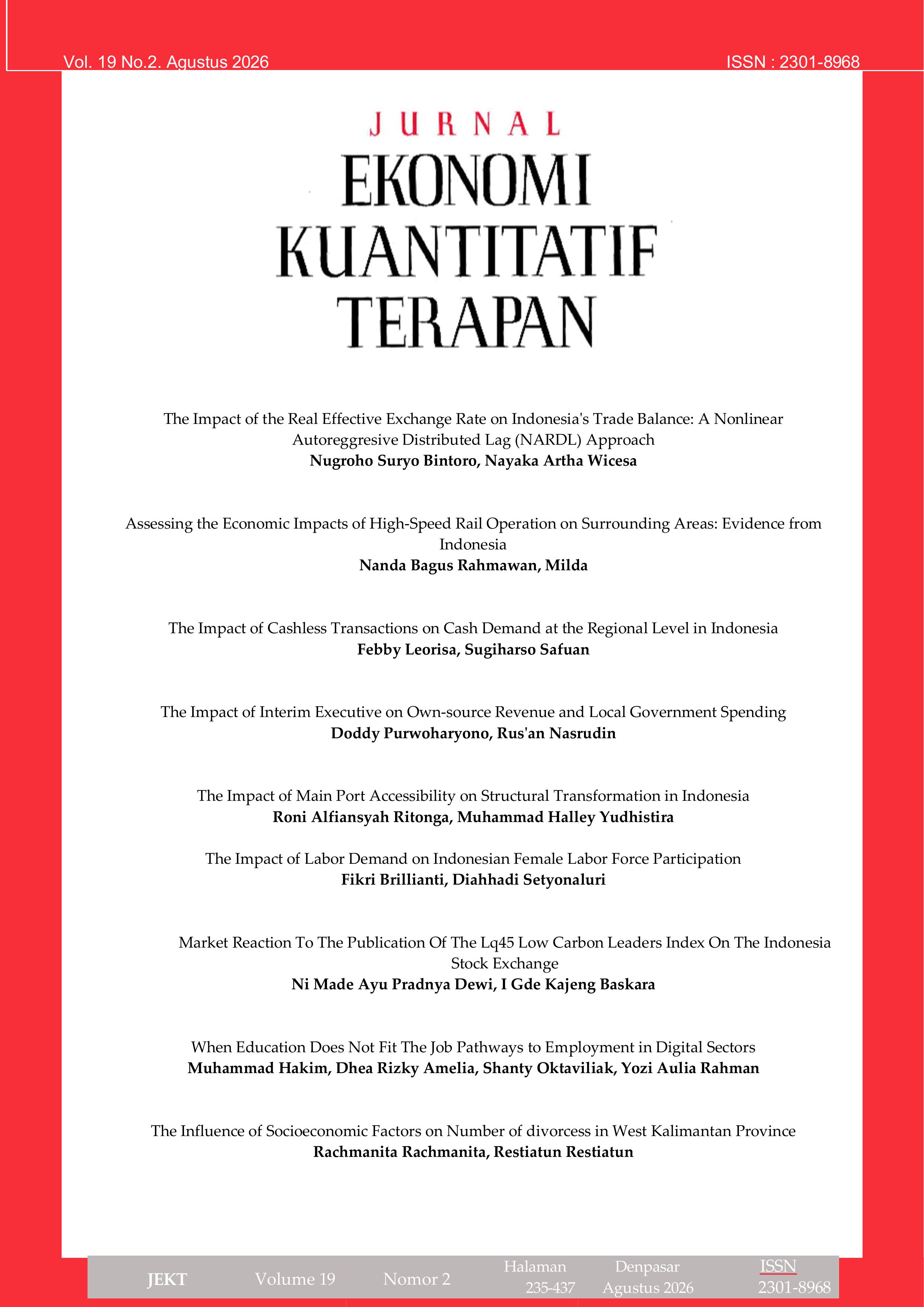
When Education Does Not Fit The Job Pathways to Employment in Digital Sectors
DOI:
https://doi.org/10.24843/JEKT.2026.v19.i02.p08Abstract
This study examines job-education mismatch in Indonesia’s high-digital-intensity (HDI) sectors, focusing on vertical mismatch in the form of overeducation and undereducation. Using data from the 2018 National Labor Force Survey (Sakernas) and applying a logit model, the research assesses the probability of highly educated individuals with mismatched qualifications entering the SID sector. The findings show that overqualified workers experience an 18.4% lower likelihood of joining SID compared to well-matched individuals, while underqualified workers face a 6.10% penalty. Overqualification leads to skill underutilization and reduced job satisfaction, whereas underqualified workers may still enter operational digital roles. Additionally, demographic characteristics gender, age, urban residence, and internet usage—significantly affect SID participation, with men, younger individuals, urban residents, and active internet users showing higher probabilities. The study highlights the need for adaptive education systems, stronger digital skills, and policies that align workforce capabilities with the rapidly evolving demands of Indonesia’s digital economy.
Downloads
Published
Issue
Section
License
Copyright (c) 2026 Jurnal Ekonomi Kuantitatif Terapan

This work is licensed under a Creative Commons Attribution-NonCommercial 4.0 International License.

This work is licensed under a Creative Commons Attribution 4.0 International License.