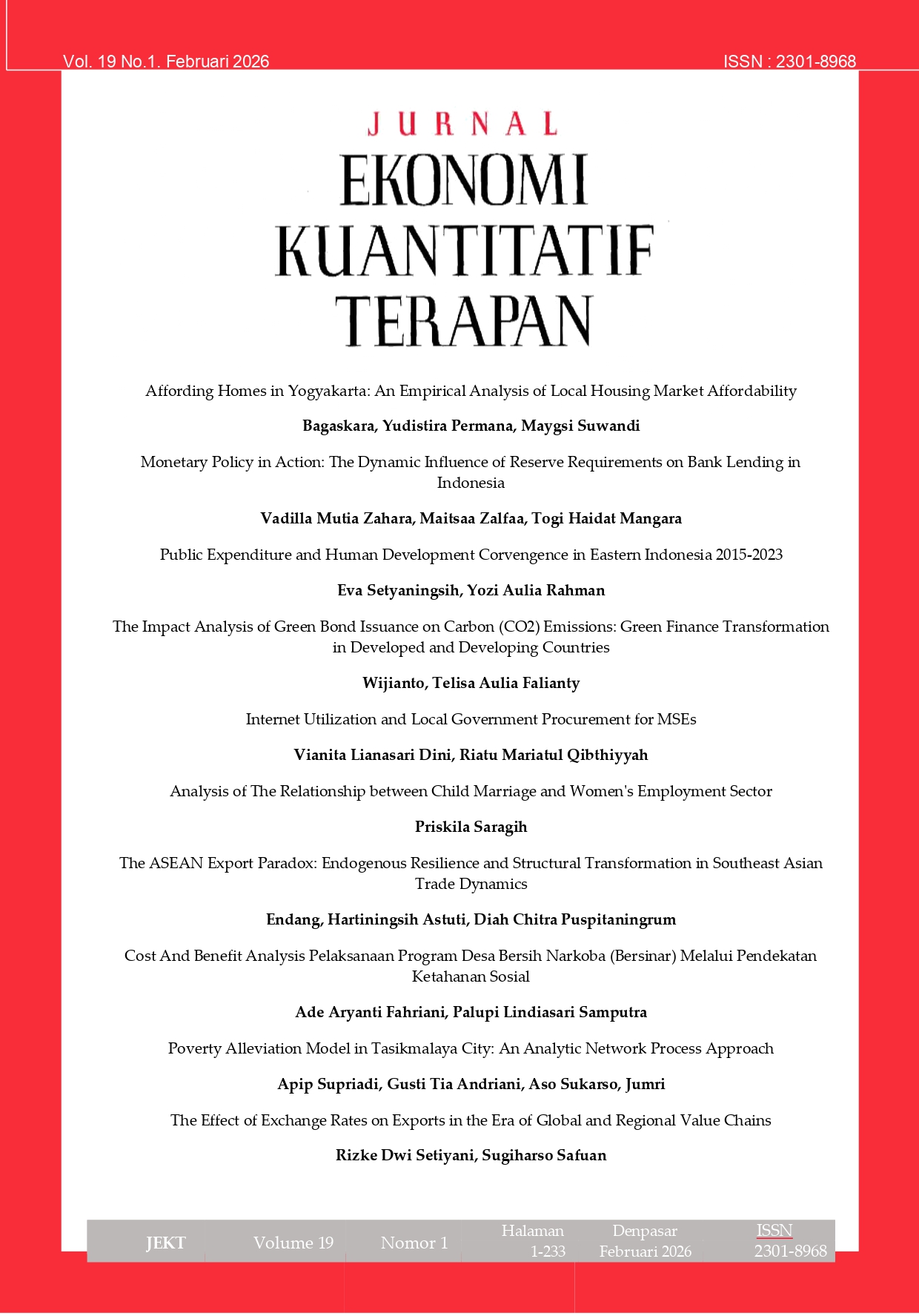
The Impact Analysis of Green Bond Issuance on Carbon (CO2) Emissions: Green Finance Transformation in Developed and Developing Countries
Impact Analysis of Green Bond Issuance on Carbon (CO2) Emissions: Green Finance Transformation in Developed and Developing Countries
DOI:
https://doi.org/10.24843/JEKT.2026.v19.i01.p04Keywords:
Micro and Small IndustryAbstract
This study seeks evidence of whether the issuance of green bonds can affect carbon emissions in developed and developing countries. Identifying this link is crucial in reducing emissions and mitigating climate change. However, empirical evidence on the impact of green bonds is often limited because the data year series covers only a few years. Using the Generalized Method of Moments (GMM), the analysis in this study covered dynamic data from 16 countries between 2016 and 2021. The finding shows that the issuance of green bonds significantly impacted carbon emissions in both developed and developing countries. The more green bonds issued, the lower the carbon emissions. The results also show that green bond issuance in developed and developing countries differs. In developed countries, large investment-class issuers within the banking sector primarily benefit from greenium linked to green bonds. Meanwhile, developing countries face barriers to green bond development, including a lack of proper institutional arrangements, minimum volume requirements, and high transaction costs. Aside from addressing these barriers, the government must focus on improving facilities and infrastructure to increase the impact of issuing green bonds in order to transition to a green economy
References
Alexandri, M. B. (2015). Analysis of Abbasi, S., & Ahmadi Choukolaei, H. (2023). A systematic review of green supply chain network design literature focusing on carbon policy. Decision Analytics Journal, 6(January), 100189. https://doi.org/10.1016/j.dajour.2023.100189
Arezki, R., P. Bolton, S. Peters, F. Samama, and J. Stiglitz. 2016. “From Global Savings Glut to Financing Infrastructure: The Advent of Investment Platforms.” IMF Working Papers 16 (18): 1. https://doi.org/10.5089/9781475591835.001.
Arellano, M. a. (1991). Some Tests of Specification for Panel Data: Monte Carlo Evidence and an Application to Employment Equations. The Review of Economic Studies, 58 (2), 277-297.
Azhgaliyeva, D., Kapoor, A., & Liu, Y. (2020). GREEN BONDS FOR FINANCING RENEWABLE ENERGY AND ENERGY EFFICIENCY IN SOUTHEAST ASIA : Asian Development Bank Institute. 1073.
Bari, K. M., Ali, S., Waqar, S., & Sarwar, M. N. (2020). Does Forestry Resolve the Dilemma of Environmental Degradation or Economic Development? A Case for Green Economic Growth. International Journal of Innovation, Creativity, and Change, 14(7), 633-651
Baek, Jungho & Kim, Hyun Seok. (2013). “Is economic growth good or bad for the environment? Empirical evidence from Korea,” Energy Economics, Elsevier, vol. 36(C), pages 744-749.
Baker, M. P., Bergstresser, D. B., Serafeim, G., & Wurgler, J. A. (2018). Financing the Response to Climate Change: The Pricing and Ownership of U.S. Green Bonds. SSRN Electronic Journal. https://doi.org/10.2139/ssrn.3275327
Banga, J. (2019). The green bond market: a potential source of climate finance for developing countries. Journal of Sustainable Finance and Investment, 9(1), 17–32. https://doi.org/10.1080/20430795.2018.1498617
Battiston, S., A. Mandel, I. Monasterolo, F. Schütze, and G. Visentin. 2017. “A Climate Stress-test of the Financial System.” Nature Climate Change 7 (4): 283–288. https://doi.org/10.1038/nclimate3255.
Beckerman, W. (1992). Economic growth and the environment: Whose growth? whose environment? World Development, 20(4), 481–496. https://doi.org/10.1016/0305-750X(92)90038-W
Bhutta, U. S., Tariq, A., Farrukh, M., Raza, A., & Iqbal, M. K. (2022). Green bonds for sustainable development: Review of literature on development and impact of green bonds. Technological Forecasting and Social Change, 175. https://doi.org/10.1016/j.techfore.2021.121378
Blumstein, A., & Beck, A. J. (1999). Population Growth in U. S. Prisons, 1980-1996. Crime and Justice, 26, 17–61. http://www.jstor.org/stable/1147683
Bose, S., Khan, H. Z., Rashid, A., & Islam, S. (2018). What drives green banking disclosure? An institutional and corporate governance perspective. Asia Pacific Journal of Management, 35(2), 501–527. https://doi.org/10.1007/s10490-017-9528-x
Caramichael, J., & Rapp, A. C. (2022). The Green Corporate Bond Issuance Premium. SSRN Electronic Journal, 2500(1346). https://doi.org/10.2139/ssrn.4194858
Chen, C., Pantzalis, C., & Park, J. C. (2013). Press coverage and stock price deviation from fundamental value. Journal of Financial Research. https://doi.org/10.1111/ j.1475-6803.2013.12007.x
Cheng, B., Ioannou, I., & Serafeim, G. (2014). Corporate social responsibility and access to finance. Strategic Management Journal, 35(1), 1–23. https://doi.org/ 10.1002/smj.2131
Cheng, P., Ji, G., Zhang, G., & Shi, Y. (2022). A closed-loop supply chain network considering consumer’s low carbon preference and carbon tax under the cap-and-trade regulation. Sustainable Production and Consumption, 29, 614–635. https://doi.org/10.1016/j.spc.2021.11.006
Chiesa, M., & Barua, S. (2019). The surge of impact borrowing: the magnitude and determinants of green bond supply and its heterogeneity across markets. Journal of Sustainable Finance and Investment, 9(2), 138–161. https://doi.org/10.1080/20430795.2018.1550993
Clapp, C., Alfsen, K. H., Torvanger, A., & Lund, H. F. (2015). Influence of climate science on financial decisions. Nature Climate Change, 5(2), 84–85. https://doi.org/10.1038/nclimate2495
Claessens, Stijn, Daniela Klingebiel, and Sergio Schmukler. 2007. Government bonds in domestic and foreign currency: the role of institutional and macroeconomic factors. Review of International Economics 15: 370–413
Climate Bonds Initiative and HSBC. 2017. Bonds and Climate Change: State of the Market in 2017. Annual Report. London: Climate Bonds Initiative. https://www.climatebonds.net/resources/reports/bonds-and-climate-change-state-market-2017
Cole, M. A., Rayner, A. J., & Bates, J. M. (1997). The Environmental Kuznets Curve: An Empirical Analysis. Environment and Development Economics, 2(04), 401-416.
Costa-Campi, M. T., García-Quevedo, J., & Martínez-Ros, E. (2017). What are the determinants of investment in environmental R&D? Energy Policy, 104, 455–465. https://doi.org/10.1016/j.enpol.2017.01.024
Creutzig, F., Roy, J., Lamb, W. F., Azevedo, I. M. L., Bruin, W. B. de, Dalkmann, H., Edelenbosch, O. Y., Geels, F. W., Grübler, A., BHepburn, C., Hertwich, E., Khosla, R., Mattauch, L., Minx, J. C., Ramakrishnan, A., Rao, N. D., Steinberger, J., Tavoni, M., Ürge-Vorsatz, D., & Weber, E. U. (2018). Towards demand-side solutions for mitigating climate change Manuscript accepted for publication in Nature Climate Change. Nature Climate Change, 8(4), 268–271.
Dan, A., & Tiron-Tudor, A. (2021). The Determinants of Green Bond Issuance in the European Union. Journal of Risk and Financial Management, 14(9). https://doi.org/10.3390/jrfm14090446
Tang, D. Y., & Zhang, Y. (2020). Do shareholders benefit from green bonds? Journal of Corporate Finance, 61(December), 1–18. https://doi.org/10.1016/j.jcorpfin.2018.12.001
Dasgupta, S., Laplante, B., Wang, H., & Wheeler, D. (2002). Confronting the Environmental Kuznets Curve. Journal of Economic Perspectives, 16(1), 147-168.
Della Bina, A., & Guerrini, A. (2020). “Do Green bonds Contribute to Reducing Carbon Emissions? A Literature Review.” Business Strategy and the Environment, 29(4), 1577-1593.
Dong, K., Sun, R., Jiang, H., & Zeng, X. (2018). CO2 emissions, economic growth, and the environmental Kuznets curve in China: What roles can nuclear energy and renewable energy play? Journal of Cleaner Production, 196, 51–63. https://doi.org/10.1016/j.jclepro.2018.05.271
E., & Tzeremes, N. G. (2020). “Assessing the Environmental Efficiency of Green bond Issuers: A Two-Stage GMM Approach.” Journal of Cleaner Production, 261, 121067.
Ehlers & Packer. (2017). Green bond finance and certification. BIS Quarterly Review, September, 89–104.
Fatica, S., & Panzica, R. (2021). Green bonds as a tool against climate change? Business Strategy and the Environment, 30(5), 2688–2701. https://doi.org/10.1002/bse.2771
Fatica, S., Panzica, R., & Rancan, M. (2021). The pricing of green bonds: Are financial institutions special? The Journal of Financial Stability, 54. https://doi.org/10.1016/j.jfs.2021.100873
Flammer, C. (2021). Corporate green bonds. Journal of Financial Economics, 142(2), 499–516. https://doi.org/10.1016/j.jfineco.2021.01.010
G. B. (2014). Voluntary Process Guidelines for Issuing Green Bonds. January, 13, 2014.
Gabr, D. H., & Elbannan, M. A. (2023). Green finance insights: evolution of the green bonds market. Management & Sustainability: An Arab Review. https://doi.org/10.1108/msar-02-2023-0008
Grossman, G. M., & Krueger, A. B. (1995). Economic Growth and the Environment. The Quarterly Journal of Economics, 110(2), 353-377.
Hassel, L., & Soana, M. G. (2020). “Green Bonds and Climate Change Mitigation.” In Handbook of Climate Change Management (pp. 1-18). Springer.
Halicioglu, F. (2009). An econometric study of CO2 emissions, energy consumption, income and foreign trade in Turkey. Energy Policy, 37(3), 1156–1164. https://doi.org/doi:10.1016/j.enpol.2008.11.012.
Houghton, R. A. (2012). Carbon emissions and the drivers of deforestation and forest degradation in the tropics. Current Opinion in Environmental Sustainability, 4(6), 597–603. https://doi.org/10.1016/j.cosust.2012.06.006
Hsu, S.-L., Tsai, Y.-C., & Cheng, L.-T. (2019). “The Relationship between Green bond Issuance and Carbon Emissions: Evidence from the European Market.” Journal of Sustainable Finance & Investment, 9(2), 178-195
Hu, G., Wang, X., & Wang, Y. (2021). Can the green credit policy stimulate green innovation in heavily polluting enterprises? Evidence from a quasi-natural experiment in China. Energy Economics, 98, Article 105134. https://doi.org/10.1016/j.eneco.2021.105134
Huang, Z., liao, G., & Li, Z. (2019). Loaning scale and government subsidy for promoting green innovation. Technological Forecasting and Social Change, 144, 148–156. https://doi.org/10.1016/j.techfore.2019.04.023
Initiative, C. B. (2016). Bonds and Climate Change the State of the Market in 2016.
Initiative, C. B. (2019). Green bond market summary. URL: https://www. climatebonds. net/files/reports/2019_annual_highlights-final. pdf.
Jin, T., & Kim, J. (2018). What is better for mitigating carbon emissions – Renewable energy or nuclear energy? A panel data analysis. Renewable and Sustainable Energy Reviews, 91(March 2017), 464–471. https://doi.org/10.1016/j.rser.2018.04.022
Jugurnath, B., & Emrith, A. (2018). Impact of Foreign Direct Investment on Environment Degradation: Evidence from SIDS Countries. The Journal of Developing Areas, 52(2), 13-26.
Jo, H., & Na, K. (2019). “The Effect of Green bond Issuance on Firm-Level Carbon Emissions: Evidence from Korea.” Sustainability, 11(16), 4352
Kanamura, T. (2020). Are green bonds environmentally friendly and good performing assets? Energy Economics, 88, Article 104767. https://doi.org/10.1016/j. eneco.2020.104767
Kochetygova, J., & Jauhari, A. (2014). Climate change, green bonds and index investing: the new frontier. Retrieved, 20, 2017.
Krüger, P. (2015). Corporate goodness and shareholder wealth. Journal of Financial Economics, 115(2), 304–329. https://doi.org/10.1016/j.jfineco.2014.09.008
Löffler, K. U., Petreski, A., & Stephan, A. (2021). Drivers of green bond issuance and new evidence on the “greenium.” Eurasian Economic Review, 11(1), 1–24. https://doi.org/10.1007/s40822-020-00165-y
L., Tsai, Y.-C., & Cheng, L.-T. (2019). “The Relationship between Green Bond Issuance and Carbon Emissions: Evidence from the European Market.” Journal of Sustainable Finance & Investment, 9(2), 178-195.
Liu, M., Tuan, L. T., & Zhang, Z. (2020). “The Impact of Green Bonds on Corporate Carbon Emissions: Evidence from China.” International Journal of Finance & Economics, 25(1), 97-112.
Liu, Z. (2005). Reading behavior in the digital environment: Changes in reading behavior over the past ten years. Journal of Documentation, 61, 700-712. doi:10.1108/00220410510632040Mankiw, N. G. (2016). Macroeconomics. USA: Shani Fisher.
Liu, L., Zhao, Z., Zhang, M., & Zhou, D. (2022). Green investment efficiency in the Chinese energy sector: Overinvestment or underinvestment? Energy Policy, 160, Article 112694. https://doi.org/10.1016/j.enpol.2021.112694
Malamas, V., Dasaklis, T. K., Arakelian, V., & Chondrokoukis, G. (2023). A blockchain framework for digitizing securities issuance: the case of green bonds. Journal of Sustainable Finance and Investment, 1–27. https://doi.org/10.1080/20430795.2023.2275212
Mercer. 2015. Investing in Times of Climate Change. Mercer Report. New York. https://files.zotero.net/19506020670/mercer-climate-change-report-2015.pdf
Mirza, F. M., & Kanwal, A. (2017). Energy Consumption, Carbon Emissions and Economic Growth in Pakistan: Dynamic Causality Analysis. Renewable and Sustainable Energy Reviews, 72, 1233-1240. https://doi.org/10.1016/j.rser.2016.10.081Principles,
Nicholson, W. (2000). Mikroekonomi Intermediate dan Aplikasinya. Edisi Kedelapan. Jakarta: Erlangga
OECD. 2014. Lessons From Established and Emerging Green Investment Bank Models.. https://www.oecd.org/environment/cc/GIFF%20Background%20Note%20 %2011%20June%202014%20-Final.pdf.
OECD. 2017. Mobilising Bond Markets for a Low-Carbon Transition, Green Finance and Investment. Paris: EOCD Publishing. http://doi.org/10.1787/9789264272323-en.
Pham, L. 2016. “Is It Risky to Go Green? A Volatility Analysis of the Green Bond Market.” Journal of Sustainable Finance & Investment 6 (4): 263–291. https://doi.org/10.1080/20430795.2016.1237244.
Pickering, J., J. Skovgaard, S. Kim, J. T. Roberts, D. Rossati, M. Stadelmann, and H. Reich. 2015. “Acting on Climate Finance Pledges: Inter-agency Dynamics and Relationships with Aid in Contributor States.” World Development 68: 149–162. https://doi.org/10.1016/j.worlddev.2014.10.033
Panayotou, T. (1993). Empirical Test and Policy Analysis of Environmental Degradation at Different Stages of Economic Development. In WORLD EMPLOYMENT PROGRAMME RESEARCH. https://doi.org/http://scihub.tw/http://www.ilo.org/public/libdoc/ilo/1993/93B09_31_engl.pdf
Phim Phanthavong, H. (2013). The Impacts of Economic Growth on Environmental Conditions In Laos. 4(5), 766–774.
Rahmansyah, T. A. (2012). The Impact of Human Activities on Carbon Dioxide Emission in Asian Countries From a Spatial Econometric Perspective, University of Groningen, Faculty of Economics and Business. https://feb.studenttheses.ub.rug.nl.
Reichelt, K.J. and Wang, D. (2010) National and Office-Specific Measures of Auditor Industry Expertise and Effects on Audit Quality. Journal of Accounting Research, 48, 647-686. https://doi.org/10.1111/j.1475-679X.2009.00363.x
Reboredo, J. C. (2018). Green bond and financial markets: Co-movement, diversification and price spillover effects. Energy Economics, 74, 38–50. https://doi.org/ 10.1016/j.eneco.2018.05.030
Russo, A., Mariani, M., & Caragnano, A. (2021). Exploring the determinants of green bond issuance: Going beyond the long-lasting debate on performance consequences. Business Strategy and the Environment, 30(1), 38–59. https://doi.org/10.1002/bse.2608
Saeed Meo, M., & Karim, M. Z. A. (2022). The role of green finance in reducing CO2 emissions: An empirical analysis. Borsa Istanbul Review, 22(1), 169–178. https://doi.org/10.1016/j.bir.2021.03.002
Samuelson, P. A. (2010). Economics. McGraw-Hill Companies, Inc: New York
Sasana, Hadi & Kusuma, Panji & Setyaningsih, Yuliani. (2019). The Impact of Carbon Emissions on Government Expenditure of the Health Sector in Indonesia. E3S Web of Conferences.
Sartzetakis, E. S. (2020). Green bonds as an instrument to finance low carbon transition. Economic Change and Restructuring, 0123456789.
https://doi.org/10.1007/s10644-020-09266-9
Schoenmaker, D. 2017. Investing for the Common Good: A Sustainable Finance Framework.BRUEGEL. http://bruegel.org/2017/07/investing-for-the-common-good-a-sustainable-financeframework/
Scholtens, B., & Kang, F. (2018). “Green Bond Issuance and the Effects of Investor Sentiment.” Journal of Sustainable Finance & Investment, 8(2), 97-114.
Sukirno, S. (2000). Teori Makro Ekonomi. Jakarta: PT Raja Grafindo Persada.
Stern, D. I. (2004). The Rise and Fall of the Environmental Kuznets Curve. World Development, 32(8), 1419-1439.
Stefano Carattini & Garth Heutel & Givi Melkadze. 2021. “Climate Policy, Financial Frictions, and Transition Risk,” NBER Working Papers 28525, National Bureau of Economic Research, Inc.
Tang, D., & Zhang, Y. (2020). Do shareholders benefit from green bonds? J. Corp. Journal of Corporate Finance, 61.
https://doi.org/10.1016/j.jcorpfin.2018.12.001
Tang, M., Walsh, G., Lerner, D., Fitza, M. A., & Li, Q. (2018). Green innovation, managerial concern and firm performance: An empirical study. Business Strategy and the Environment, 27(1), 39–51. https://doi.org/10.1002/bse.1981
Todaro, M. d. (2006). Pembangunan Ekonomi Edisi Kesembilan. Jakarta: Erlangga.
World Bank Group. (2014). The World Bank Group A to Z 2015. World Bank Publications.
World Bank. 2015a. “Green Bond Impact Report.” Technical Report. Washington, DC
Downloads
Published
Issue
Section
License
Copyright (c) 2026 Jurnal Ekonomi Kuantitatif Terapan

This work is licensed under a Creative Commons Attribution-NonCommercial 4.0 International License.

This work is licensed under a Creative Commons Attribution 4.0 International License.