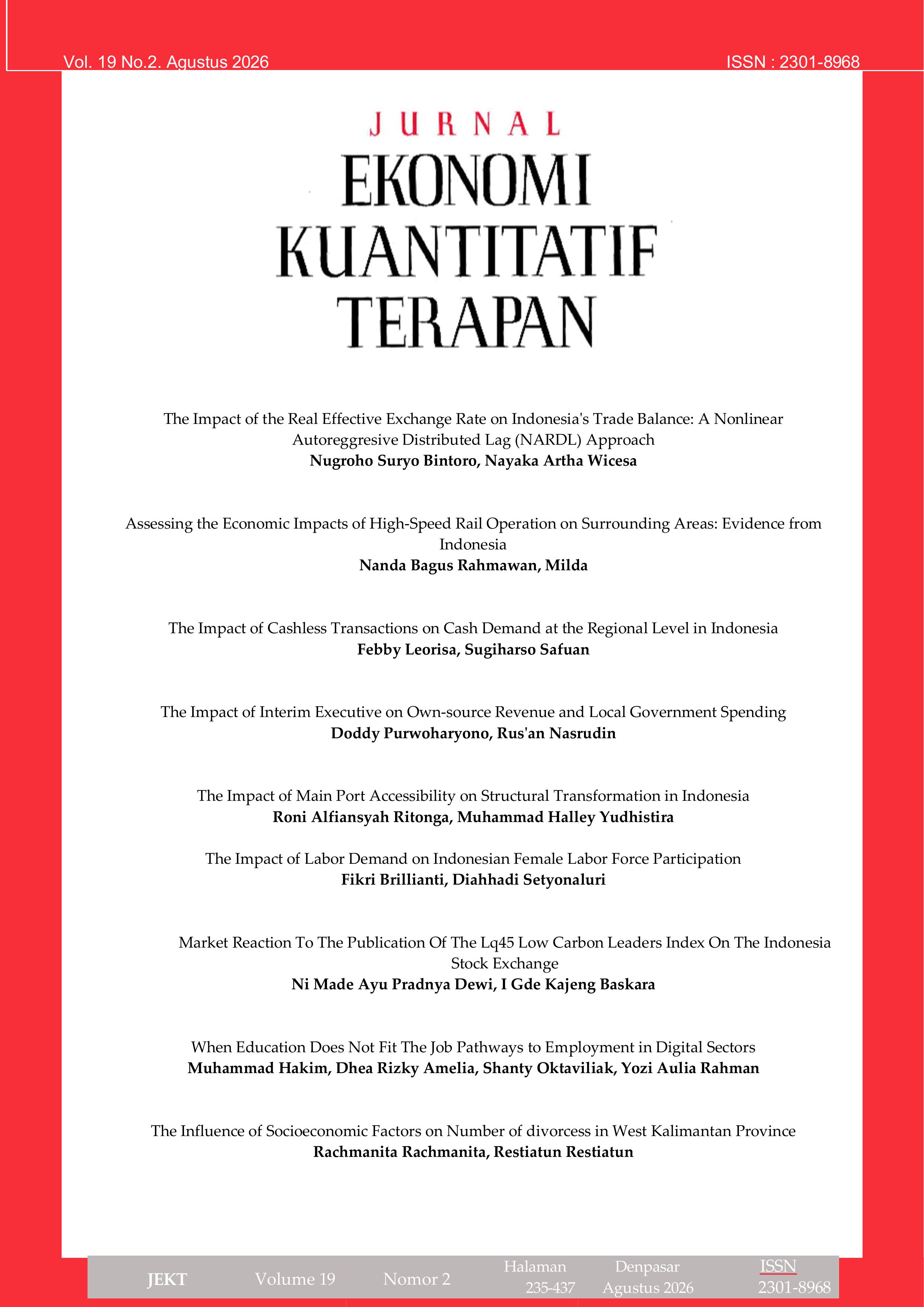
Assessing the Economic Impacts of High-Speed Rail Operation on Surrounding Areas: Evidence fromIndonesia
DOI:
https://doi.org/10.24843/JEKT.2026.v19.i02.p02Keywords:
High-speed rail, Transportation, economic activity, Economic Growth, Night-time light, Difference-in-DifferencesAbstract
As a developing country, Indonesia has successfully built its first high-speed rail (HSR), which is also the first in Southeast Asia. The HSR development forms part of the national transportation infrastructure modernization to enhance connectivity between strategic regions. Research on HSR impacts in Indonesia remains limited; therefore, this study tries to establish the causal impact of HSR development on the economic activities of the surrounding areas. This study uses the smallest administrative units (villages/urban wards) as the unit of analysis and Night-time light (NTL) intensity as a proxy for economic activity. The estimation results indicate that proximity to HSR stations significantly increases local economic activity. The findings are robust to various tests, such as falsification tests, applying Propensity Score Matching (PSM), placebo tests, and using an alternative sample period. This research contributes to the literature on infrastructure development by providing additional evidence on the benefit of infrastructure on local economies.
References
Ahlfeldt, G.M. and Feddersen, A. (2018) ‘From periphery to core: measuring agglomeration effects using high-speed rail’, Journal of Economic Geography, 18(2), pp. 355–390. Available at: https://doi.org/10.1093/jeg/lbx005.
Azhari, A.A.A. (2024) Dampak sosial dan ekonomi pada pembangunan infrastruktur Kereta Api Cepat Jakarta–Bandung terhadap masyarakat di Jakarta Timur. Undergraduate thesis. UIN Syarif Hidayatullah Jakarta. Available at: https://repository.uinjkt.ac.id/dspace/handle/123456789/84631.
Bappenas (2016) Kereta api cepat mendorong pertumbuhan ekonomi. Available at: https://www.bappenas.go.id/id/berita/kereta-api-cepat-mendorong-pertumbuhan-ekonomi?utm_source=chatgpt.com (Accessed: 12 August 2025).
Carbo, J.M., Graham, D.J., Anupriya, Casas, D. and Melo, P.C. (2019) ‘Evaluating the causal economic impacts of transport investments: evidence from the Madrid–Barcelona high speed rail corridor’, Journal of Applied Statistics, 46(9), pp. 1714–1723. Available at: https://doi.org/10.1080/02664763.2018.1558188.
Cascetta, E., Cartenì, A., Henke, I. and Pagliara, F. (2020) ‘Economic growth, transport accessibility and regional equity impacts of high-speed railways in Italy: Ten years ex post evaluation and future perspectives’, Transportation Research Part A: Policy and Practice, 139, pp. 412–428. Available at: https://doi.org/10.1016/j.tra.2020.07.008.
Deng, T., Gan, C., Perl, A. and Wang, D. (2020) ‘What caused differential impacts on high-speed railway station area development? Evidence from global nighttime light data’, Cities, 97, 102568. Available at: https://doi.org/10.1016/j.cities.2019.102568.
Diao, M. (2018) ‘Does growth follow the rail? The potential impact of high-speed rail on the economic geography of China’, Transportation Research Part A: Policy and Practice, 113, pp. 279–290. Available at: https://doi.org/10.1016/j.tra.2018.04.024.
Doerr, L., Dorn, F., Gaebler, S. and Potrafke, N. (2020) ‘How new airport infrastructure promotes tourism: evidence from a synthetic control approach in German regions’, Regional Studies, 54(10), pp. 1402–1412. Available at: https://doi.org/10.1080/00343404.2020.1714022.
Dong, L., Du, R., Kahn, M., Ratti, C. and Zheng, S. (2021) ‘“Ghost cities” versus boom towns: Do China's high-speed rail new towns thrive?’, Regional Science and Urban Economics, 89, 103682. Available at: https://doi.org/10.1016/j.regsciurbeco.2021.103682.
Du, Z., Wu, W., Liu, Y., Zhi, W. and Lu, W. (2021) ‘Evaluation of China’s High-Speed Rail Station Development and Nearby Human Activity Based on Nighttime Light Images’, International Journal of Environmental Research and Public Health, 18(2), 557. Available at: https://doi.org/10.3390/ijerph18020557.
Elvidge, C.D., Zhizhin, M., Ghosh, T., Hsu, F.C. and Taneja, J. (2021) ‘Annual time series of global VIIRS nighttime lights derived from monthly averages: 2012 to 2019’, Remote Sensing, 13(5), 922. Available at: https://doi.org/10.3390/rs13050922.
Garmendia, M., Ribalaygua, C. and Ureña, J.M. (2012) ‘High speed rail: implication for cities’, Cities, 29, S26–S31. Available at: https://doi.org/10.1016/j.cities.2012.06.005.
Guo, Y., Yu, W., Chen, Z. and Zou, R. (2020) ‘Impact of high-speed rail on urban economic development: An observation from the Beijing–Guangzhou line based on night-time light images’, Socio-Economic Planning Sciences, 72, 100905. Available at: https://doi.org/10.1016/j.seps.2020.100905.
Glaeser, E.L. and Kohlhase, J.E. (2004) ‘Cities, regions and the decline of transport costs’, Papers in Regional Science, 83(1), pp. 197–228. Available at: https://doi.org/10.1007/s10110-003-0183-x.
Gibson, J., Olivia, S., Boe-Gibson, G. and Li, C. (2021) ‘Which night lights data should we use in economics, and where?’, Journal of Development Economics, 149, 102602. Available at: https://doi.org/10.1016/j.jdeveco.2020.102602.
Hendra, Y.N.R., Pujiwat, R., Upahita, D.P. and Utomo, D.P. (2023) Multiplier Effects Analysis of Development on The High Speed Train Industry on Indonesia National Economic Growth. Available at: https://doi.org/10.5109/7151767.
Huang, C., Zhu, H. and Su, M. (2024) ‘Transportation infrastructure and economic growth: Evidence from “new nighttime light data” in the Yangtze River Delta’, PLoS ONE, 19(8), e0306477. Available at: https://doi.org/10.1371/journal.pone.0306477.
Huntington-Klein, N. (2021) The Effect: An Introduction to Research Design and Causality. Chapman and Hall/CRC. Available at: https://doi.org/10.1201/9781003226055.
Jia, S., Zhou, C. and Qin, C. (2017) ‘No difference in effect of high-speed rail on regional economic growth based on match effect perspective?’, Transportation Research Part A: Policy and Practice, 106, pp. 144–157. Available at: https://doi.org/10.1016/j.tra.2017.08.011.
Kemenhub (2023) Presiden Joko Widodo resmikan kereta cepat pertama di Asia Tenggara. Available at: https://www.dephub.go.id/post/read/presiden-joko-widodo-resmikan-kereta-cepat-pertama-di-asia-tenggara (Accessed: 12 August 2025).
Lakshmanan, T.R. (2011) ‘The broader economic consequences of transport infrastructure investments’, Journal of Transport Geography, 19(1), pp. 1–12. Available at: https://doi.org/10.1016/j.jtrangeo.2010.01.001.
Long, F., Zheng, L. and Song, Z. (2018) ‘High-speed rail and urban expansion: An empirical study using a time series of nighttime light satellite data in China’, Journal of Transport Geography, 72, pp. 106–118. Available at: https://doi.org/10.1016/j.jtrangeo.2018.08.011.
Liu, L. and Zhang, M. (2018) ‘High-speed rail impacts on travel times, accessibility, and economic productivity: A benchmarking analysis in city-cluster regions of China’, Journal of Transport Geography, 73, pp. 25–40. Available at: https://doi.org/10.1016/j.jtrangeo.2018.09.013.
Mahardika, M.D., Irawan, M.Z. and Bastarianto, F.F. (2022) ‘Exploring the potential demand for Jakarta–Bandung high-speed rail’, Transportation Research Interdisciplinary Perspectives, 15, p.100658. Available at: https://doi.org/10.1016/j.trip.2022.100658.
Niu, F., Xin, Z. and Sun, D. (2021) ‘Urban land use effects of high-speed railway network in China: A spatial spillover perspective’, Land Use Policy, 105, 105417. Available at: https://doi.org/10.1016/j.landusepol.2021.105417.
Niu, F. and Zhu, L. (2025) ‘The intercity industrial distribution effects of China’s high-speed railway: Evidence from nighttime light remote sensing data’, Remote Sensing, 17(6), 1102. Available at: https://doi.org/10.3390/rs17061102.
Pratiwi, A., Rizmadayanti, E.D., Ramadhan, F.T.A., Guntara, M.R., Abdullah, R.R. and Wicaksana, R. (2022) Analisis dampak proyek Kereta Cepat Jakarta–Bandung (KCJB) terhadap perekonomian Provinsi Jawa Barat. Undergraduate thesis. Universitas Indonesia. Available at: https://doi.org/10.24198/padjir.v2i2.26044.
PT Kereta Cepat Indonesia China (KCIC) (2025) Sejarah Perusahaan. Available at: https://kcic.co.id/tentang-kami/sejarah (Accessed: 9 September 2025).
Qin, Y. (2017) ‘No county left behind? The distributional impact of high-speed rail upgrades in China’, Journal of Economic Geography, 17(3), pp. 489–520. Available at: https://doi.org/10.1093/jeg/lbw013.
Ren, X., Zeng, G., Dong, K. and Wang, K. (2023) ‘How does high-speed rail affect tourism development? The case of the Sichuan-Chongqing Economic Circle’, Transportation Research Part A: Policy and Practice, 169, 103588. Available at: https://doi.org/10.1016/j.tra.2023.103588.
StataCorp LLC (2023) Stata causal inference and treatment-effects estimation reference manual. Stata Press. Available at: https://www.stata.com/manuals/causal.pdf.
Wetwitoo, J. and Kato, H. (2019) ‘Regional and local economic effects from proximity of high-speed rail stations in Japan: Difference-in-differences and propensity score matching analysis’, Transportation Research Record, 2673(9), pp. 323–333. Available at: https://doi.org/10.1177/0361198119844757.
Widyanesti, S. and Rafii, M.M. (2024) ‘Analisis faktor kepuasan pelanggan pada kualitas layanan: Studi Kereta Cepat Indonesia Cina (KCIC)’, e-Proceeding of Management. Available at: https://share.google/T2knu1OfbHvpzpaTs.
Yang, L., Hu, L., Shang, P. and Ye, Y. (2021) ‘Estimating the impacts of high-speed rail on service industry agglomeration in China: Advanced modelling with spatial difference-in-difference models and propensity score matching’, Journal of Transport Economics and Policy (JTEP), 55(1), pp. 16–35. Available at: https://www.jstor.org/stable/pdf/27106114.
Yoo, S., Kumagai, J. and Managi, S. (2024) ‘Urban-rural gap induced by high-speed rail: 35 years of evidence from Japan’, Research in Transportation Business & Management, 55, 101131. Available at: https://doi.org/10.1016/j.rtbm.2024.101131.
Yu, L. (2021) ‘Study on treatment effects and spatial spillover effects of Beijing–Shanghai HSR on the cities along the line’, The Annals of Regional Science, 67(3), pp. 671–695. Available at: https://doi.org/10.1007/s00168-021-01061-2.
Yu, N. and Jin, Y. (2023) ‘The unintended economic impact of high-speed rail on China’s non-core cities: A spatial-difference-in-differences analysis’, Cities, 143, 104618. Available at: https://doi.org/10.1016/j.cities.2023.104618.
Zhang, F., Wang, F., Yao, S. and Fu, F. (2023) ‘High-speed rail and tourism expansion in China: a spatial spillover effect perspective’, Technological and Economic Development of Economy, 29(6), pp. 1753–1775. Available at: https://doi.org/10.3846/tede.2023.19813.
Zheng, L., Xue, Y. and Huang, D. (2025) ‘Inter-city transport hubs and intra-city polycentric structure: Evidence from high-speed rail stations and airports in China’, Journal of Transport Geography, 123, 104132. Available at: https://doi.org/10.1016/j.jtrangeo.2025.104132.
Zheng, L., Long, F., Chang, Z. and Ye, J. (2019) ‘Ghost town or city of hope? The spatial spillover effects of high-speed railway stations in China’, Transport Policy, 81, pp. 230–241. Available at: https://doi.org/10.1016/j.jtrangeo.2025.104132.
Downloads
Published
Issue
Section
License
Copyright (c) 2026 Jurnal Ekonomi Kuantitatif Terapan

This work is licensed under a Creative Commons Attribution-NonCommercial 4.0 International License.

This work is licensed under a Creative Commons Attribution 4.0 International License.