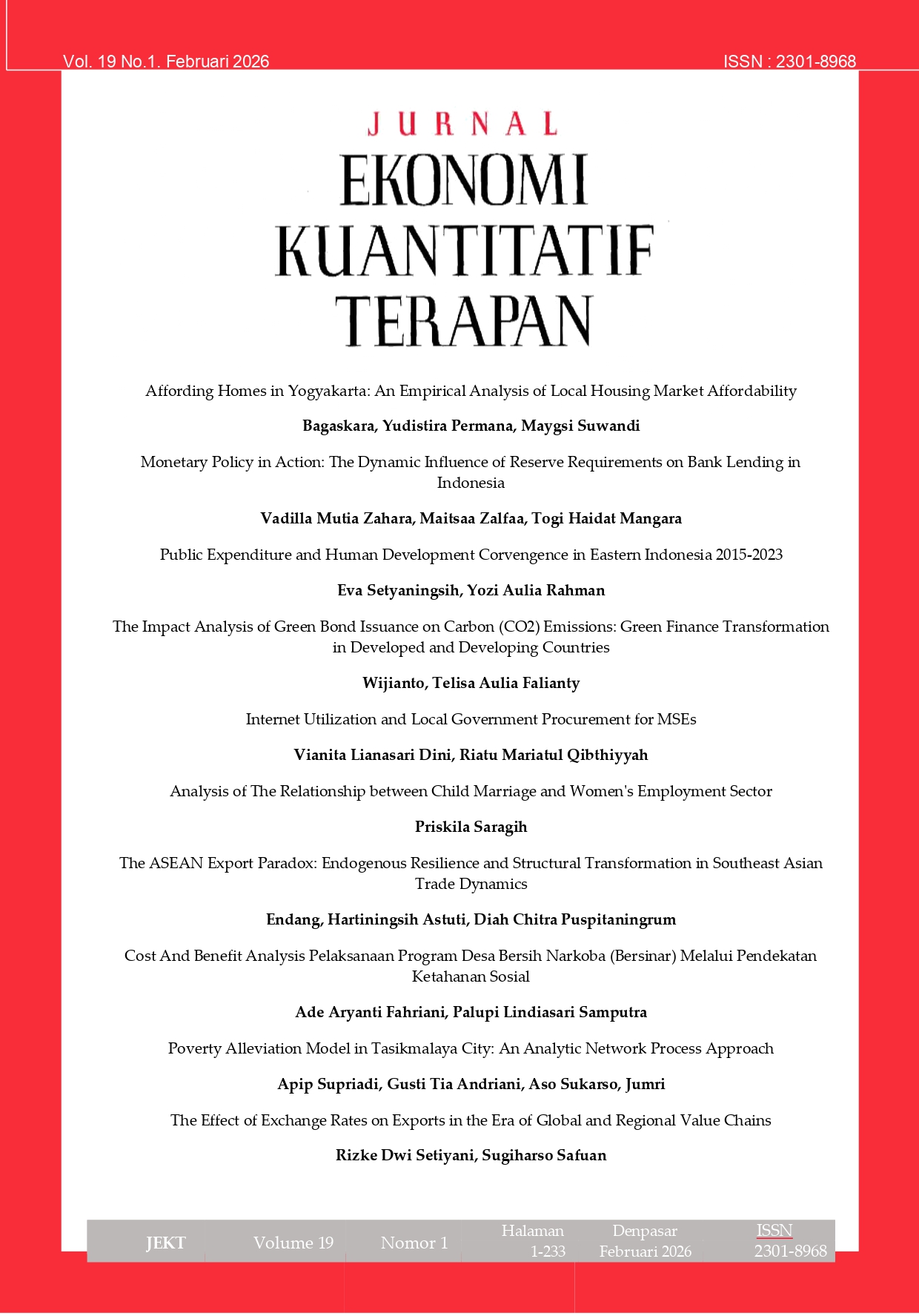
Analysis of The Relationship between Child Marriage and Women's Employment Sector
DOI:
https://doi.org/10.24843/JEKT.2026.v19.i01.p06Abstract
ABSTRAK
Pernikahan anak masih menjadi suatu masalah yang dihadapi di Indonesia. Hal ini turut berkontribusi padanya lambatnya peningkatan Tingkat Partisipasi Angkatan Kerja (TPAK) perempuan. Pernikahan anak berimplikasi pada tingkat pendidikan yang rendah sehingga banyak perempuan yang mengalami putus sekolah. Padahal, dibutuhkan modal manusia yang berkualitas dan berdaya saing untuk bisa berpartisipasi pada sektor pekerjaan formal yang menyediakan upah, jaminan, dan perlindungan sosial bagi pekerjanya. Penelitian ini melengkapi penelitian sebelumnya dengan menggunakan data Survei Sosial Ekonomi Nasional (SUSENAS) 2023 dan mengakomodir aturan terbaru usia minimal pernikahan pada UU No. 16 Tahun 2019 menggunakan Linear Probability Model (LPM) serta menguji kestabilan arah koefisien pernikahan anak melalui oster test. Temuan menunjukkan bahwa pada jangka pendek, pernikahan tidak berpengaruh terhadap peluang perempuan bekerja di sektor formal (mengacu pada konsep sektor formal BPS). Salah satu alasan yang mungkin mendasari perbedaan ini adalah periode observasi yang pendek dan keterbatasan metodologi. Sehingga penelitian di masa mendatang perlu mempertimbangkan batasan dari studi ini.
Kata kunci: pernikahan anak, sektor formal, linear probability model, oster test
Klasifikasi JEL: J12, J13, J16, J21, J24
ABSTRACT
Child marriage is still a problem faced in Indonesia. This also contributed to the slow increase in the Female Labor Force Participation Rate (LFP). Child marriage has implications for low levels of education, so many women drop out of school. In fact, quality and competitive human capital is needed to be able to participate in the formal work sector that provides wages, guarantees, and social protection for its workers. This study complements previous research using data from the 2023 National Socio-Economic Survey (SUSENAS) and accommodates the latest rules on the minimum age of marriage in Law No. 16 of 2019 using the Linear Probability Model (LPM) and testing the stability of the direction of the child marriage coefficient through the oster test. The findings show that in the short term, marriage has no effect on women's chances of working in the formal sector (referring to the BPS formal sector concept). One of the possible reasons underlying this difference is the short observation period and methodological limitations. So future research needs to consider the limitations of this study.
Keywords: child marriage, formal sector, linear probability model, oster test
JEL Classification Codes: J12, J13, J16, J21, J24
Downloads
Published
Issue
Section
License
Copyright (c) 2026 Jurnal Ekonomi Kuantitatif Terapan

This work is licensed under a Creative Commons Attribution-NonCommercial 4.0 International License.

This work is licensed under a Creative Commons Attribution 4.0 International License.