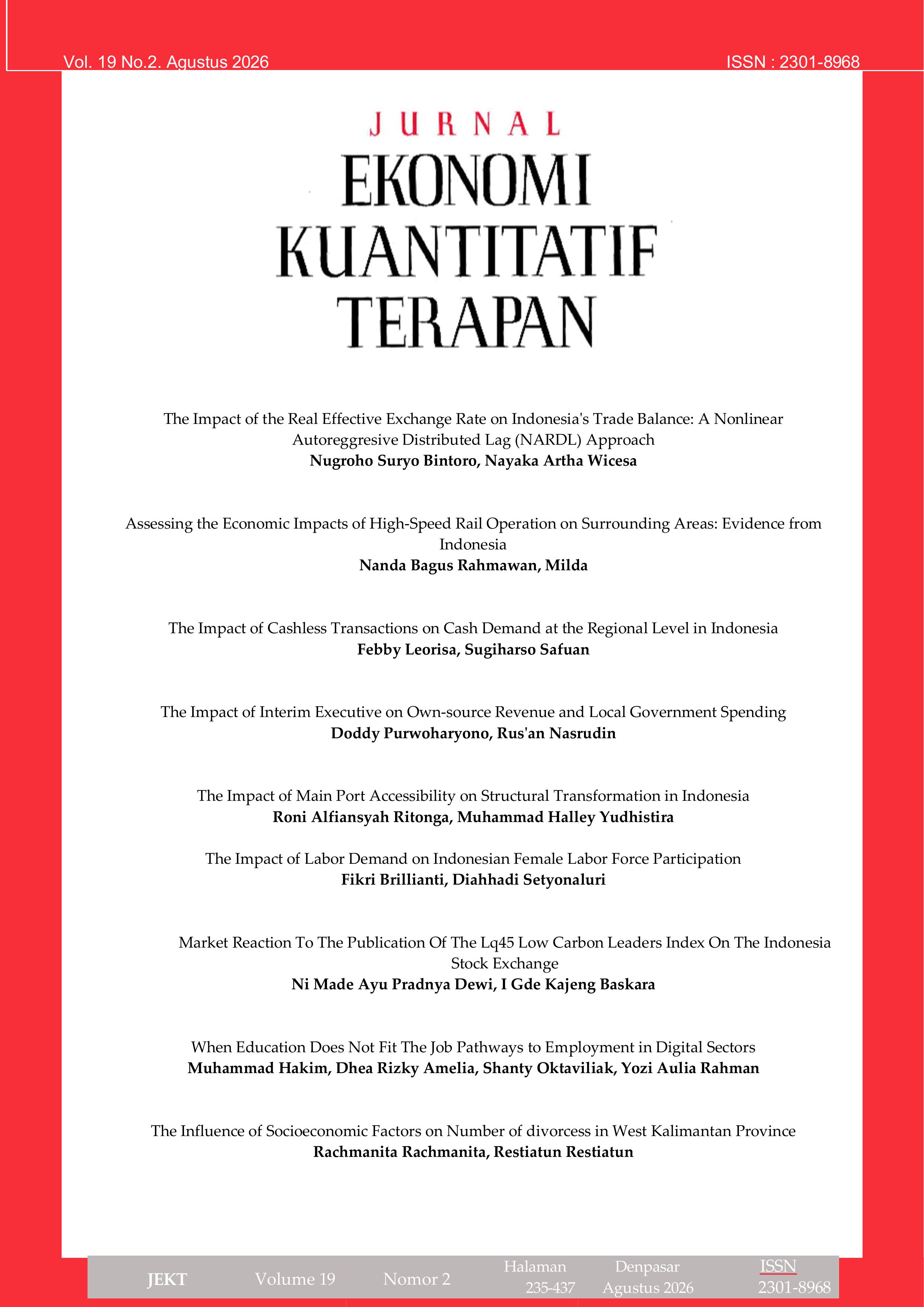
The Impact of Interim Executive on Own-source Revenue and Local Government Spending
DOI:
https://doi.org/10.24843/JEKT.2026.v19.i02.p04Keywords:
Regional Government, Local Government Taxation, Local Government ExpendituresAbstract
This study examines the fiscal effect of interim local executives appointed by central government in Indonesia during 2022-2023 due to Pilkada Serentak. Using panel data from 508 districts and staggered difference-in-difference, this study estimates causal impact of interim local executives on own-source revenue and local government spending. Results show no significant effect on own-source revenue, but a decline in local government spending under interim leadership. These outcomes are explained by differences in accountability, incentives, and local executive background where interim executives are vertically accountable to the central government, driven by bureaucratic career goals, and often lack local political experience. Interim executives tend to be administratively obedient, but conservative in fiscal policy and less responsive to regional needs. These findings highlight potential trade-offs in appointing interim leaders and call for a careful review of their use in future election cycles to protect local autonomy and decentralization goals.
References
Alesina, A. and Tabellini, G. (2007), “Bureaucrats or Politicians? Part I: A Single Policy Task”, American Economic Review, Vol. 97 No. 1, pp. 169–179, doi: 10.1257/aer.97.1.169.
Alesina, A. and Tabellini, G. (2008), “Bureaucrats or politicians? Part II: Multiple policy tasks”, Journal of Public Economics, Vol. 92 No. 3–4, pp. 426–447, doi: 10.1016/j.jpubeco.2007.06.004.
Baker, A.C., Larcker, D.F. and Wang, C.C.Y. (2022), “How much should we trust staggered difference-in-differences estimates?”, Journal of Financial Economics, Vol. 144 No. 2, pp. 370–395, doi: 10.1016/j.jfineco.2022.01.004.
Brodjonegoro, B. and Martinez-Vazquez, J. (2004), “An Analysis of Indonesia’s Transfer System: Recent Performance and Future Prospects”, Reforming Intergovernmental Fiscal Relations and the Rebuilding of Indonesia, Edward Elgar Publishing, doi: 10.4337/9781845421656.00015.
Caetano, C. and Callaway, B. (2024), “Difference-in-Differences when Parallel Trends Holds Conditional on Covariates”.
Callaway, B. and Sant’Anna, P.H.C. (2021), “Difference-in-Differences with multiple time periods”, Journal of Econometrics, Vol. 225 No. 2, pp. 200–230, doi: 10.1016/j.jeconom.2020.12.001.
de Chaisemartin, C. and D’Haultfœuille, X. (2020), “Two-Way Fixed Effects Estimators with Heterogeneous Treatment Effects”, American Economic Review, Vol. 110 No. 9, pp. 2964–2996, doi: 10.1257/aer.20181169.
Freedman, S.M., Hollingsworth, A., Simon, K.I., Wing, C. and Yozwiak, M. (2023), Designing Difference in Difference Studies With Staggered Treatment Adoption: Key Concepts and Practical Guidelines.
Goodman-Bacon, A. (2021), “Difference-in-differences with variation in treatment timing”, Journal of Econometrics, Vol. 225 No. 2, pp. 254–277, doi: 10.1016/j.jeconom.2021.03.014.
Jung, H. (2023), “Do young politicians make a difference? Evidence from local public expenditure in South Korea”, Economics of Governance, Vol. 24 No. 4, pp. 473–499, doi: 10.1007/s10101-023-00299-0.
Lewis, B.D. (2018), “Local Government Form in Indonesia: Tax, Expenditure, and Efficiency Effects”, Studies in Comparative International Development, Vol. 53 No. 1, pp. 25–46, doi: 10.1007/s12116-017-9236-z.
Lewis, B.D. (2022), “The impact of democratic elections on taxation: Quasi-experimental evidence from subnational Indonesia”, Economics Letters, Vol. 211, p. 110270, doi: 10.1016/j.econlet.2022.110270.
Lewis, B.D. and Dong, S. (2025), “The transition to direct mayoral elections in clientelistic environments: Causal public spending and service delivery effects”, Journal of Development Economics, Vol. 172, p. 103380, doi: 10.1016/j.jdeveco.2024.103380.
Li, Z. and Yu, A.Z. (2023), “The Last Strike: Age, Career Incentives and Taxation in China”, Studies in Comparative International Development, Vol. 58 No. 1, pp. 55–78, doi: 10.1007/s12116-022-09356-x.
Morgan, D.R. and Kickham, K. (1999), “Changing the Form of County Government: Effects on Revenue and Expenditure Policy”, Public Administration Review, Vol. 59 No. 4, pp. 315–324.
Sjahrir, B.S., Kis-Katos, K. and Schulze, G.G. (2013), “Political budget cycles in Indonesia at the district level”, Economics Letters, Vol. 120 No. 2, pp. 342–345, doi: 10.1016/j.econlet.2013.05.007.
Sun, L. and Abraham, S. (2021), “Estimating dynamic treatment effects in event studies with heterogeneous treatment effects”, Journal of Econometrics, Vol. 225 No. 2, pp. 175–199, doi: 10.1016/j.jeconom.2020.09.006.
Downloads
Published
Issue
Section
License
Copyright (c) 2026 Jurnal Ekonomi Kuantitatif Terapan

This work is licensed under a Creative Commons Attribution-NonCommercial 4.0 International License.

This work is licensed under a Creative Commons Attribution 4.0 International License.