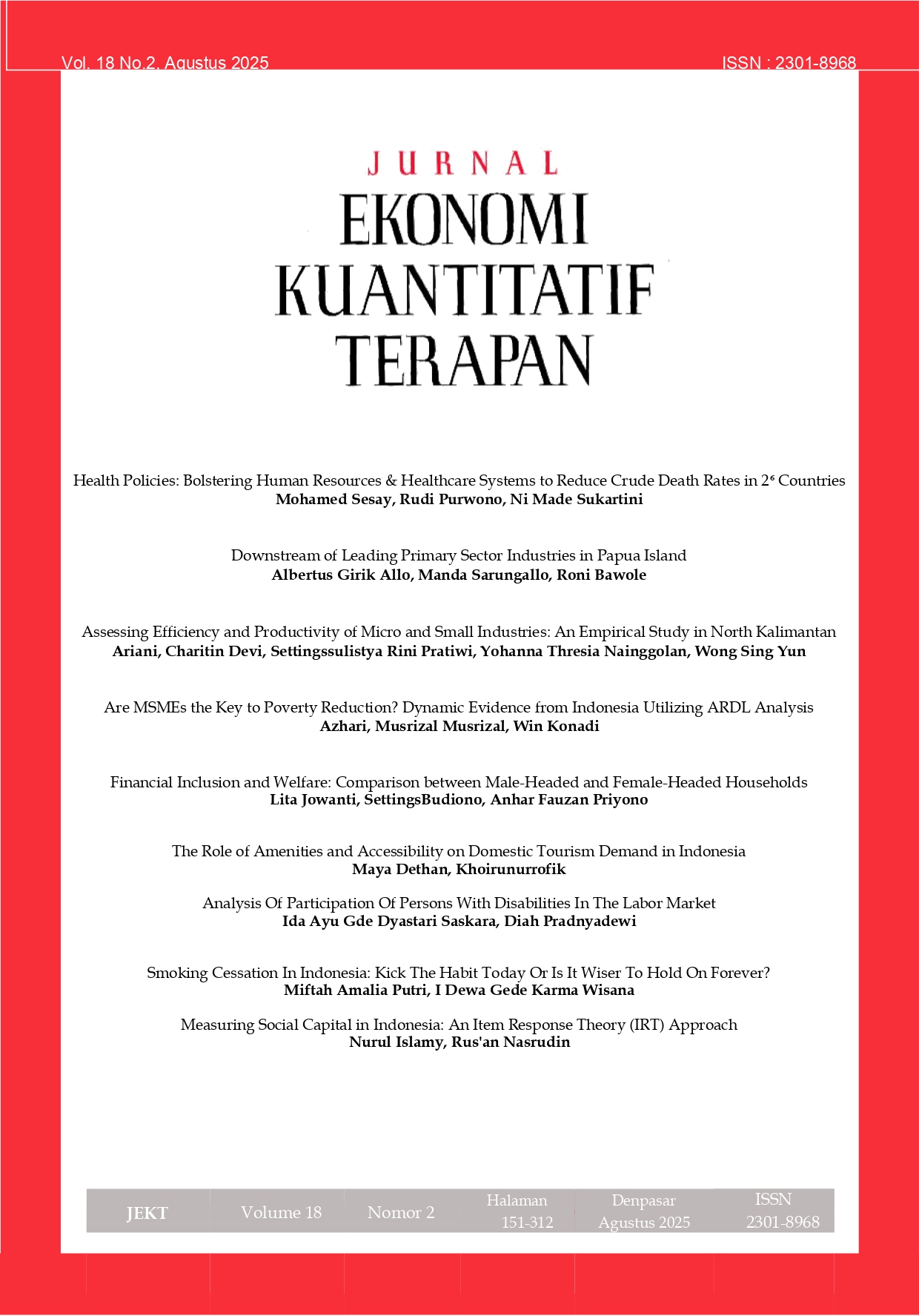
Measuring Social Capital in Indonesia: An Item Response Theory (IRT) Approach
DOI:
https://doi.org/10.24843/JEKT.2025.v18.i02.p09Keywords:
Social Capital, Trust, Social Participation, Tolerance, IRT GRM, CartogramAbstract
This study assesses social capital in Indonesia using the Item Response Theory (IRT) with the Graded Response Model (GRM), based on data from the 2021 Happiness Level Survey (SPTK) by Statistics Indonesia (BPS), involving 74,684 respondents. Social capital is measured across three dimensions: trust, social participation, and tolerance. Trust is further categorized into bonding (close relations), bridging (community leaders), and linking (institutions), with the highest levels in Sulawesi and the lowest in urban areas like Jakarta and Banten. Social participation is higher in rural areas, while tolerance is strongest in multicultural regions such as East Nusa Tenggara and North Kalimantan. The findings underscore the need for region-specific strategies to strengthen social capital, including institutional transparency and inclusive engagement. Reviving programs like Pendidikan Moral Pancasila (PMP) and the National Program for Community Empowerment (PNPM) can enhance trust, participation, and tolerance. The IRT-GRM model offers a robust approach for analyzing ordinal data and informing inclusive development policies.
References
Andrich, G. (1978). A rating formulation for ordered response categories. Psychometrika, 43(4), 561–573. https://doi.org/10.1007/BF02293814
Aspinall, E., & Mietzner, M. (2019). Indonesia’s Democratic Paradox: Competitive Elections amidst Rising Illiberalism. Bulletin of Indonesian Economic Studies, 55(3), 295–317. https://doi.org/10.1080/00074918.2019.1690412
Baker, F. B., & Kim, S. H. (2017). The basics of item response theory using R. Springer.
Bertrand, M., & Mullainathan, S. (2004). Are Emily and Greg more employable than Lakisha and Jamal? A field experiment on labor market discrimination. American Economic Review, 94(4), 991–1013. https://doi.org/10.1257/0002828042002561
Bourdieu, P. (1986). The forms of capital. In J. G. Richardson (Ed.), Handbook of theory and research for the sociology of education (pp. 241–258). Greenwood Press.
Coleman, J. S. (1988). Social capital in the creation of human capital. American Journal of Sociology, 94(Suppl.), S95–S120. https://doi.org/10.1086/228943
Coleman, J. S. (1990). Foundations of social theory. Harvard University Press.
Dasgupta, P., & Serageldin, I. (Eds.). (2000). Social capital: A multifaceted perspective. World Bank.
De Ayala, R. J. (2009). The theory and practice of item response theory. Guilford Press.
Embretson, S. E., & Reise, S. P. (2000). Item response theory for psychologists. Lawrence Erlbaum Associates.
Fafchamps, M., & Minten, B. (2002). Social capital and the firm: Evidence from agricultural traders in Madagascar. Economic Development and Cultural Change, 50(3), 429–447. https://doi.org/10.1086/342734
Fukuyama, F. (1995). Trust: The social virtues and the creation of prosperity. Free Press.
Fukuyama, F. (2001). Social capital, civil society, and development. Third World Quarterly, 22(1), 7–20. https://doi.org/10.1080/713701144
Geertz, C. (1960). The religion of Java. University of Chicago Press.
Gibson, J. L. (2006). Enigmas of intolerance: Fifty years after Stouffer’s Communism, Conformity, and Civil Liberties. Perspectives on Politics, 4(1), 21-34. https://doi.org/10.1017/S153759270606004X
Grootaert, C., & van Bastelaer, T. (Eds.). (2004). The role of social capital in development: An empirical assessment. Cambridge University Press.
Grootaert, C., Narayan, D., Jones, V. N., & Woolcock, M. (2004). Measuring Social Capital: An Integrated Questionnaire. World Bank Working Paper No. 18.
Guiso, L., Sapienza, P., & Zingales, L. (2009). Cultural biases in economic exchange. The Quarterly Journal of Economics, 1095–1131.
Latief, H. (2013). Islamic philanthropy and the private sector in Indonesia. Indonesian Journal of Islam and Muslim Societies, 3(2). https://doi.org/10.18326/ijims.v3i2.175-201
Knack, S., & Keefer, P. (1997). Does social capital have an economic payoff? A cross-country investigation. Quarterly Journal of Economics, 112(4), 1251–1288. https://doi.org/10.1162/003355300555475
Krishna, A., & Shrader, E. (2000). Cross-cultural measures of social capital: A tool and results from India and Panama. Social Capital Initiative Working Paper No. 21. World Bank.
Lulun, F. N., Sahusilawane, A. M., & Siwalette, J. D. (2019). Pengaruh modal sosial terhadap tingkat pendapatan petani di Desa Waiheru Kecamatan Baguala Kota Ambon. Agrilan: Jurnal Agribisnis Kepulauan, 7(2). https://doi.org/10.30598/agrilan.v7i2.889
Nasution, A. (2017). Peranan modal sosial dalam pengurangan kemiskinan rumah tangga di perdesaan Indonesia. Jurnal Ekonomi dan Kebijakan Publik, 7(2). https://doi.org/10.22212/jekp.v7i2.672
Masters, G. N. (1982). A Rasch model for partial credit scoring. Psychometrika, 47(2), 149–174. https://doi.org/10.1007/BF02296272
McPherson, J. M., Lynn, S.-L., & Cook, J. M. (2001). Birds of a feather: Homophily in social networks. Annual Review of Sociology, 27, 415–444. https://doi.org/10.1146/annurev.soc.27.1.415
Norris, P., & Inglehart, R. (2019). Cultural backlash: Trump, Brexit, and the rise of authoritarian populism. Cambridge University Press
Norris, P. (2011). Democratic deficit: Critical citizens revisited. Cambridge University Press. https://doi.org/10.1017/CBO9780511973383
OECD. (2011). How’s life? Measuring well-being. OECD Publishing. https://doi.org/10.1787/9789264121164-en
Ostrom, E. (1990). Governing the commons: The evolution of institutions for collective action. Cambridge University Press.
Portes, A. (1998). Social capital: Its origins and applications in modern sociology. Annual Review of Sociology, 24, 1–24. https://doi.org/10.1146/annurev.soc.24.1.1
Putnam, R. D. (1993). Making democracy work: Civic traditions in modern Italy. Princeton University Press.
Putnam, R. D. (2000). Bowling alone: The collapse and revival of American community. Simon & Schuster.
Rusmawati, E., Hartono, D., & Aritenang, A. F. (2023). Food security in Indonesia: the role of social capital. Development Studies Research, 10(1). https://doi.org/10.1080/21665095.2023.2169732
Sabatini, F. (2009). Social capital as social networks: A new framework for measurement and an empirical analysis of its determinants and consequences. Journal of Socioeconomics, 38(3), 429–442. https://doi.org/10.1016/j.socec.2008.06.001
Samejima, F. (1969). Estimation of latent ability using a response pattern of graded scores. Psychometrika Monograph Supplement, 34(4), 1–97.
Sen, A. (1999). Development as freedom. Oxford University Press.
Stiglitz, J. E., Sen, A., & Fitoussi, J. P. (2009). Report by the Commission on the Measurement of Economic Performance and Social Progress.
Stiglitz, J. E., Sen, A., & Fitoussi, J.-P. (2009). Report by the Commission on the Measurement of Economic Performance and Social Progress. Commission on the Measurement of Economic Performance and Social Progress.
Tadjoeddin, Z. (2014). Explaining collective violence in contemporary Indonesia: from conflict to cooperation. Springer.
Taupan, M. H. (2014). Hubungan tingkat modal sosial terhadap tingkat pendapatan pelaku UKM. Jurnal Mahasiswa Sosiologi Universitas Brawijaya, 3(2).
Tyler, T. R., & Jackson, J. (2014). Popular legitimacy and the exercise of legal authority: Motivating compliance, cooperation, and engagement. Psychology, Public Policy, and Law, 20(1), 78–95. https://doi.org/10.1037/a0034514
van der Linden, W. J., & Hambleton, R. K. (Eds.). (1997). Handbook of modern item response theory. Springer.
Woolcock, M., & Narayan, D. (2000). Social capital: Implications for development theory, research, and policy. The World Bank Research Observer, 15(2), 225–249. https://doi.org/10.1093/wbro/15.2.225
World Bank. (2007). Two years after the Java earthquake and tsunami: Implementing community-based reconstruction, increasing transparency. The World Bank. Retrieved from https://documents.worldbank
Downloads
Published
Issue
Section
License
Copyright (c) 2025 Jurnal Ekonomi Kuantitatif Terapan

This work is licensed under a Creative Commons Attribution-NonCommercial 4.0 International License.

This work is licensed under a Creative Commons Attribution 4.0 International License.