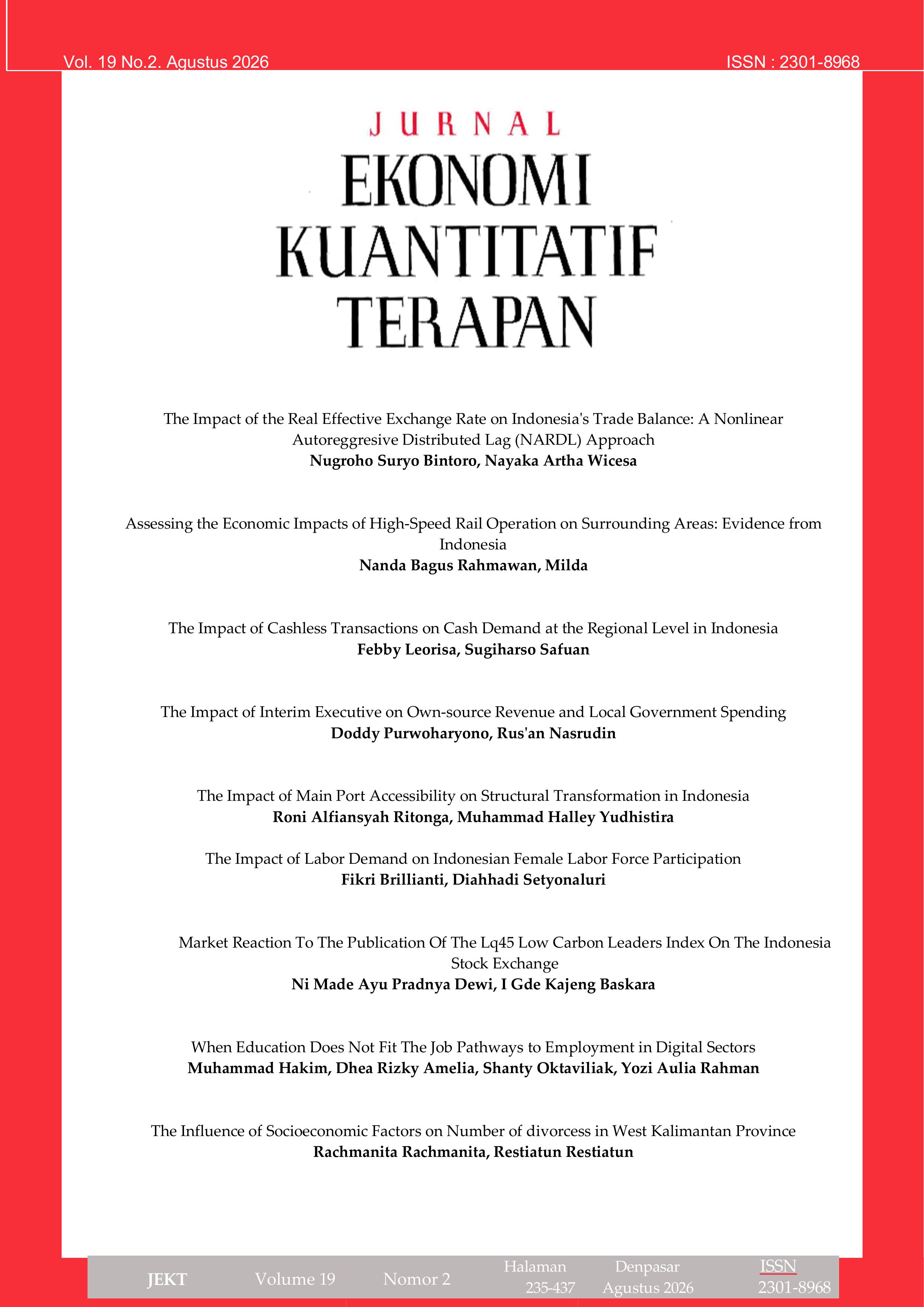
The Impact of Cashless Transactions on Cash Demand at the Regional Level in Indonesia
DOI:
https://doi.org/10.24843/JEKT.2026.v19.i02.p03Keywords:
cash demand, digital payments, debit card, electronic money, regional disparityAbstract
Penelitian ini mengkaji pengaruh transaksi non-tunai—yang mencakup penggunaan kartu debit, kartu kredit, dan uang elektronik—terhadap permintaan uang tunai di Indonesia dengan menggunakan data panel tingkat kabupaten/kota untuk periode 2019 hingga 2024. Dengan menerapkan model Two-Way Fixed Effects (TWFE), hasil penelitian menunjukkan bahwa transaksi menggunakan kartu debit dan kartu kredit secara signifikan menurunkan permintaan uang tunai di tingkat nasional, yang mengindikasikan peran keduanya sebagai substitusi terhadap uang tunai. Sebaliknya, penggunaan uang elektronik hanya menunjukkan pengaruh yang signifikan secara statistik di wilayah Jawa, yang mencerminkan adanya disparitas regional dalam adopsi pembayaran digital. Di wilayah Jawa, uang elektronik berfungsi sebagai substitusi uang tunai, sedangkan di luar Jawa, kartu debit lebih berperan dalam menurunkan penggunaan uang tunai. Temuan ini menegaskan pentingnya kebijakan yang disesuaikan secara spasial untuk mendorong adopsi sistem pembayaran digital yang lebih luas dan efektif di seluruh wilayah Indonesia.
This study investigates the impact of non-cash transactions—including debit card, credit card, and electronic money usage—on cash demand in Indonesia using district-level panel data from 2019 to 2024. Employing a Two-Way Fixed Effects (TWFE) model, the findings reveal that debit and credit card transactions significantly reduce cash demand at the national level, indicating their role as substitutes for cash. In contrast, electronic money usage shows a statistically significant effect only in Java, reflecting regional disparities in digital payment adoption. While electronic money functions as a substitute for cash in Java, debit card transactions remain more influential in reducing cash usage in non-Java regions. These results underscore the importance of spatially adaptive policies to support broader and more effective digital payment adoption across Indonesia.
References
Achord, S., Chan, J., Collier, I., Nardani, S., & Rochemont, S. (2017). A cashless society benefits, risks and issues (Interim Paper).
Al-Laham, M., Al-Tarawneh, H., & Abdallat, N. (2009). Development of electronic money and its impact on the central bank role and monetary policy. Issues in Informing Science and Information Technology.
Amromin, G., & Chakravorti, S. (2009). Whither loose change? The diminishing demand for small-denomination currency. Journal of Money, Credit and Banking, 41(3), 315–335. https://doi.org/https://doi.org/10.1111/j.1538-4616.2009.00207.x
Arango-Arango, C. A., & Suárez-Ariza, N. (2020). Digital payments adoption and the demand for cash: New international evidence. Journal of Payments Strategy & Systems , 14(4). https://doi.org/https://doi.org/10.69554/GALF4042
Aristiyowati, E. S., & Falianty, T. A. (2019). Peranan perkembangan inovasi finansial sistem pembayaran dalam mempengaruhi permintaan uang di Indonesia. EKUITAS (Jurnal Ekonomi Dan Keuangan), 2(3), 404–426. https://doi.org/10.24034/j25485024.y2018.v2.i3.128
Baubeau, P. (2016). Dematerialization and the cashless society: A look backward, a look sideward. In The Book of Payments: Historical and Contemporary Views on the Cashless Society (pp. 85–94). Palgrave Macmillan. https://doi.org/10.1057/978-1-137-60231-2_9
Bech, M. L., Faruqui, U., Ougaard, F., & Picillo, C. (2018). Payments are a-changin’ but cash still rules. BIS Quarterly Review. https://www.bis.org/publ/qtrpdf/r_qt1803g.pdf
Cabezas, L., & Jara, A. (2021). The demand for cash: Stylized facts and substitution by electronic means of payment. In CEPAL Review N° (Vol. 135).
Demirgüç-Kunt, A., The, R. L., & Bank, W. (2008). Finance, financial sector policies, and long-run growth (WPS4469). http://econ.worldbank.org.
Djebbouri, M., Mansouri, A., & Tahi, A. (2019). Determinants of Money Demand in Algeria: An Empirical Study Using Cointegration and Error Correction Model. Modern Applied Science, 13(10), 78. https://doi.org/10.5539/mas.v13n10p78
Fabris, N. (2019). Cashless society - The future of money or a utopia? Journal of Central Banking Theory and Practice, 8(1), 53–66. https://doi.org/10.2478/jcbtp-2019-0003
Hasan, I., De Renzis, T., & Schmiedel, H. (2012). Retail payments and economic growth. SSRN Electronic Journal. https://doi.org/10.2139/ssrn.2100651
Huang, Z., Lahreche, A., Saito, M., & Wiriadinata, U. (2024). E-Money and monetary policy transmission (WP/24/69).
Igamo, A. M., & Falianty, T. A. (2018). The impact of electronic money on the efficiency of the payment system and the substitution of cash In Indonesia. SIJDEB, 2(3), 237–254. http://ejournal.unsri.ac.id/index.php/sijdeb
Ivanovski, K., & Churchill, S. A. (2019). Economic policy uncertainty and demand for money in Australia. Applied Economics, 51(41), 4516–4526. https://doi.org/10.1080/00036846.2019.1593936
Joseph, A., Larrain, M., & Ottoo, R. (2013). Comparing the forecasts of money demand. Procedia Computer Science, 20, 478–483. https://doi.org/10.1016/j.procs.2013.09.306
Kanojia, P., & Lal, M. (2023). Moderation effect of demographic factors in adoption of electronic payments. International Journal of Management Practice, 16(1), 18–37. https://doi.org/10.1504/IJMP.2023.10052014
Khiaonarong, T., Humphrey, D., Bricco, J., Changchun, M., Han, F., Ishi, K., Jonker, N., Koch, M., Löber, K., Mineshima, A., Natarajan, H., Qiu,
M., Sandal, K., Segendorf, B., & Wendt, F. (2019). Cash use across countries and the demand for Central Bank Digital Currency (WP/19/46).
Mishkin, F. S. (2016). The Economics of Money, Banking, and Financial Markets (Eleventh Edition). Pearson Education Limited.
Mlambo, C., & Msosa, S. K. (2020). The effect of financial technology on money demand: Evidence from selected African States. International Journal of Economics and Business Administration, VIII(1), 366–373. https://doi.org/https://doi.org/10.35808/ijeba/430
Nagayasu, J. (2012). Financial innovation and regional money. Applied Economics, 44(35), 4617–4629. https://doi.org/10.1080/00036846.2011.593500
Odeleye, A. T., & Akam, D. (2020). Money demand function: A re-assessment in Sub-Saharan Africa. Iranian Economic Review, 2022(1), 61–77. https://doi.org/10.22059/ier.2020.77207
Onah, E. O., Ujunwa, A. I., Ujunwa, A., & Ogundele, O. S. (2020). Effect of financial technology on cash holding in Nigeria. African Journal of Economic and Management Studies, 12(2), 228–249. https://doi.org/10.1108/AJEMS-04-2020-0190
Ozili, P. K. (2018). Impact of digital finance on financial inclusion and stability. Borsa Istanbul Review, 18(4), 329–340. https://doi.org/10.1016/j.bir.2017.12.003
Raya, J. M., & Vargas, C. (2022). How to become a cashless economy and what are the determinants of eliminating cash. Journal of Applied Economics, 25(1), 543–562. https://doi.org/10.1080/15140326.2022.2052000
Rogoff, K. S. (2017). The Curse of Cash. Princeton University Press.
Schneider, F., & Kepler, J. (2009). The shadow economy in Europe. www.visaeurope.com.
Schomburgk, L., Belli, A., & Hoffmann, A. O. I. (2024). Less cash, more splash? A meta-analysis on the cashless effect. Journal of Retailing, 100(3), 382–403. https://doi.org/10.1016/j.jretai.2024.05.003
Skibińska-Fabrowska, I., Czuchryta, M., & Żak, A. (2023). The relationship between payment inclusion and the demand for cash. Bank i Kredyt, 54(4), 365–388. https://bankikredyt.nbp.pl/content/2023/04/bik_04_2023_02.pdf
Tavor, T., Gonen, L. D., Weber, M., & Spiegel, U. (2018). The modified Baumol equation: Theory and evidence. Review of European Studies , 10(1). https://doi.org/10.5539/jmr.v10n1p25
Tehranchian, A. M., Samimi, A. J., & Yazdandoust, A. (2012). The impact of modern technology on demand for money in Iran. Iranian Economic Review, 16(32). https://doi.org/https://doi.org/10.22059/ier.2012.32742
Whitesell, W. C. (1989). The demand for currency versus debitable accounts: Note. In Source: Journal of Money, Credit and Banking (Vol. 21, Number 2).
Zins, A., & Weill, L. (2016). The determinants of financial inclusion in Africa. Review of Development Finance, 6(1), 46–57. https://doi.org/10.1016/j.rdf.2016.05.001
Downloads
Published
Issue
Section
License
Copyright (c) 2026 Jurnal Ekonomi Kuantitatif Terapan

This work is licensed under a Creative Commons Attribution-NonCommercial 4.0 International License.

This work is licensed under a Creative Commons Attribution 4.0 International License.