INDEXING




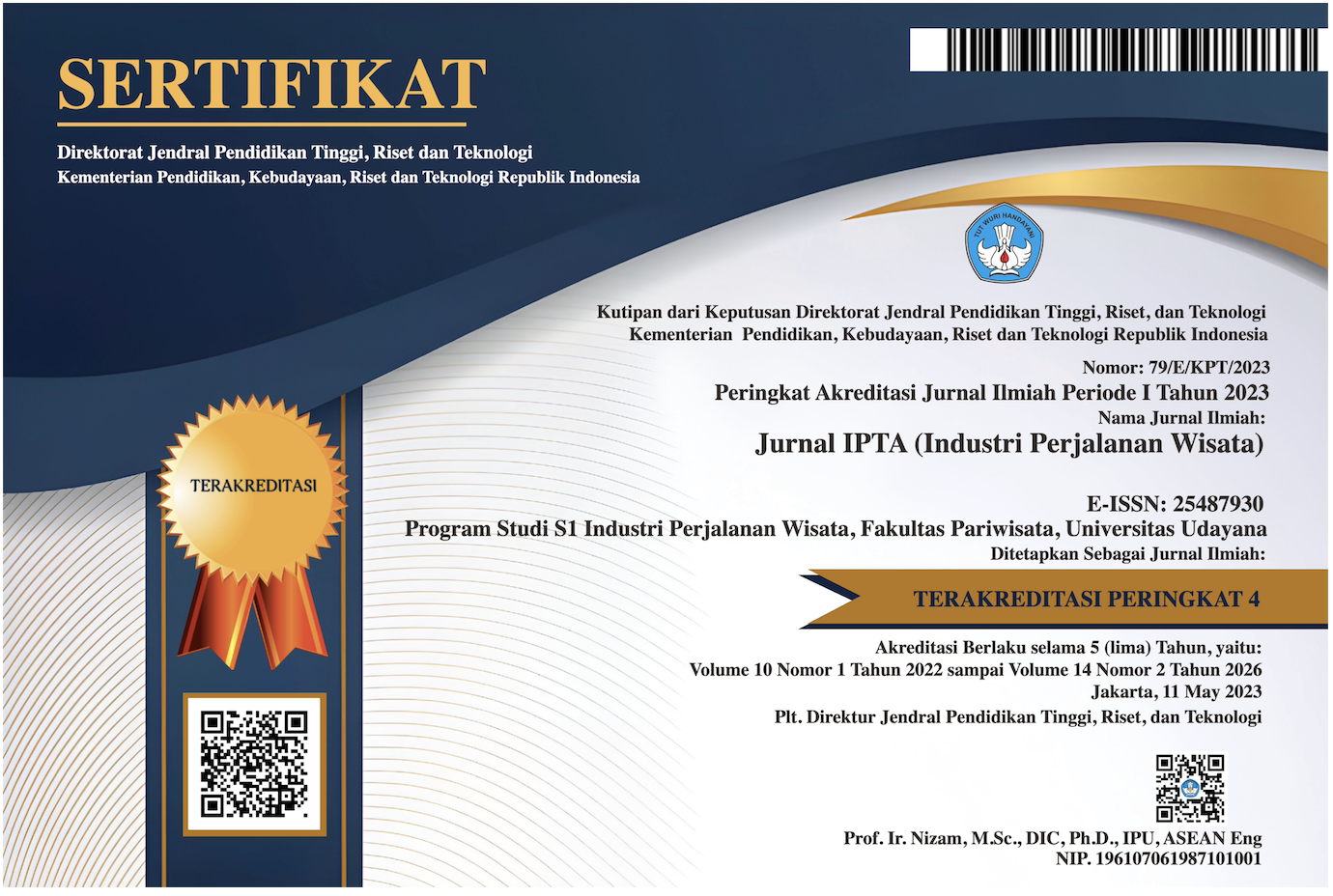
ACCREDITATION
JOURNAL INFORMATION
Author Guidelines and Template
ARTICLE TEMPLATE

| ISSN INFORMATION |
| TOOLS |

Plagiarism Detection Tool

Reference Management Tool

Jurnal IPTA (Jurnal Industri Perjalanan Wisata) recognizes the increasing use of generative artificial intelligence (AI) and AI-assisted technologies in academic research and scholarly publishing. To uphold academic integrity, research transparency, and publication ethics, the journal establishes the following policy governing the use of AI tools in manuscript preparation, submission, and peer review.
Generative AI tools, including ChatGPT, Gemini, DeepSeek, Claude, and other AI-assisted technologies, cannot be listed as authors or co-authors of a manuscript. Authorship requires substantial intellectual contribution, accountability for the work, and the ability to take responsibility for the integrity and accuracy of the research, which AI tools cannot fulfill.
Authors must transparently disclose the use of generative AI tools or AI-assisted technologies in the preparation of their manuscripts. Disclosure is required when AI tools are used for purposes including, but not limited to:
Language editing, proofreading, and manuscript refinement.
Literature review assistance, summarization, and research synthesis.
Data analysis, interpretation, or other analytical processes.
Image, figure, table, or other visual content generation.
Citation suggestions, reference identification, or bibliography assistance.
Development or refinement of research questions, conceptual frameworks, or manuscript structure.
The disclosure should identify the AI tool used, its purpose, and the extent of its contribution. Depending on the nature of the use, the disclosure should be included in the Acknowledgements or Methods section. Where relevant, authors should also follow the journal's submission instructions.
Example of disclosure:
“The authors used OpenAI’s ChatGPT to assist with language editing and refinement of the manuscript. All AI-generated outputs were critically reviewed and verified by the authors, who take full responsibility for the accuracy, originality, and integrity of the published work.”
If no generative AI tools were used in the preparation of the manuscript, no disclosure is required unless otherwise specified by the journal.
Authors remain fully responsible for the originality, accuracy, validity, and integrity of their manuscripts, regardless of whether AI tools have been used. All AI-generated or AI-assisted outputs must be carefully reviewed and verified by the authors before submission.
Authors must ensure that AI-assisted content does not introduce factual inaccuracies, unsupported claims, fabricated references, plagiarism, inappropriate paraphrasing, or misrepresentation of research findings. The use of AI does not diminish the authors' responsibility to comply with applicable research ethics, copyright requirements, and publication standards.
The following practices are strictly prohibited:
Fabrication, falsification, or manipulation of research data, findings, or evidence using AI tools.
Creation of fake citations, references, quotations, or other unverifiable scholarly sources.
Misleading manipulation or alteration of research images, figures, tables, or visual materials.
Use of AI-generated content to misrepresent originality, research contributions, authorship, or the actual conduct of research.
Plagiarism or other forms of academic misconduct involving AI-generated or AI-assisted content.
Any use of AI that violates research ethics, copyright, confidentiality, or applicable data protection requirements.
Violations of this policy may result in manuscript rejection, correction, retraction of a published article, or other appropriate actions in accordance with the journal's publication ethics procedures.
Peer reviewers must not upload or disclose submitted manuscripts, unpublished research findings, or confidential editorial correspondence to publicly accessible or unauthorized AI tools. Such practices may compromise manuscript confidentiality, intellectual property, and the integrity of the peer review process.
Peer reviewers must not use AI tools to evaluate manuscripts or generate peer review reports unless explicitly permitted by the journal's editorial team. Where AI use is authorized, reviewers must:
Obtain the required editorial permission before using AI tools.
Maintain the confidentiality of manuscripts and all associated materials.
Independently verify any AI-assisted analysis or suggestions.
Disclose their use of AI to the editor when required.
Retain full responsibility for the accuracy, fairness, objectivity, and content of their reviews.
Editors must also exercise appropriate judgment when using AI-assisted technologies and must protect confidential manuscript information throughout the editorial process.
Jurnal IPTA (Jurnal Industri Perjalanan Wisata) reserves the right to periodically review and update this policy in response to developments in AI technology, scholarly publishing practices, and internationally recognized publication ethics standards.
This policy draws on guidance and recommendations from the following organizations:
Elsevier, Generative AI Policies for Journals: https://www.elsevier.com/about/policies-and-standards/generative-ai-policies-for-journals
Committee on Publication Ethics (COPE): https://publicationethics.org/
Authors, reviewers, and editors are expected to comply with this policy to maintain the quality, credibility, and ethical standards of scholarly publications in Jurnal IPTA (Jurnal Industri Perjalanan Wisata).
ACCREDITATION
JOURNAL INFORMATION
Author Guidelines and Template
| ISSN INFORMATION |
| TOOLS |
Plagiarism Detection Tool
Reference Management Tool
Jurnal IPTA (Industri Perjalanan Wisata)
E-ISSN : 2548-7930 | P-ISSN : 2338-8633
Department of Tour and Travel Studies, Faculty of Tourism, Udayana University
 Licensed under a Creative Commons Attribution-ShareAlike 4.0 International License