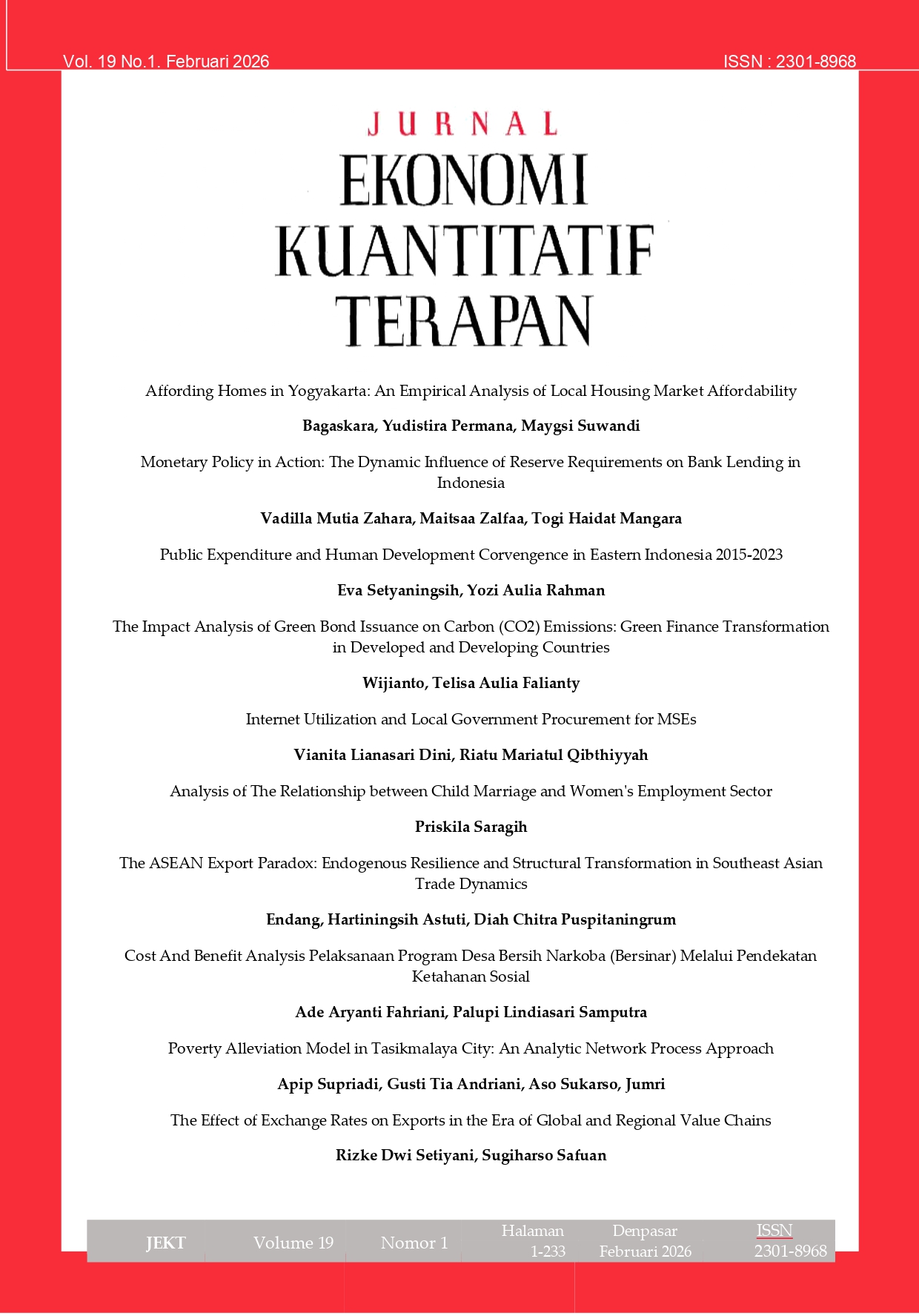
The ASEAN Export Paradox: Endogenous Resilience and Structural Transformation in Southeast Asian Trade Dynamics
DOI:
https://doi.org/10.24843/JEKT.2026.v19.i01.p07Keywords:
International trade, Economic integration, Export, VECM, ASEANAbstract
This study analyzes relationships between ASEAN exports and key macroeconomic variables (imports, GDP current prices, GDP per capita, inflation, FDI) during 2013-2022. Few studies have discussed this relationship using a Vector Error Correction Model approach with comprehensive panel data from all ASEAN member states. Results reveal that exports exhibit high endogeneity with 98.21% of variability explained by internal dynamics. This research identifies a temporal dichotomy where imports positively affect exports in the short-term but negatively in the long-term. We observe an "Economic Development Paradox" where GDP growth reduces export orientation as domestic markets strengthen. Granger causality tests confirm the export-led growth hypothesis for ASEAN economies. FDI functions as a structural catalyst with positive long-term effects on export performance. This study contributes methodologically through analysis that combines long-term equilibrium relationships with short-term adjustment mechanisms. These findings have implications for regional trade policy, highlighting the need for strategic FDI enhancement, balanced development approaches, and strengthened value chain integration to sustain ASEAN's competitiveness, which has not yet formed a fully integrated economic community.
Downloads
Published
Issue
Section
License
Copyright (c) 2026 Jurnal Ekonomi Kuantitatif Terapan

This work is licensed under a Creative Commons Attribution-NonCommercial 4.0 International License.

This work is licensed under a Creative Commons Attribution 4.0 International License.