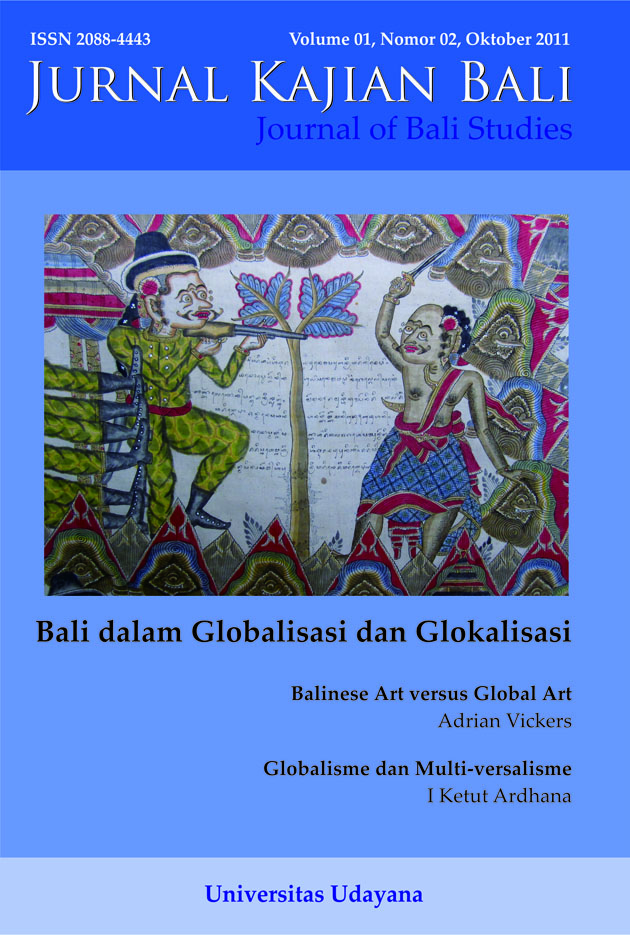
Balinese Art versus Global Art
Keywords:
art, tourism, historiographyAbstract
There are two reasons why “Balinese art” is not a global art form, firstbecause it became too closely subordinated to tourism between the 1950sand 1970s, and secondly because of confusion about how to classify“modern” and “traditional” Balinese art. The category of ‘modern’ artseems at first to be unproblematic, but looking at Balinese paintingfrom the 1930s to the present day shows that divisions into ‘traditional’,‘modern’ and ‘contemporary’ are anything but straight-forward. Indismantling the myth that modern Balinese art was a Western creation,this article also shows that Balinese art has a complicated relationship toIndonesian art, and that success as a modern or contemporary artist inBali depends on going outside the island.
Downloads
References
Arcana, Putu Fajar. 2009. “Teka-teki Nyoman Masriadi”, Kompas,
Minggu, 19 July.
Bakker, Wim. 1985. Bali Verbeeld. Delft: Vokenkundig Museum
Nusantara.
Bonnet, Rudolf. “Beeldende Kunst in Gianjar.” Djåwå 16 (1936):
59-72.
Clark, John. 1998. Modern Asian Art. Honolulu: University of
Hawaii Press.
______. 2007. “History of the Asian ‘New’: Biennales and
Contemporary Asian Art,” in Asian Art History in the
Twenty-First Century, ed. Vishakha N. Desai. New Haven:
Yale University Press.
Cooper, Thomas. 2005. Sacred Painting in Bali, Bangkok: Orchid
Press.
______. 2003. “Two Paintings Attributable to I Ketut Gede, 19th
Century Master Painter of North Bali.” Archipel 65: 145-61.
Couteau, Jean. 1999. Museum Puri Lukisan. Ubud: Ratna Wartha
Foundation.
Fisher, Joseph. 1990. “Problems and Realities of Modern Balinese
Art.” In Modern Indonesian Art. Three Generations of Tradition
and Change 1945-1990, ed. Joseph Fischer, 90-105, Jakarta and
New York: Panitia Pameran KIAS [1990-91] and Festival of
Indonesia.
Forge, Anthony. 1993. “Balinese Painting: Revivial or Reaction.”
In Modernity in Asian Art, edited by John Clark, pp. 18-28,
Sydney: Wild Peony.
Geertz, Hildred. 1994. Images of Power: Balinese Paintings Made for
Gregory Bateson and Margaret Mead (Honolulu: University of
Hawai’i Press.
______. 1991. “A Theater of Cruelty: The Context of a Topeng
Performance”. In State and Society in Bali: Historical, Textual,
and Anthropological Approaches, edited by H. Geertz, pp. 165-
197, Leiden: KITLV Press.
Geertz, Hildred, and Ida Bagus Madé Togog. 2005. Tales from a
Charmed Life: A Balinese Painter Reminisces, Honolulu:
University of Hawai’i Press.
Haks, F, Jop Ubbens, Adrian Vickers, Leo Haks and Guus Maris.
1999. Pre-War Balinese Modernists 1928-1942: An Additional
Page in Art History, Haarlem: Ars et Animatio.
Herlambang, Rustika. 2008. “Percakapan di atas Kanvas”, < http://
rustikaherlambang.wordpress.com/2008/08/11/i-nyoman-
masriadi/>, last read 22nd March 2011.
Hill, Christopher. 2006. Survival and Change: Three Generations of
Balinese Painters, Canberra: Pandanus Books.
Hinzler, H.I.R. 1983. “The Artist Behind the Drawings.” Indonesia
Circle 30, no. March (): 5-12.
______. 1986-1987. Catalogue of Balinese Manuscripts in the Library of
the University of Leiden and Other Collections in the Netherlands.
Part I, Reproductions of the Balinese Drawings from the Van Der
Tuuk Collection; Part II, Descriptions of the Balinese Drawings
from the Van Der Tuuk Collection 2 vols. Leiden: Brill.
Holt, Claire. 1967. Art in Indonesia: Continuities and Change, Ithaca
and London: Cornell University Press.
Marianto, M Dwi; Seng Yu Jin; and Wang Zineng. 2008. Masriadi:
Black Is My Last Weapon, Singapore: Singapore Art
Museum.
Northmore, Mary. 2001. Seniwati Gallery of Art by Women: The
First Ten Years, 1991-2001. Ubud: Seniwati Gallery of Art by
Women.
Moerdowo, R.M. 1977. Reflections on Balinese Traditional and Modern
Arts, Denpasar: Udayana University.
Sabapathy, T.K. 2010. Nyoman Masriadi: Reconfiguring the Body,
Singapore: Gajah Gallery.
Smith, Terry. 2009. What Is Contemporary Art? Chicago: University
of Chicago Press.
Soemantri et al. 2008. Ida Bagus Made: The Art of Devotion. Ubud:
Ratna Wartha Foundation.
Soemantri, Hilda (ed). 1998. Visual Art. Vol. 7, Indonesian Heritage,
Singapore: Archipelago Press, 1998.
Spanjaard, Helena. 2003. Modern Indonesian Painting. Meppel:
Sotherby’s.
Stutterheim, W. F. 1934. “Een Nieuwe Loot aan een Oude Stam.”
Elsevier’s Geillustreered Maandschrift XLIV (6): 391-400
Sukra, Wayan [Thomas Freitag]. 2006. Mangu Putra: Belief.
Surabaya: Rupa Galeri.
______. Triumph and Defeat/ Kemenangan Dan Kekalahan: 10 Tahun
Kelompok Galang Kangin. Yogyakarta: Griya Santrian Gallery,
Taman Budaya, 2006.
Sukra, Wayan and Vidyasuri Utami. 2006. The Paintings of Ni
Nyoman Sani. Yogyakarta: Cahaya Timur.
Supangkat, Jim. 2008. Legacy of Sagacity: The Case of Putu Sutawijaya,
Yogyakarta: Galeri Canna.
______. 2010. Ethnicity Now: Indonesian Contemporary Art by I Wayan
Bendi, I Made Djirna, Heri Dono, Nasirun, Samuel Indratama,
Angki Purbandono, Indieguerillas, and Yudi Sulitya, Jakarta:
Garisartspace.
Vickers, Adrian. 2009. “The Sanur School of Painting and Theo
Meier.” In Museum Pasifika: Selected Artworks of Asia Pacific,
edited by Philippe Augier and Georges Breguet, 33-39,
Singapore: Equinox.