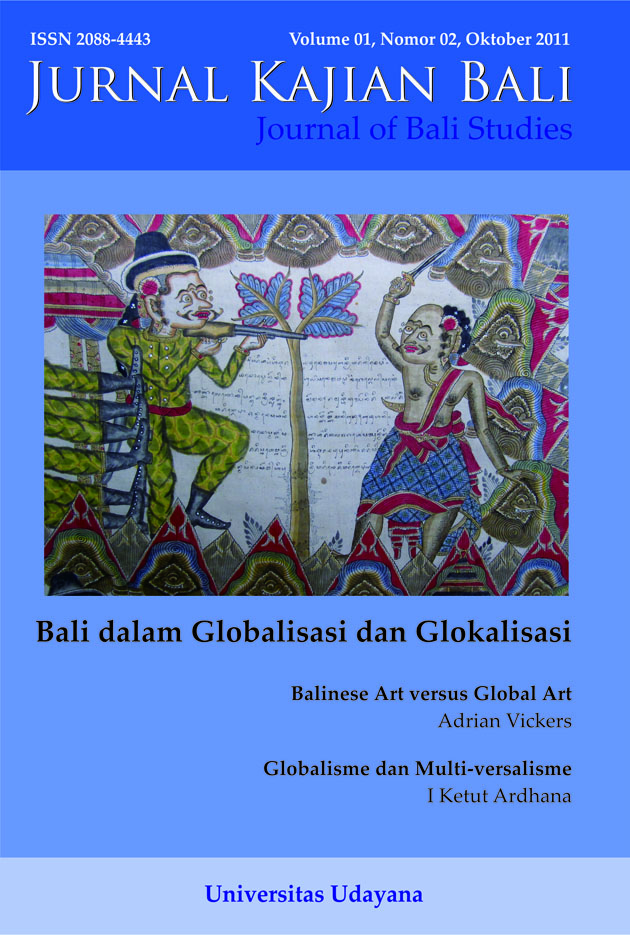
Global Kamasan
Keywords:
Kamasan, painting, traditional, contemporary, art, collectingAbstract
The painting tradition of Kamasan is often cited as an example of theresilience of traditional Balinese culture in the face of globalisation andthe emergence of new forms of art and material culture. This articleexplores the painting tradition of Kamasan village in East Bali and it’srelationship to the collecting of Balinese art. While Kamasan paintingretains important social and religious functions in local culture, thevillage has a history of interactions between global and local playerswhich has resulted in paintings moving beyond Kamasan to circulate invarious locations around Bali and the world. Rather than contribute to thedemise of a local religious or cultural practice, exploring the circulation ofpaintings and the relationship between producers and collectors revealsthe nuanced interplay of local and global which characterises the ongoingtransformations in traditional cultural practice.
Downloads
References
Agus Dermawan, T. 2006. Bali Bravo: Leksikon Pelukis Tradisional
Bali 200 tahun. Jakarta: Panitia Bali Bangkit.
Angelino, P de kat. 1921. “Over the smeden en eenige andere
ambachslieden op Bali” Tijdschrift voor Indische Taal-, Land-
en Volkenkunde, Deel 60 & 61.
Barley, Nigel. 2009. Island of Demons. Singapore: Monsoon Books.
Bullough, Nigel and Klot, Steven E. 1972. Bali: An Adventure
in Cultural Ecology / Hedendaagse Schilderkunst Van Bali.
Amsterdam: Kosmos and KIT.
Campbell, Siobhan. 2010. “Collector and Collected: Exploring
the Intercultural Nature of a Museum Collection.” TAASA
Review, 19(4).
Carpenter, Bruce W. 1997. W.O.J. Nieuwenkamp: First European
Artist in Bali. Singapore: Periplus Editions.
Cooper, Thomas. 2005. Sacred Painting in Bali. Bangkok: Orchid
Press.
Cooper, Thomas L. 2003. “Two Paintings Attributable to I Ketut
Gédé, 19th Century Master Painter of North Bali”, Archipel
(65).
Covarrubias, Miguel. 1937. Island of Bali. New York: Knopf.
Dwikora, Putu Wirata. 2001. “Balinese Society and Contemporary
Arts” in Bali, Living in Two Worlds: A Critical Self-Portrait,
eds. Urs Ramseyer, Rama Surya and I. Gusti Raka Panji
Tisna. Basel: Museum der Kulturen; Schwabe.
Forge, Anthony. 1978. Balinese Traditional Paintings: A selection from
the Forge Collection of the Australian Museum, Sydney. Sydney:
Australian Museum.
Friend, Donald. 2006. The Diaries of Donald Friend. Canberra:
National Library of Australia.
Galestin, Theodoor Paul. 1962. Hedendaagse Kunst van Bali. Utrecht:
Centraal Museum.
Geertz, Hildred. 2004. The Life of a Balinese Temple: Artistry,
Imagination, and History in a Peasant Village. Honolulu:
University of Hawaii Press.
Geertz, Hildred. 2005. Tales from a Charmed life: A Balinese Painter
Reminisces. Honolulu: University of Hawai’i Press.
Gunarsa, I Nyoman. 2009. “Nyoman Mandra - The Master of
Classical Balinese Painting” in Retrospective I Nyoman
Mandra, Griya Santrian Gallery, Sanur, Bali.
Hinzler, H. I. R. 1986. Catalogue of Balinese manuscripts in the
Library of the University of Leiden and other collections in the
Netherlands. Leiden, The Netherlands: Leiden University
Press.
Hobart, Angela. 1990. “The Enlightened Prince Sutasoma:
Transformations of a Buddhist Story.” Indonesia (49).
Hooykaas, C. 1971. “Pamurtian in Balinese Art.” Indonesia (12).
Kayam, Umar. 1990. “From Nyoman Mandra to Ivan Sagito: The
Continuous Quest for Style and Form in Indonesian Art”
in Modern Indonesian Art, Three Generations of Tradition and
Change, ed. Joseph Fischer. Jakarta.
Mann, Richard. 2006. Classical Balinese Painting, Nyoman Gunarsa
Museum, Klungkung, Bali. Nyoman Gunarsa Museum of
Classical Balinese Painting in collaboration with Gateway
Books International.
Marrison, G.E. 1995.
Mrazek, Jan. 2008. “Ways of Experiencing Art: Art History,
Television, and Javanese Wayang” in What’s the use of art?:
Asian visual and material culture in context, eds. Jan Mrazek
and Morgan Pitelka. Honolulu: University of Hawai’i
Press.
Myers, Fred R. 2001. “Introduction” in The Empire of Things:
Regimes of Value and Material Culture, ed. Fred R. Myers.
Santa Fe: Oxford: James Currey.
Parta, I Wayan Seriyoga. 2011. Fragments of Subconscious Memory:
A Solo Exhibition by Teja Astawa, Tony Raka Art Gallery. Mas,
Ubud, Bali.
Pucci, Idanna. 1992. Bhima Swarga. Boston: Little, Brown & Co.
Sarojini. 2010. Concealed Secrets in the Museum Buildings of Ubud
Bali. ???
Taylor, Alison. 1991. Living Traditions in Balinese Painting. Peliatan,
Ubud, Bali: Agung Rai Gallery of Fine Art.
Vickers, Adrian. 1982. “A Balinese Illustrated Manuscript of the
Siwaratrikalpa.” Bijdragen tot de Taal-, Land- en Volkenkunde
138(4).
Vickers, Adrian. 2005. Journeys of desire : a study of the Balinese text
Malat. Leiden: KITLV Press.
Vickers, Adrian. 2009. “I Nyoman Mandra: Guardian of Tradition,
Master of Innovation” in Retrospective I Nyoman Mandra,
Griya Santrian Gallery. Sanur, Bali.
Wiener, Margaret J. 1995. Visible and Invisible Realms: Power, Magic,
and Colonial Conquest in Bali. Chicago: University of Chicago
Press.
Worsley, Peter. 1984. “E74168.” Review of Indonesian and Malaysian
Affairs (18).
Wulff, Inger. 2002. “Early Indonesian Collections in Copenhagen.”
In Treasure Hunting? Collectors and Collections of Indonesian
Artefacts, eds. Reimar Schefold and Han Vermeulen. Leiden:
CNWS Publications.