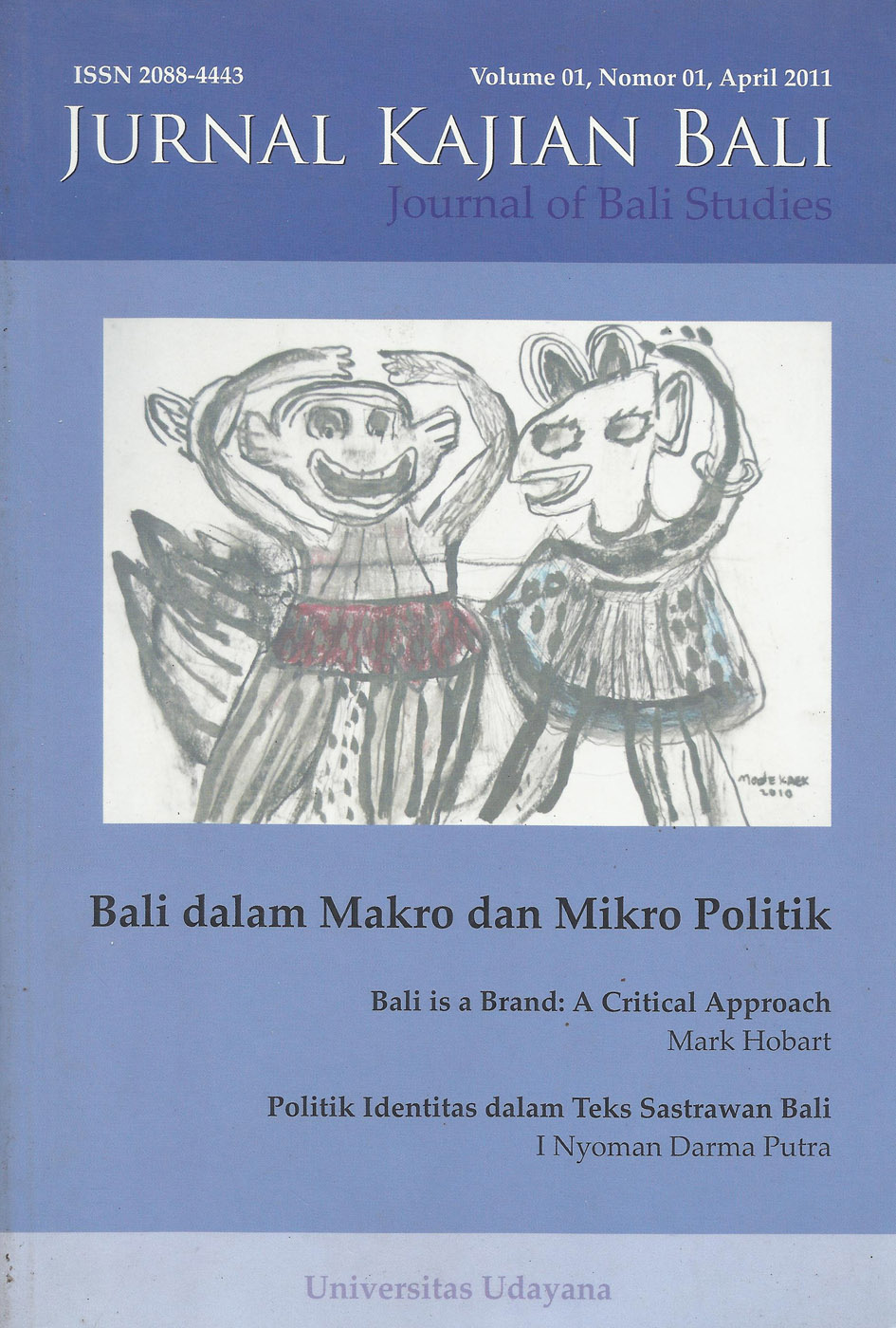
Getting the Story Straight? Some Untimely Thoughts on History, Literature and the Performing Arts in Bali
Keywords:
Performing Arts, Topéng, History, Power, Literature, LanguageAbstract
Sudah cukup jelas bahwa ada hubungan mendalam antara seni pertunjukandan kesusastraan Bali. Yang mungkin masih kurang jelas adalah karakter darihubungan tersebut. Para penulis akademis maupun nonakademis seringkalimenekankan pentingnya sastra kuno India dan cerita babad untuk lakon wayangkulit, arja, topéng dan lain sebagainya. Walaupun ahli seni pertunjukan dariluar negeri kerapkali menekankan pentingnya sastra kuno, di mana sebenarnyamereka tidak mempunyai latar belakang yang kuat di bidang bahasa lokal dansastra kuno, mereka jarang sekali mengomentari masalah seni pertunjukan.Memang ada beberapa pengecualian yang penting. Akan tetapi, pada umumnya,itulah keadaan yang terjadi sekarang di bidang studi seni pertunjukan. Artikel inimenggunakan contoh dari sebuah pertunjukan topéng pajegan untuk menyarankanbahwa kita perlu memperhatikan sejarah, bahasa dan sastra lokal secara lebihbernuansa. Pendekatan seperti ini mungkin akan lebih sensitif terhadap sisipolitik—baik dari seni pertunjukan Bali maupun dari proses pengajarannya.
Downloads
References
Bali Post. 2006a. ‘Dari Silayukti; Umat Hindu Diingatkan Laksanakan
Ajaran Kebenaran’. Bali Post. http://www.balipost.co.id/
balipostcetak/2006/4/26/bd1.htm
Bali Post. 2006b. ‘Pura Silayukti; Pasraman Mpu Kuturan’. Bali Post.
http://www.balipost.co.id/balipostcetak/2006/4/26/bd2.htm
Bandem, I.M. and deBoer, F.E. 1995. Balinese Dance in Transition;
Kaja and Kelod. Kuala Lumpur: Oxford University Press.
Bateson, G. 1973 [1949]. ‘Bali: The Value System of a Steady State’.
In Steps to an Ecology of Mind. London: Paladin.
Becker, A.L. 1979. ‘Text-Building, Epistemology, and Aesthetics in
Javanese Shadow Theater’. In A.L. Becker and A. Yengoyan
(eds.), The Imagination of Reality: Essays in Southeast Asian
Coherence Systems, pp. 211-243. New Jersey: Ablex Publishing
Corporation.
Bhadra, I W. 1937. ‘Het “Mabasan” of de Beoefening van het Oud-
Javaansch op Bali’. Mededeelingen van de Kirtya Liefrinck-van
der Tuuk V, supplement. Soerabaya: Bijlage.
Butler, J. 1993. Bodies That Matter: On the Discursive Limits of ‘Sex’.
New York and London: Routledge.
Coldiron, M. 2004. Trance and Transformation of the Actor in Japanese
Noh and Balinese Masked Dance-Drama. Lewiston, Queenston,
Lampeter: The Edwin Mellen Press.
Emigh, J. 2008. ‘Culture, Killings, and Criticism in the Years of Living
Dangerously: Bali and Baliology’. The Cambridge Companion to
Performance Studies. Davis, T.C. (ed.). Cambridge: Cambridge
University Press, pp. 60-75.
Finkelstein, A. 2000. Harmony and the Balance: An Intellectual History
of Seventeenth-Century English Economic Thought. Ann Arbor:
University of Michigan Press.
Foley, K. and I.N. Sedana. 2005. ‘Balinese Mask Dance from the
Perspective of a Master Artist: I Ketut Kodi on “Topeng”’.
Asian Theatre Journal. 22(2): 199-213.
Fox, R. 2003. ‘Substantial Transmissions: A Presuppositional
Analysis of “the Old Javanese Text” as an Object of
Knowledge, and its Implications for the Study of Religion in
Bali’. Bijdragen tot de Taal-, Land- en Volkenkunde, 159(1): 65-
107.
Fox, R. 2005. ‘Plus ça change... Recent Developments in Old
Javanese Studies and their Implications for the Study of
Religion in Contemporary Bali’. Bijdragen tot de Taal-, Land- en
Volkenkunde, 161(1).
Fox, R. Critical Reflections on Religion and Media in Contemporary Bali.
Numen Book Series: Studies in the History of Religions, 130.
Leiden: Brill.
Geertz, H. 1991. ‘A Theatre of Cruelty: The Contexts of a Topeng
Performance’. In H. Geertz (ed.) State and Society in Bali. Leiden:
Koninklijk Insituut Voor Taal-, Land- En Volkenkunde.
Geertz, H. 1994. Images of Power: Balinese Paintings Made for Gregory
Bateson and Margaret Mead. Honolulu: University of Hawaii
Press.
Hinzler, H. I. R. 1981. Bima Swarga in Balinese Wayang. The Hague:
Martinus Nijhoff.
Hobart, M. 2000. After Culture: Anthropology as Radical Metaphysical
Critique. Yogyakarta, Indonesia: Duta Wacana University
Press.
Hobart, M. 2002. ‘Live or dead? Televising theatre in Bali’. In:
Ginsburg, F., Abu-Lughod, L. and Larkin, B. (eds.). Media
Worlds: Anthropology on New Terrain. Berkeley, Los Angeles,
London: University of California Press, pp. 370-382.
Hobart, M. 2008. The Prince of Nusa’s Vow: a Balinese Arja-Prèmbon
Play. http://www.criticalia.org/Theatre_Plays.htm
Hunter, T. 1988. Balinese Language: Historical Background and
Contemporary State. Unpublished doctoral dissertation.
University of Michigan.
Jendra, I.W. 1996. ‘Kedwibahasaan Bahasa Bali dan Bahasa Indonesia
dalam Aktivitas Seni Mabebasan di Bali.’ Unpublished
doctoral dissertation. Universitas Gadjah Mada.
Jenkins, R. 1978. ‘Topeng: Balinese Dance Drama.’ Performing Arts
Journal. 3(2): 39-52.
Juniartha, I.W. 2001. ‘Balinese Hinduism on the Brink of Violent
Conflict’. December 27, 2001. The Jakarta Post.
Mahmood, S. 2005. The Politics of Piety: The Islamic Revival and the
Feminist Subject. Princeton: Princeton University Press.
Robson, S.O. 1972. ‘The Kawi Classics in Bali’. Bijdragen tot de Taal-,
Land- en Volkenkunde. 128: 308-329.
Rubinstein, R. 1993. ‘Pepaosan: Challenges and Change’. In
D. Schaareman (ed.) Balinese Music in Context: A Sixty-
Fifth Birthday Tribute to Hans Oesch, pp. 85-113. Forum
Ethnomusicologicum 4. Winterthur: Amadeus.
Rubinstein, R. 2000. Beyond the Realm of the Senses; The Balinese Ritual
of Kekawin Composition. Leiden: Koninklijk Insituut Voor Taal-
, Land- en Volkenkunde.
Spies, W. and B. de Zoete .2002 [1938]. Dance and Drama in Bali.
Singapore: Periplus Editions.
Sudharta, T.R. and I.W. Surpha. 2006. Parisada Hindu Dharma dengan
Konsolidasinya. Surabaya: Pāramita.
Swellengrebel, J.L. 1960. ‘Introduction’. In W.F. Wertheim et al.,
eds. Bali: Studies in Life, Thought, and Ritual. The Hague: W.
van Hoeve; pp.77-100.
Vickers, A. 1990. ‘Balinese Texts and Historiography’. History and
Theory. 29: 158-178.
Vickers, A. 2005. Journeys of Desire: A Study of the Balinese Text Malat.
Verhandelingen Van Het Koninklijk Instituut Voor Taal-,
Land- en Volkenkunde. Leiden: KITLV.
Wiener, M.J. 1995. Visible and Invisible Realms; Power, Magic, and
Colonial Conquest in Bali. Chicago: University of Chicago
Press.
Young, E. 1980. Topeng in Bali: Change and Continuity in a Traditional
Drama Genre. Unpublished doctoral dissertation. University
of California at San Diego.
Zoetmulder, P.J., with S.O. Robson. 1982. Old Javanese-English
Dictionary. Two volumes. ’s-Gravenhage: Nijhoff.
Zurbuchen, M.S. 1989. ‘Internal Translation in Balinese Poetry’.
In A.L. Becker, ed. Writing on the Tongue. Michigan papers
on South and Southeast Asia, number 33. USA: Ann Arbor,
Center for South and Southeast Asian Studies.