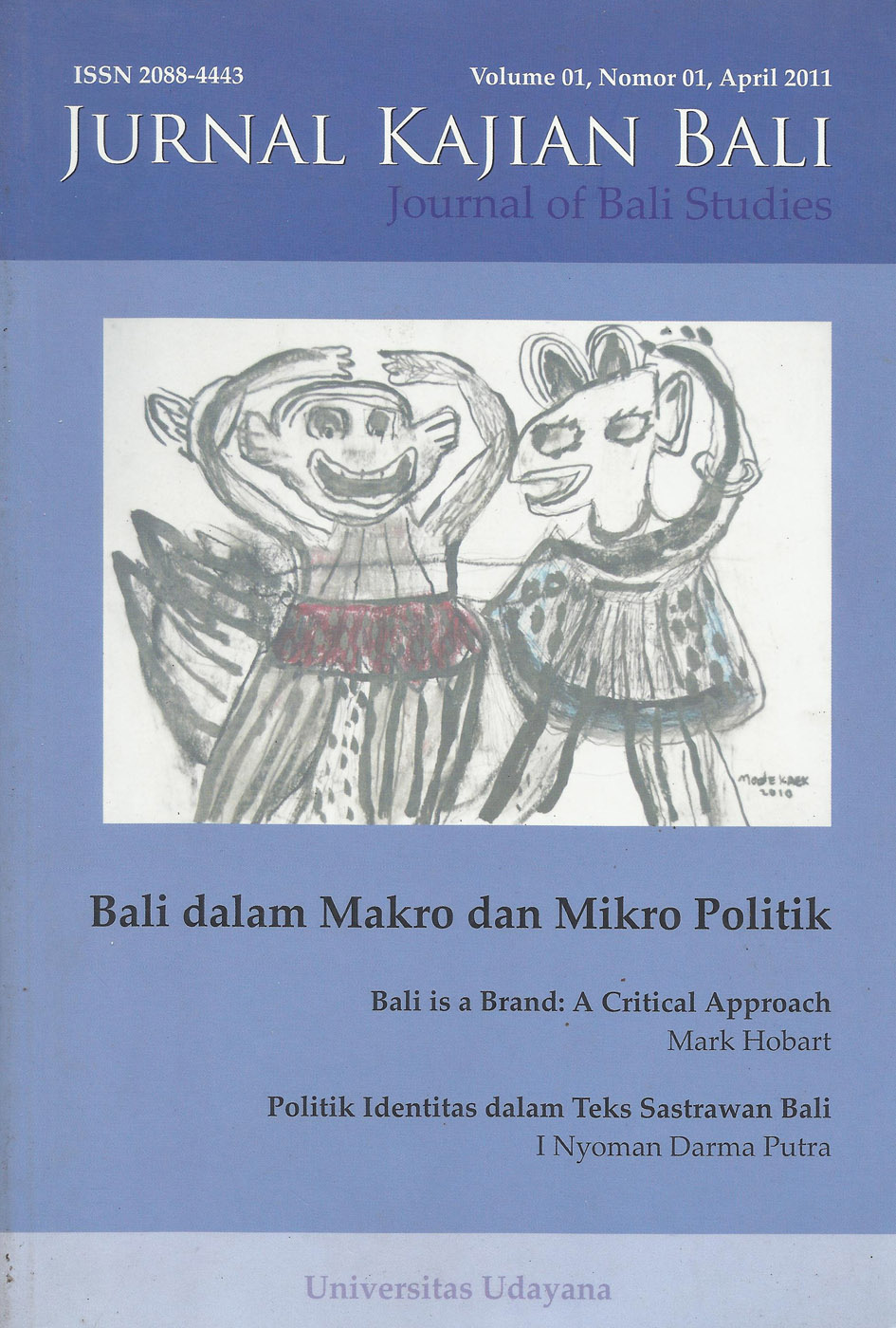
Bali is a Brand: A Critical Approach
Keywords:
Bali, Branding, Kebudayaan sebagai Komoditi, Teori Konsumsi, DiscourseAbstract
Kajian kebudayaan Bali kebingungan oleh karena yang dimaksudkan dengan ‘kebudayaan’ sangat kurang terang. Apakah kebudayaan merupakan esensi atau jiwa orang Bali, suatu gagasan politik yang direkayasa oleh Orde Baru, atau cara menjual seni pertunjukan, barang atau pengalaman kepada wisatawan? Jarang disadari di Indonesia bahwa Bali terkenal di Eropa sebelum Pulau Bali ditemukan oleh pelaut Barat yang sedang mencari sorga di dunia ini. Sejarah Bali tidak bisa dipisahkan dari khayalan orang Barat. Dilihat dari pandangan cultural studies, dari awal Bali merupakan ‘brand’ untuk dipasarkan – dan objek yang dijual adalah kebudayaan. Untuk mengerti apa yang sedang terjadi di Bali, perlu dipahami teori konsumsi dan branding. Walaupun kelihatannya yang dijual dan dibeli adalah barang atau pengalaman, sebenarnya yang dikonsumsi adalah perbedaan. Artikel ini menawarkan pemahaman mendalam mengenai hukumhukum branding dari sudut pandang kajian budaya. Kata Kunci: Bali; Branding; Kebudayaan sebagai Komoditi; Teori Konsumsi; Discourse.
Downloads
References
Adorno, T. & Horkheimer, M. [1944] 1993. The culture industry:
enlightenment as mass deception. In The cultural studies
reader. ed. S. During, London: Routledge.
Barkin, G. 2006.The foreignizing gaze: producers, audiences and
the symbols of the ‘Traditional’. Entertainment media in
Indonesia. eds. M. Hobart & R. Fox. special issue of Asian
journal of communication, 16, 4: 352-370..
Barthes, R. 1973. Myth today. In Mythologies. trans. A. Lavers,
London: Paladin.
Baudrillard, J. 1970. La société de consommation. Paris: Gallimard.
______. 1988. The system of objects. In Jean Baudrillard: selected
writings. ed. M. Poster, trans. J. Mourrain, Oxford: Polity.
______. 1990. Seduction. trans. B. Singer, New York: St. Martin’s
Press.
Baulch, E. 2007. Making scenes: reggae, punk, and death metal in 1990s
Bali. London: Duke Univ. Press.
Boeke, J.H. [1930] 1966. Dualistic economics. In Indonesian economics:
the concept of dualism in theory and policy. The Hague: van
Hoeve.
Boon, J.A. 1977. The anthropological romance of Bali 1597-1972:
dynamic perspectives in marriage and caste, politics and religion.
Cambridge: Univ. Press.
Fabian, J. 1991. Culture, time and the object of anthropology. In
Time and the work of anthropology. New York: Harwood.
Fiske, J. 1987. Television culture. London: Methuen.
Fox, R. forthcoming. Of Ajeg and Agama: history and the mediation of
Bali’s recent past.
Goldenweiser, A. 1936. Loose ends of a theory on the individual
pattern and involution in primitive society. In Essays in
anthropology presented to A.L Kroeber. ed. R. Lowie, Berkeley:
Univ. of California Press.
Goodman, N. Languages of art. Indianapolis: Bobbs-Merrill.
Gramsci, A. 1971a. The study of philosophy. In Selections from the
prison notebooks of Antonio Gramsci. eds. & trans. Q. Hoare &
G. Nowell Smith, London: Lawrence &Wishart.
______. 1971b. Critical notes on an attempt at popular sociology.
In Selections from the prison notebooks of Antonio Gramsci. eds.
& trans. Q. Hoare & G. Nowell Smith, London: Lawrence
&Wishart.
Heisenberg, W. 1958. Physics and philosophy: the revolution in modern
science. New York: Harper, 1958.
Hobart, M. 2000. After culture. anthropology as radical metaphysical
critique. Yogyakarta: Duta Wacana Press; freely accessible
online at http://www.criticalia.org/Books.htm.
______. 2005. The profanity of the media. In Media Anthropology.
Eds. E. Rothenbuhler & M. Coman, London: Sage.
______. 2006. Just talk? anthropological reflections on the object of
media studies in Indonesia. Asian journal of social science 34,
3: 492-519.
______. 2007. Rethinking Balinese dance. in M. Cohen, A. Lopez
y Royo and L. Nozlopy, Indonesian performing arts in a
transnational context, special issue of Indonesia and the Malay
World, 35: 107-28.
Hobsbawm, E.J. & Ranger, T. eds. 1983. The invention of tradition.
Cambridge: Univ. Press.
Karatani, K. 1998. Uses of aesthetics: after Orientalism. trans. S.
Kohso Boundary 25, 2: 145-160
Krause, G. 1920. Bali: Volk, Land, Tanze, Feste, Temple. Hagen:
Folkwang.
Laclau, E. & Mouffe, C. 1985. Hegemony and socialist strategy:
towards a radical democratic politics. trans. W. Moore & P.
Cammack, London: Verso.
Lury, C. 2004. Brands: the logos of the global economy. London:
Routledge.
Picard, M. 1996. Bali: cultural tourism and touristic culture. trans. D.
Darling, Singapore: Archipelago Press.
______. 1999. The discourse of Kebalian: transcultural constructions
of Balinese identity. In Staying local in the global village: Bali
in the twentieth century. eds. R. Rubinstein & L. Connor.
Honolulu: Univ. of Hawai’i Press.
Raffles, T.S. 1817. The History of Java. Vol. 2.
Reis, A. & Reis, L. 2003. The 22 immutable laws of branding. London:
Profile Books.
Santikarma, D. 2003. Bali erect. Latitudes. 43: 13-17.
Simmel, G. [1907] 1990. The philosophy of money. trans. T. Bottomore
& D. Frisby, London: Routledge.
Tylor, E.B. 1871. Primitive culture: researches into the development of
mythology, philosophy, religion, art and custom. London: John
Murray.
Vickers, A. 1989. Bali: a paradise created. Berkeley, CA.: Periplus.
Widjaja, N.M. 2008. About Bali environment. The Jakarta Post.
Wednesday, 7th. May 2008.
Wijaya, M., Pemayun, C.O. & Raka, G.P. 1981. Bali’s art centre, Wedi
Budaya, and the annual festival of the arts. Denpasar: Dipardi
Bali.
Williams, R. 1983. Keywords: a vocabulary of culture and society.
London: Flamingo.