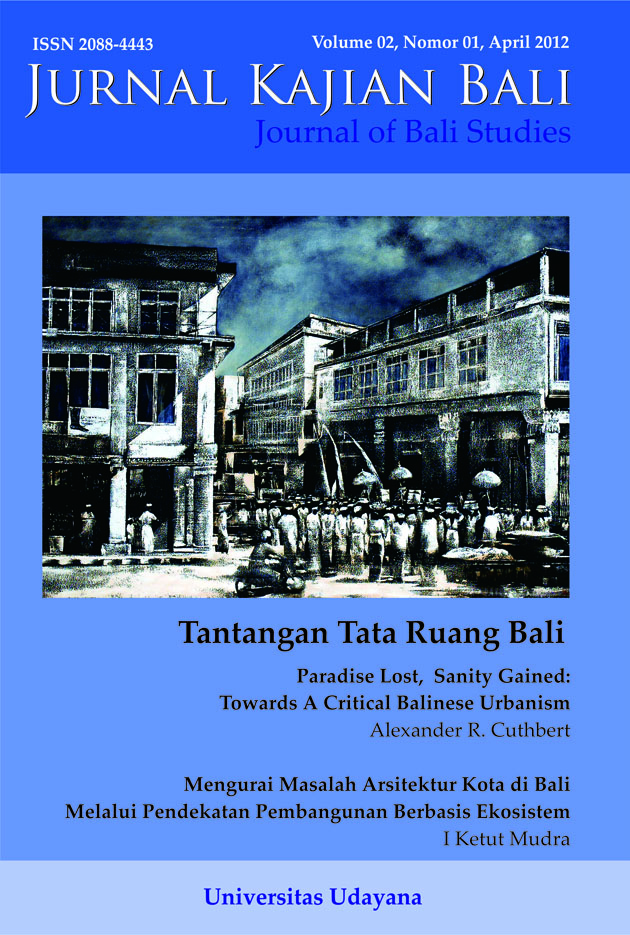
Paradise Lost, Sanity Gained: Towards a Critical Balinese Urbanism
Keywords:
Paradise, culture, globalization, corruption, vernacular, the New UrbanismAbstract
Bali is a global tourist destination having had the added descriptor paradise for most of the last century. But it is now transparent to most visitors that serious problems prevail across the entire local economy and built environment. The incoherence of development is largely to blame. Given the failure to generate a new Balinese architecture that matches the integrity of the old, Balinese urbanists are now caught in a Gordian knot where a unified traditional architecture remains, yet a new architecture is not forthcoming. How to untie the knot is the question. Architecture suffered major discontinuity when traditional building was largely abandoned in the face of progressive urbanization. The problem remains unresolved. The following paper represents a preliminary attempt to expose key issues. It suggests methods of moving forward. But a new momentum demands a new philosophy in the realm of urban theory, the foundation of all professional activity. No significant progress can take place without it. My attention is therefore directed to answering the question how can the transition be made from traditional Balinese architecture emerging from the dynamics of feudalism, to its conscious translation and accommodation within post-modernity, informational capitalism, and globalization? While the problem needs tackled at several levels – education, policy, strategy and enforcement, I suggest in conclusion that these should be framed within generic principles derived from vernacular transformations, a culture of critical Balinese regionalism, and an adaptation of the New Urbanist lexicon to a tropical environment.
Downloads
References
Aditjondro G. J. 2000. Chopping the global tentacles of the Suharto
oligarchy: Can Aotearoa (New Zealand) Lead The Way? http://
www.unhas.ac.id/rhiza/arsip/arsip-macam2/gja1.html
Aditjondro G.J. 1995. Bali, Jakarta’s colony: social and ecological
impacts of Jakarta – based conglomerates in Bali’s tourism
industry: Working Paper No 58. Asia Research Centre: Murdoch
University.
Aditjondro, G.J. 2007. Soeharto’s Bali Hotels and Travel agents. http://
bali-hotels-villas.blogspot.com/2007/07/suhartos-bali-hotels-
travel-agents.html.
Aditjondro, G.J. 2008. Balinese identity as tourist attraction. Tourist
Studies. Aug 8:155-173.
Aditjondro, G.J. 1997. The struggle for democratic rights in the
Asian Pacific. http://www.focusweb.org /publications/1997/
Struggle%20fro%20democratic%20rights.htm
Al Hindi, K. F. and Staddon, C. 1997. The hidden histories and
geographies of neo-traditional town planning: the case of
Seaside, Florida. Environment and Planning D: Society and Space,
15(3)349-372.
Anderson, B. 1988. Cacique Democracy in the Philippines: Origins and
Dreams. The New Left Review.1/169 May/June
Anderson, B. 1998. Exit Suharto - Obituary for a Mediocre Tyrant. The
New Left Review 50. March-April.
Armesto, F. 2002. Truth: A History and a Guide for the Perplexed. London.
St. Martin’s Press.
Audirac, I. and Shermyen, A. H. 1994. An evaluation of neo-traditional
design’s social prescription: postmodern placebo or remedy for
suburban malaise? Journal of Planning Education and Research. 13
(3)161-173.
Banai, R. 1996. A theoretical assessment of ‘neotraditional’ settlement
form by dimensions of performance. Environment and Planning
B: Environment and Design, 23(2) 177-190.
Boughton, R. 2012. Bali’s Dickensian Workers. Bali Post V8:18 p 2.
Brower, S. 2002. The sectors of the transect. The Journal of Urban Design
7(3) 313-320.
Castells, M. 1977. The Urban Question. London: Arnold.
Celik, Z and Favro, D. 1988. Methods of Urban History: Journal of
Architectural Education Vol. 41, No. 3. pp. 4-9.
Connell, J. 1993. Bali revisited: Death, rejuvenation and the Tourist
Cycle. Society and Space.11: 641-881.
Covarrubias, M. 1936. The Island of Bali. New York: A Knopf.
Cribb, R. (ed.) 1990. The Indonesian Killings of 1965-66. Clayton: Monash
University.
Cuthbert, A.R. 1986. Architecture, Society and Space. London:
Pergamon.
Cuthbert, A.R. 2003 (ed). Designing Cities – Critical Readings in Urban
Design. Oxford: Routledge.
Cuthbert, A.R. 2006. The Form of Cities – Political Economy and Urban
Design Oxford: Blackwell.
Cuthbert, A.R. 2007. Requiem for an era. The International Journal of
Urban Design (12:4, whole issue).
Cuthbert, A.R. 2011. Understanding Cities: Method in Urban Design.
Oxford: Routledge.
Cuthbert, A.R. 2012a. Vernacular transformations - context, issues,
debates. Chapter 1 in Vernacular Transformations. Culture, Evolving
Tradition: Vernacular architecture, Society and Place. Udayana
University Press Bali. G.A.M. Suartika (ed). In Press.
Cuthbert, A. R. 2012b. Paradise lost, reality regained – towards a critical
Balinese urbanism. (This issue)
De Quincy, T. 2003. Confessions of an English Opium eater. London: Penguin
(orig. 1821)
De Zoete, Beryl and Spies, W. 1938. Dance and Drama in Bali. London:
Faber and Faber.
Duany, A. 2002. Introduction to the special issue: the transect. The
Journal of Urban Design. 7(3) 251-260.
Duany, A. 2000. A new theory of urbanism. The Scientific American,
283(6) 90-91.
Engels, F. 1973 (orig 1892). The Condition of the Working Class in England.
Lawrence and Wishart: London.
Falconer, A.K. 2001. The new urbanism: where and for whom?
investigation of a new paradigm. Urban Geography, 22(3) 202-
219.
Frampton, K. 1983. Towards a critical regionalism – six points for
an architecture of resistance. In The Anti- Aesthetic: Essays on
Postmodern Culture. Hal Foster (ed) Port Townsend: Bay Press.
Frampton, K. 1988. Place- form and cultural identity. In John Thackara
(ed) Design after Modernism Chapter 3.London: Thames and
Hudson.
Geddes, P. 1997 (orig 1915). Cities in Evolution: An Introduction to the Town
Planning Movement and the Study of Civics. London: Routledge.
Geertz,C. 1980. Nagara. The Theatre State in 19th Century Bali. Princeton:
Princeton U.P.
Godelier, M. and Thom, M.1986. The Mental and the Material – Thought,
Economy and Society. London, Verso.
Haas, T. 2008. The New Urbanism and Beyond. New York NY: Rizzoli.
Hall, E. T. 1959.The Silent Language. New York: Doubleday.
Harvey D. 1989. The Condition of Postmodernity. Oxford: Blackwell.
Harvey, D. 1973. Social Justice and the City. London. Arnold.
Henry, M. 2011:How to Retire in Bali: and Live in Paradise.
Hobart, A., Ramseyer, U., and Leeman., A. 1996. The Peoples of Bali.
Oxford: Blackwell.
Hobart, M. 2002. Welcome to Criticalia. (Web page devoted to critical
discussion)
Holland, P. 1993. No higher than a coconut tree. Controls on tourist
development on the Bali foreshore. Faculty of Business Working
Papers. Swinbourne University.
http://www.unhas.ac.id/rhiza/arsip/arsip-macam2/gja1.html
Huxley, A. 1953. The Doors of Perception- Heaven and Hell. London:
Harper Collins.
Jencks, C. 1977. The Language of Postmodern Architecture. London:
Academy.
Karazija, V. 2012: Bali as Jakarta’s cash cow. Bali Times. July 6-12 p. 2.
Katz, P. 1994. The New Urbanism. New York: McGraw Hill.
Kitchen, P. 1975. A Most Unsettling Person: an Introduction to the Ideas
and Life of Patrick Geddes. London: Gollancz.
Kusno, A. 2010. The Appearances of Memory. Mnemonic Practices of
Architecture and Urban Form in Indonesia. Duke University Press:
Durham and London
Kusno, A. 2000. Behind the Postcolonial 2000.
Le Corbusier. 1980: Modulor 1 and Modulor 2. Cambridge, MA: Harvard
University Press.
Lewis J. and Lewis L. 2009. Bali’s Silent Crisis: Desire, Tragedy, and
Transition.
Macrae, G. and Parker, S. 2000. Would the Real Undagi Please Stand Up?
On the Social Location of Balinese architectural Knowledge.
Marx, K. and Engels, F. 1999 (orig. 1872). The Communist Manifesto with
Related Documents. Boston: Bedford St. Martins.
McHarg, I. 1969. Design with Nature. NY: Natural History Press.
Mehr, N. 2009. Constructive Bloodbath in Indonesia: The United States, Great
Britain and the Mass Killings of 1965-1966: London: Spokesman
books.
Mumford, L. 1961. The City in History. New York: Harcourt, Brace and
Jovanovitch.
Nordholt, H. S. 1986. Bali- Colonial Conceptions and Political Change1700-
1940. Rotterdam: Erasmus University Press.
Nordholt, H.S. 1996. The Spell of Power: A History of Balinese Politics.
Leiden. KITLV Press.
Nordholt, H.S. 2008. Bali- an Open Fortress, 1995-2005: Regional
Autonomy, Electoral Democracy and Entrenched Identities.
Nordholt, H.S. 1991. State. Village and Ritual in Bali. Amsterdam: VU
University Press.
Picard, M. 1996. Bali- Cultural Tourism and Touristic culture. Singapore:
Archipelago Press.
Picard, M. 2010. Balinese identity as tourist attraction: From `cultural
tourism’ (pariwisata budaya) to `Bali erect’ (ajeg Bali) Tourist
Studies. 2008 8: 155. Online at http://tou.sagepub.com/
content/8/2/155
Plato.orig 380 BC. The Republic. London: Simon and Brown. 2012.
Pringle, R. 2004. A Short History of Bali. Allen and Unwin: Sydney.
Robinson, G. 1995. The Dark Side of Paradise: Political Violence in Bali.
Ithaca: Cornell University Press.
Sayer, A. 1984. Method in Social Science. London: Hutchison.
Scarborough, V.L. Schoenfelder, J.W., and Lansing, S. J. 1999.
Early statecraft in Bali: The water temple complex and the
decentralization of the political economy. Research in Economic
Anthropology 20: 299-330.
Scott, Allen (2000). The Cultural Economy of Cities. London: Sage.
Suartika, G.A. 2010. Morphing Bali. The State, Planning and Culture.
Saarbrucken: Lambert Academic Publishing.
Thackara. J. 1988. Design After Modernism. London: Thames and
Hudson.
Talen, E. 2006. New Urbanism and American Planning. The Conflict of
Cultures. London: Routledge.
Van der Kraan, A. 1983. “Bali: Slavery and the Slave Trade.” In A. Reid
(ed) Slavery Bondage and Dependency in Southeast Asia p.335. St
Lucia: University of Queensland Press.
Vickers, A. 1989. Bali: A Paradise Created. Victoria: Penguin Books.
Vickers, A. 1996 (ed). Being Modern in Bali. New Haven: Yale
University.
Vitruvius. P. orig. 40 BC. Ten Books on Architecture: De Architectura:
Translated by HK Morgan. Digireads .com
Wittfogel, K.A. 1957. Oriental Despotism.
Wu, F. 2008. China’s Emerging Cities: The Making of New Urbanism.
London: Routledge.