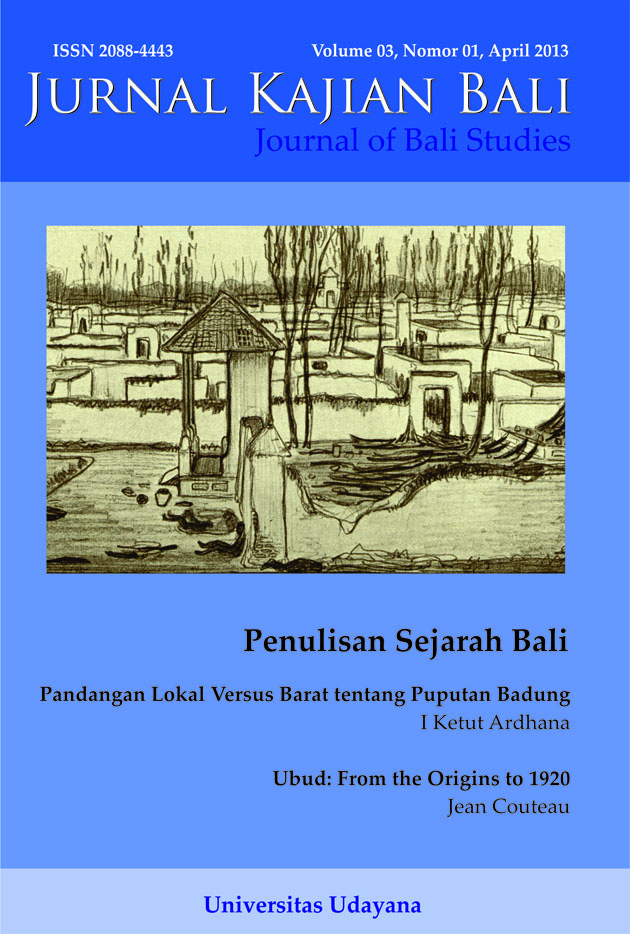
Ubud: From The Origins to 1920
Keywords:
prince of Ubud, knowledge of tradition, modernizing BaliAbstract
Today’s historis often tries to weave together unquestionable
facts with a narrative that consciously gives room to past
myths and legends. The following article about the famous
“cultural” resort of Ubud freely applies this approach to history.
Myths and legends about the origin of Ubud combine with
unquestionable historical facts to convey, beyond the Ubud’s
raw history proper, the prevailing athmosphere of Ubud’s
pre-modern past. Thus the mythical seer Resi Merkandaya
is made to appear alongside the story of the kembar buncing
(fraternal, non-identical twins) of the House of Ubud, and the
history of Western presence and intervention.
Downloads
References
Agung, Ide Anak Agung Gede (1993), Kenangan Masa Lampau, Zaman
Kolonial Hindia Belanda dan Zaman Pendudukan Jepang di Bali,
Jakarta: Yayasan Obor Indonesia.
Belo, J. (1935) ‘Study of Customs pertaining to twins in Bali’ in Tiljd. Ind. TLV, Deel LXXV, alf 4.
Covarrubias, M. 1937. Island of Bali, New York: Knopf.
Robert Cribb, 2010. Digital Atlas of Indonesia history. Copenhagen: NIAS
Press.
Hilbery, Rosemary. 1979. Reminiscences of a Balinese Prince, Tjokorda
Gede Agung Sukawati, South-East Asia Paper no 14, SEA Studies,
University of Hawaii.
Kempers, B. 1991, Monumental Bali: Introduction to Balinese archaeology &
guide to the monuments, Berkeley/Jakarta: Periplus.
Mac Rae, G.S. 1997. Economy, Ritual and History in a Balinese Tourist Town.
Unpublished PhD Thesis, University of Auckland.
Schulte Nordholt, Henk. 1996. The Spell of Power, a History of Balinese
Politics 1650-1940, Leiden: KITLV Press.
Wijaya, Nyoman. 2006. Dua Lembar Dokumen: Perang Badung versus
Belanda 1906, Seminar Peringatan Dies Natalis ke-44 Universitas
Udayana dan HUT ke-48, Fakultas Sastra UNUD, Denpasar,
Selasa 19.
Vickers, Adrian. 1989. Bali, a Paradise Created, Australia: Penguin Books.
Van Kol. Teport Graaf van Limburg Stirum was Governor General from
1916 to 1921.