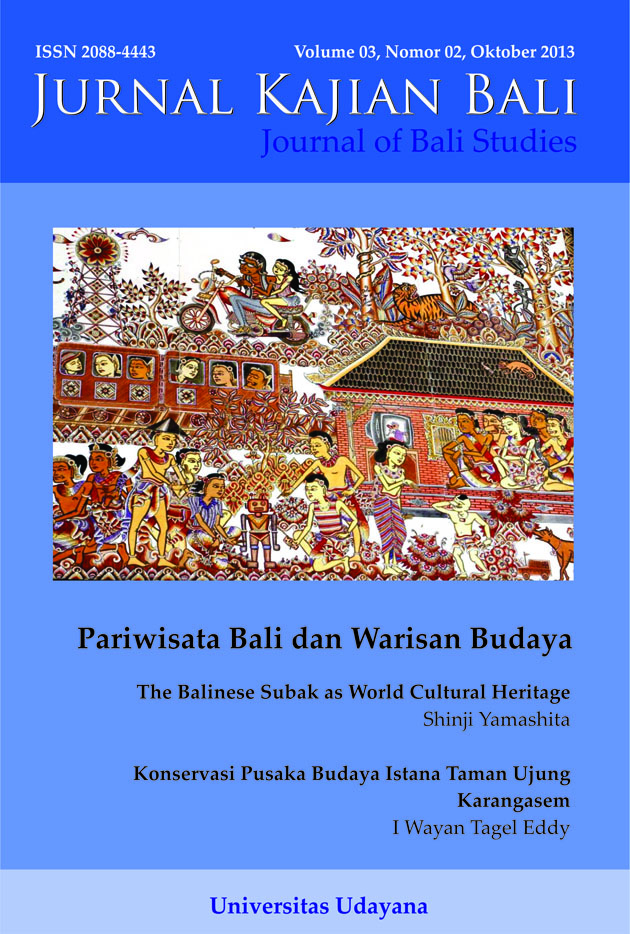
The Balinese Subak as World Cultural Heritage: In the Context of Tourism
Keywords:
subak, world heritage, cultural resource, agriculture, globalizationAbstract
“Cultural Landscape of Bali Province: the Subak Systemas a Manifestation of the Tri Hita Karana Philosophy” wasinscribed in UNESCO’s World Heritage List in 2012. Thispaper discusses the Balinese subak as a world culturalheritage site in the context of cultural resources, culturalpolitics, and cultural tourism, comparing it with otherworld cultural heritage sites in East Asia. The paper alsoexamines subak and agriculture from the viewpoint ofvillage tourism, which has been developed in recent yearsas an alternative to mass tourism. In so doing, the paperaims to contribute to the discussion of complex culturaland agricultural processes in contemporary Bali. Thepaper concludes that making cultural heritage in the age ofglobalization is a dynamic process, involving local, nationaland global levels. What is important, then, is to createnew meanings in the cultural landscape for a sustainablefuture.
Downloads
References
Aditjondoro, George, 1995, Bali, Jakarta’s colony: Social and
ecological impacts of Jakarta-based conglomerates in Bali’s
tourism industry. Working Paper No. 58. Asia Research Centre,
Murdoch University.
Adorno, Theodor W., 1990, Cultural industries reconsidered. Jeff rey
C. Alexander and Steven Seidman eds. Culture and society:
Contemporary debates, pp.275-282. Cambridge, New York and
Melbourne: Cambridge University Press.
Appadurai, Arjun, 2000, Modernity at large: Cultural dimensions of
globalization. Minneapolis: The University of Minnesota Press.
Beck, U., Giddens, A. and Lash, S., 2005, Refl exive modernization: Politics,
tradition and aesthetics in the modern social order. Cambridge:
Polity Press.
Bourdieu, Pierre, 1986, The forms of capital. John G. Richardson ed.
Handbook of theory and research for the sociology of education. New
York, Westport, Connecticut, and London: Greenwood Press.
----, 1990, Artistic taste and cultural capital. Jeff rey C. Alexander and
Steven Seidman eds. Culture and society: contemporary debates,
pp.205-215. Cambridge, New York and Melbourne: Cambridge
University Press..
----, 1993, The fi eld of cultural production. New York: Columbia
University Press.
Byczek Christian, 2011, Blessings for all? Community-based
ecotourism in Bali between global, national, and local interests:
A case study. Austrian Journal of South-East Asian Studies 4 (1):
81-106.
Cliff ord, James, 1988, The Predicament of culture: Twentieth-century
ethnography, literature, and art. Cambridge and London: Harvard
University Press.
Couteau, Jean, 2003, Aft er the Kuta bombing: In search of the Balinese
soul. Antropologi Indonesia 70: 41-59.
Darma Putra, I Nyoman and Michael Hitchcock, 2005, Pura Besakih:
A world heritage site contested. Indonesia and the Malay World
33: 225-237.
Eriksen, Thomas Hylland, 2001, Between universalism and relativism:
A critique of the UNESCO concept of culture. Jane K. Cowan
et al eds. Culture and rights: Anthropological perspectives, pp. 127-
148. Cambridge and New York: Cambridge University Press.
Harrison, David and Michel Hitchcock eds., 2005, The Politics of world
heritage: Negotiating tourism and conservation. Multilingual
Matt ers Limited.
Iwahara, Hiroi, 2012, Kankoshigen tonaru sonraku: Bali-to sonraku
komyuniti turizumu no jirei kara (“Village” as a tourism
resource: A case of community-based tourism in Bali). A paper
presented at the Sogokanko Gakkai (The Japan Society for
Interdisciplinary Tourism Studies), 9-10 June, Tokyo.
Iwamoto, Michiya, 2004, Bunka shigen, bunka isan, and fokurorizumu
(Cultural resources, cultural heritages, and folklorism).
Shigenjinruigaku chukanseikaronshu (A collection of preliminary
papers on the anthropology of resources project), pp.50-55.
Tokyo: Tokyo University of Foreign Studies.
Kikuchi, Akira, 2007, Kosumetikku agurikaruchurarizumu: Ishikawa-
ken Wajima-shi ”Shiroyoneno senmaida” no baai (Cosmetic
agriculturalism: The case of Shirayone rice terraces). Michiya
Iwamoto ed. Furusato shigenka to minzokugaku (Homeland
resources and Japanese folklore studies), pp.86-104. Tokyo:
Yoshikawakobunkan.
Marpoto, Sugent and Bruce Mitchell eds., 1995, Bali: Balancing
environment, economy and culture. Department of Geography
Publication Series 44. Waterloo, Canada: University of
Waterloo.
Mathews, Gordon, 2000, Global culture/individual identity: Search
for home in the cultural supermarket. London and New York:
Routledge.
Matsuura, Koichiro, 2008, Skai isan (World heritage). Tokyo:
Kodansha.
Morris-Suzuki, Tessa, 2002, Hihanteki sozoryoku notameni (For critical
imagination). Tokyo: Heibonsha.
Nagano, Yukiko, 2007, Indonesia Bali niokeru gurobaru turizumu
ka deno ij usha no zoka to dentoteki seikatsu yoshiki no
kaitai: Denpasar kinko Pemogan mura no jirei (The increase
of immigrants and disorganization of the traditional way of
life in the period of global tourism in Bali, Indonesia: A case
of Desa Pemogan in the suburbs of Kota Denpasar). Yamagata
Daigaku Kiyo (Bulletin of Yamagata University) 37(2): 161-208.
Picard, Michel, 2009, From ‘kebalihan’ to ‘ajeg Bali’: Tourism and
Balinese identity in the aft ermath of the Kuta bombing.
Michael Hitchcock, Victor T. King and Michael J.G. Parnwell
eds. Tourism on Southeast Asia: Challenges and new directions, pp.
99-131. Copenhagen: Nias Press.
Ringer, Greg, 1977, (Book Review) Bali: Balancing environment,
economy and culture. Annals of Tourism Research 24: 569-571.
Robertson, Roland, 1992, Globalization: Social theory and global culture.
London: Sage Publications.
Tylor, Edward, 1874 (1871), Primitive culture: Researches into the
development of mythology, philosophy, religion, language, art and
custom. Vol.1. Boston: Estes and Lauriat.
UNDP (United Nations Development Programme)/World Bank, 2003,
Bali, beyond the tragedy: Impact and challenges for tourism-
led development in Indonesia. Jakarta: UNDP/USAID/The
World Bank.
Universitas Gadjah Mada, 1992, Penyusunan Tata Ruang dan Rencana
Detail Teknis Desa Wisata Terpadu di Bali. Laporan Terakhir.
agriculturalism: The case of Shirayone rice terraces). Michiya
Iwamoto ed. Furusato shigenka to minzokugaku (Homeland
resources and Japanese folklore studies), pp.86-104. Tokyo:
Yoshikawakobunkan.
Marpoto, Sugent and Bruce Mitchell eds., 1995, Bali: Balancing
environment, economy and culture. Department of Geography
Publication Series 44. Waterloo, Canada: University of
Waterloo.
Mathews, Gordon, 2000, Global culture/individual identity: Search
for home in the cultural supermarket. London and New York:
Routledge.
Matsuura, Koichiro, 2008, Skai isan (World heritage). Tokyo:
Kodansha.
Morris-Suzuki, Tessa, 2002, Hihanteki sozoryoku notameni (For critical
imagination). Tokyo: Heibonsha.
Nagano, Yukiko, 2007, Indonesia Bali niokeru gurobaru turizumu
ka deno ij usha no zoka to dentoteki seikatsu yoshiki no
kaitai: Denpasar kinko Pemogan mura no jirei (The increase
of immigrants and disorganization of the traditional way of
life in the period of global tourism in Bali, Indonesia: A case
of Desa Pemogan in the suburbs of Kota Denpasar). Yamagata
Daigaku Kiyo (Bulletin of Yamagata University) 37(2): 161-208.
Picard, Michel, 2009, From ‘kebalihan’ to ‘ajeg Bali’: Tourism and
Balinese identity in the aft ermath of the Kuta bombing.
Michael Hitchcock, Victor T. King and Michael J.G. Parnwell
eds. Tourism on Southeast Asia: Challenges and new directions, pp.
99-131. Copenhagen: Nias Press.
Ringer, Greg, 1977, (Book Review) Bali: Balancing environment,
economy and culture. Annals of Tourism Research 24: 569-571.
Robertson, Roland, 1992, Globalization: Social theory and global culture.
London: Sage Publications.
Tylor, Edward, 1874 (1871), Primitive culture: Researches into the
development of mythology, philosophy, religion, language, art and
custom. Vol.1. Boston: Estes and Lauriat.
UNDP (United Nations Development Programme)/World Bank, 2003,
Bali, beyond the tragedy: Impact and challenges for tourism-
led development in Indonesia. Jakarta: UNDP/USAID/The
World Bank.
Universitas Gadjah Mada, 1992, Penyusunan Tata Ruang dan Rencana
Detail Teknis Desa Wisata Terpadu di Bali. Laporan Terakhir.