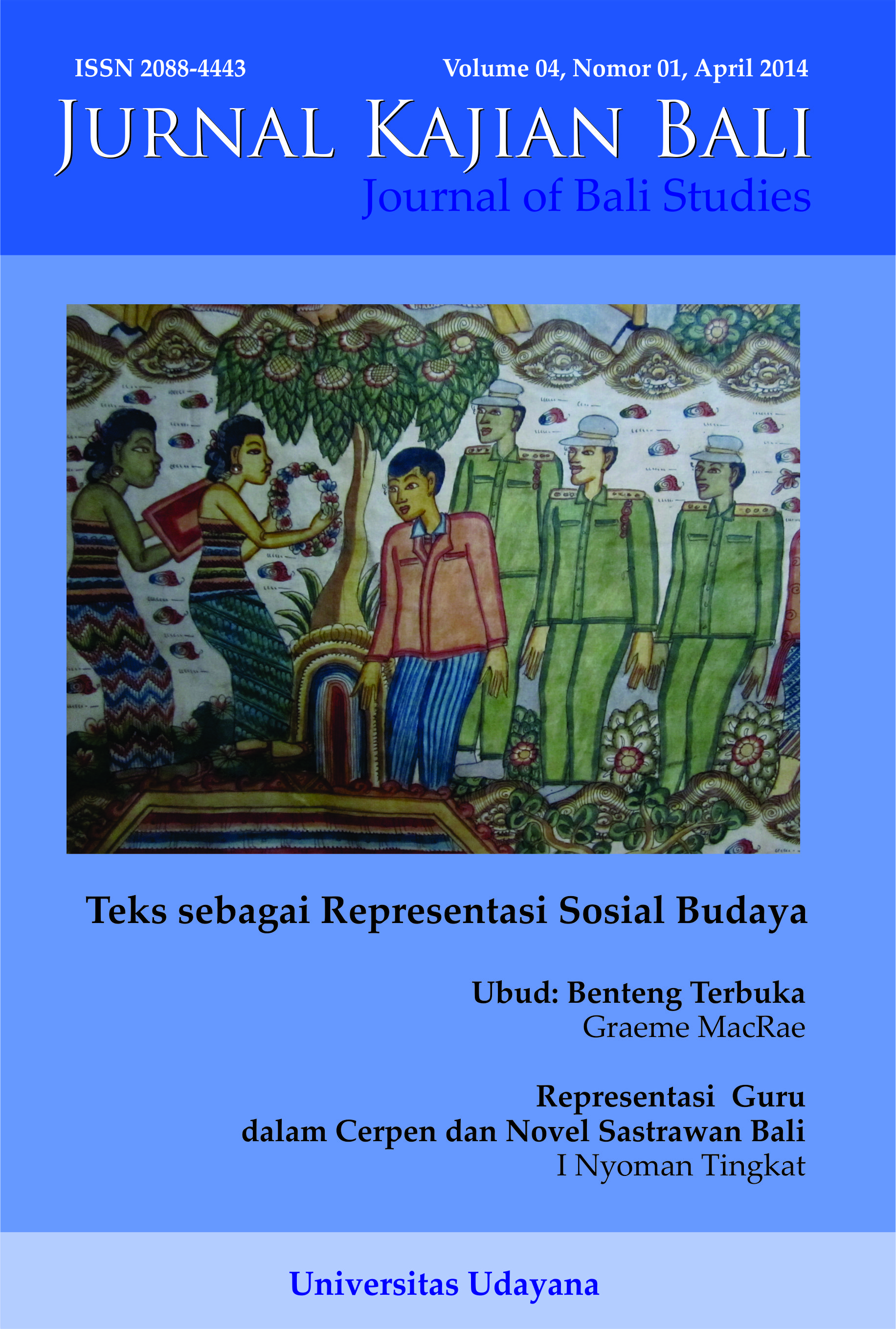
The Dynamics of the Balinese Literature in the Present Day Bali
Keywords:
Balinese literature, babad, paswara, awig-awig, cultural heritageAbstract
Balinese literature has a significant role in the context of how the
Balinese have preserved their own cultural tradition up to now.
Even though the Majapahit Kingdom in the fourteenth century
strongly influenced the Balinese tradition in the past, but it
seems that the Balinese recently also look back at their cultural
tradition prior to the period of the Majapahit influence. There are
some crucial issues in relation to the above explanation: firstly,
there have been widely debated on the issue around the origin
of the Balinese tradition. On the one hand scholars argue that
the origin of Balinese tradition is not started from the East Java
period, but it was earlier than that it had been started prior to
the period of the Majapahit such as the Middle Java period in
the 8th to 9th century or, even, in the West Java Hindu tradition
that also played a major role. However, others have not convinced
with this argument; Secondly; due to globalization process, the
Balinese perceive that the only way to anticipate the impacts of
globalization is just to revitalize the local Balinese cultures by
seeking at the Balinese literatures as the local sources like the
babad, paswara, and awig-awig; Thirdly; to counter the negative
impacts of globalization, the Balinese use their local cultural
heritage so that they can maintain their cultural tradition that
not based on Balinese tradition, but also the Javanese tradition. It
is important to discuss such issue since the influences of pre and
post Majapahit cultural traditions have indeed influenced the
cultural identity of the Balinese. On top of this, to understand
the concept of multiculturalism in the present day Bali, one
needs to trace back the dynamic of interplay amongst arrays of
cultural traditions that have affected the origin of multicultural
society there
Downloads
References
Ardhana, I Ketut. 2014. “Explore the Figure of Udayana in Bali: The
Wisdom Values of Udayana’s Role in the context of Religious,
History, Social Culture, Economy, Law, and Defence in the
Local, National and Universal Perspectives”, in I Ketut Ardhana
and I Ketut Setiawan (eds). 2014. Raja Udayana Warmadewa:
Nilai-nilai Kearifan dalam Konteks Religi, Sejarah, Sosial Budaya,
Ekonomi, Lingkungan, Hukum, dan Pertahanan dalam Perspektif
Lokal, Nasional dan Universal. Denpasar. Pustaka Larasan in
cooperation Department of Culture Gianyar Regency, and
Center for Bali Studies – Udayana University.
Ardhana, I Ketut. 2013. “Kontribusi Nilai Budaya Bali Bagi
Penguatan Kebangsaan Nasional”, Paper presented at the
National Seminar on Kebangsaan: Menggali Akar Budaya
Berkebangsaan Indonesia” held by BAPPENAS Jakarta on 2
Desember.
Ardhana, I Ketut. 2011. “The Encyclopaedia of Indonesia in the Pacific
War: In Cooperation with the Netherlands Institute for War
Documentation”, in Indonesia, April, 91. New York: Cornell
Southeast Asia Program.
Ardhana, I Ketut. 1993, “Balinese Puri in Historical Perspective: The
Role of Puri Satria and Puri Pamacutan in Social and Political
Changes in Badung, South Bali 1906—1950”, Unpublished
Master Thesis, Canberra-Australia: Faculty of Asian Studiesthe
Australian National University (ANU).
Christie, Jan Wisseman. 1986, “Negara, Mandala, and Despotic State:
Images of Early Java”, in David Marr and AC Milner. Southeast
Asia in the 9th to 14th Centuries, Singapore: Research School ofPacific Studies.
Frederich, R. 1850. Voorlopig Verslag van het Eiland Bali. (Extr. Des
Verhandelingen van het Bataviaasch Genootschap van
Kunsetn en Wettenschappen), Vol. XXIII.
Geertz, Clifford. 1980. Negara: The Theatre State in Nineteenth Century
Bali. Princeton University Press.
Geriya (et al.). 2013. Blueprint Revitalization of Gianyar toward Regency
Excellence in Arts and Culture. Collaboration Department
of Culture Gianyar Regency with Center for Bali Studies –
Udayana University.
Gullick, J. M. 1982. “The Condition of Having A Raja: A Review
of Kerajaan by A.C. Milner”, in Review of Indonesian and
Malayan Affairs, Vol. 16, No.2.
Heike, Gust 1994, “Der Balinesische Hinduismus in Geschichte und
Gegenwart”, Unpublished Master Thesis, Passau: Universitat
Passau.
Heine-Geldern, Robert .1956, Conceptions of States and Kinship in
Southeast Asia. Ithaca-New York: Southeast Asia Program
Department of Asian Studies.
Kulke, Herman, 2004. ‘Sudostasien und Indien: Sudost Asien-die
fruheste multikulturelle region der Erde?” in Bernhard
Dahm and Roderich Ptak, Sudostasien Hand Buch: Geschichte,
Gesellschaft, Politik, Wirtschaft, Kultur, Munchen: C H Beck.
Lansing, J. Stephen 1983, “The Indianization of Bali”, in Journal of
Asian Studies, XIV.
Mabbett, I W 1977, “The Indianization’ of Southeast Asia: Reflections
on the Historical Sources”, in Journal of Southeast Asian Studies,
8, 1 (March,).
Pink, Peter Wilhelm 1993, Wariga: Beitrage zur Balinesischen
Divinatiosliteratuur, Berlin/ Hamburg: Dietrich Reiner Verlag.
Ronkel. 1900, “Dagverhaal van Eene Reis van den Resident van Bali
en Lombok Vergezeld van den Countreleur voor de Politieke Aanrakingen in de Poenggawa’s Ida Bagoes Gelgel en Goesti
Ketoet Djlantik naar Tabanan en Badoeng, van 17 Juli t/m
5 Augustus 1899”, in Tijdschrift van Indische Taal-, Land-, en
Volkenkunde,
Sar Desai. D R 1997, Southeast Asia, Los Angeles: University of
California.
Schulte Nordholt, Henk. 1980. “Macht, Mensen en Middelen: Patronen
van Dynamiek in de Balische Politik 1700-1940”. Unpublished
Thesis. Amsterdam: Vrije Universiteit.
Tarnutzen, 1993, “De Andere Bali II: Urbanisierung auf der Insel der
Gotter”, dalam Geographica Helvetica, 48.
Villiers, John 1993, Sudostasien vor der Kolonialzeit, Frankfurt am Main/
Fischer Taschenbuch Verlag.