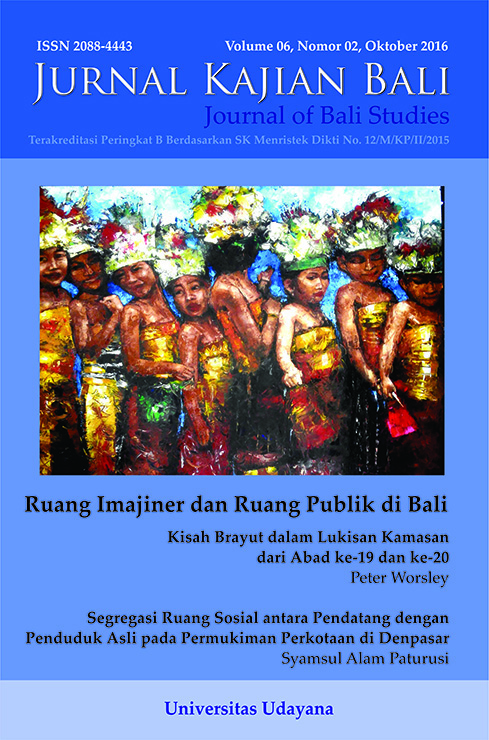
Kisah Brayut dalam Lukisan Kamasan dari Abad ke-19 dan ke-20
Keywords:
Kamasan painting, Balinese family, Brayut story, Charlie Sayer’s collectionAbstract
In this article I discuss a Kamasan painting in the Charlie Sayer’s collection in the Tropenmuseum in Amsterdam. I begin by explaining the way in which the painter has organised the design of his painting to tell the story of the Brayuts, a commoner Balinese family, and to draw attention to important aspects of family life in the nineteenth and early twentieth centuries. In the lower part of the painting we see the Brayut family celebrating the festivals of Galungan and Kuningan and in the topmost sequence of scenes the circumstances in which the head of the family, Pan Brayut, abdicates his religious and customary duties on behalf of the family in favour of his youngest son Ketut Subaya. I argue further that the painter draws attention to a radical distiction between the roles of men and women in family life in this period and to his manifest interest in illustrating the virtue of Pan Brayut, the male head of the family.
Downloads
References
Ardika, I Nengah. 1980. Gaguritan Brayut. Jakarta: Proyek Penerbitan
Buku Sastra Indonesia dan Daerah, Departemen Pendidikan dan
Kebudayaan.
Couteau, Jean. 1999. Museum Puri Lukisan. Ubud: Yayasan Ratna Wartha.
Eiseman, Fred B. 1990. Bali: Sekala and Niskala. I Essays on Religion, Ritual,
and Art. Singapore: Tuttle.
Forge, A. 1978. Balinese Traditional Paintings. A selection from the Forge
Collection of the Australian Museum, Sydney. Sydney: The Australian
Museum
Gennep, Arnold van. 1977. The Rites of Passage. London: Routledge and
Kegan Paul.
Goris, R. 1960a. ‘The Religious Character of the Village Community’, in
Swellengrebel, J. L. (ed.) Bali: Life, Thought and Ritual. The Hague
and Bandung: van Hoeve.
Goris, R. 1960b. ‘Holidays and Holy Days’, in Swellengrebel, J. L. (ed.) Bali:
Life, Thought and Ritual. The Hague and Bandung: van Hoeve.
Grader, C. J. 1939. ‘Brayoet: de geschiedenis van een Balisch gezin’, Djawa
19:260—275.
Grader, C. J. 1960. ‘Pemayun Temple of the Banjar if Tegal’ in Swellengrebel,
J. L. (ed.) Bali: Life, Thought and Ritual. The Hague and Bandung: van
Hoeve.
Grader, C.J. 1969. ‘Pura Meduwe Karang at Kubutambahan’, in
Swellengrebel, J.L. (ed.) Bali: Life, Thought and Ritual. The Hague and
Bandung: van Hoeve.
Hobart, A. 1987. Dancing Shadows of Bali: Theatre and Myth. London: KPI
and New York: Routledge and Kegan Paul.
Kanta, I Made. 1977—1978. Proses melukis tradisionil wayang Kamasan. Den
Pasar: Proyek Sasana Budaya Bali.
Kat Angelino, P. de. 1921—22. ‘Over smeden en eenige andere ambactslieden
op Bali’, Tijschrift voor Indische Taal-, Land- en Volkenkunde ( TBG)
60:207—265, 61:370—424.
Lansing, J. Stephen. 1995. The Balinese. Belmont: Wadsworth. [Case Studies
in Cultural Anthropology]
Pan Mertasih, 1940. ‘Satua I Sangging Lobankara’, Gedong Kirtya
Manuscript Collection. Ms 2091, transcribed by I Gusti Nyoman
Agung, 30 October, 1940.
Swellengrebel, J. L. 1960. ‘Introduction’, in Swellengrebel, J. L. (ed.) Bali:
Life, Thought and Ritual. The Hague and Bandung: van Hoeve.
Swellengrebel, J. L. 1969. ‘Nonconformity in the Balinese Family’, Bali:
Further Studies in Life, Thought and Ritual. The Hague: van Hoeve.
Tan, Roger Y. D. 1967. ‘The Domestic Architecture of South Bali’, Bijdragen
tot de Taal-, Land- en Volkenkunde 123:442–475.
Turner, Victor W. 1974. The Ritual Process: Structurs and Ant-Structure.
Hammondsworth: penguin Books.
Tuuk, H. N. van der. 1897—1912. Kawi-Balineesch-Nederlandsch Woordenboek.
Batavia: Landsdrukkerij. 4 vols.
Vickers, A. 2012. Balinese Art: Paintings and Drawings of Bali 1800–2010.
Singapore: Tuttle Publishing.
Zoete, de, and W. Spies. 1938. Dance and Drama in Bali. London: Faber &
Faber.