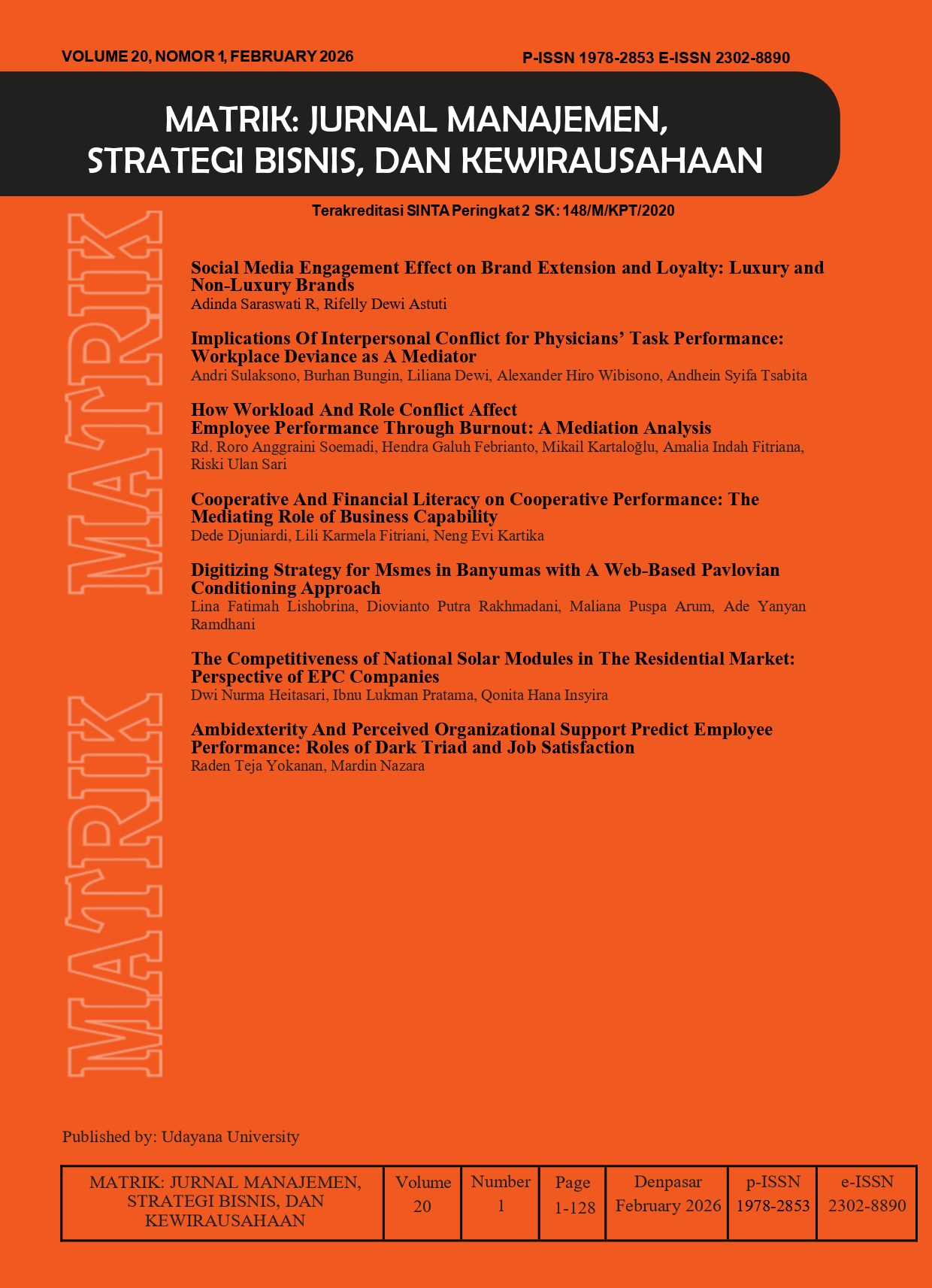
Ambidexterity and Perceived Organizational Support Predict Employee Performance: Roles of Dark Triad and Job Satisfaction
DOI:
https://doi.org/10.24843/MATRIK:JMBK.2026.v20.i01.p07Keywords:
ambidexterity; perceived organizational support; job satisfaction; dark triad.Abstract
In today’s competitive business environment, organizations must balance exploitation and exploration to sustain employee performance. This study examines the effects of ambidexterity, perceived organizational support (POS), job satisfaction, and the Employee Dark Triad on employee performance. Using a quantitative approach, data were collected from 150 employees of PT Nutrisi Keluarga, Indonesia, and analyzed using Partial Least Squares Structural Equation Modeling (PLS-SEM). The results indicate that ambidexterity and job satisfaction positively affect employee performance, while POS significantly enhances job satisfaction, which mediates its relationship with performance. Furthermore, the Employee Dark Triad shows a positive direct effect on performance but negatively moderates the relationship between ambidexterity and performance. This study contributes to the human resource management literature by developing a moderated–mediation model integrating organizational capabilities, support mechanisms, and personality traits. Practically, organizations should foster ambidexterity, strengthen organizational support, promote job satisfaction, and manage dark personality tendencies to optimize employee performance.
Downloads
References
Azmy, A., & Hartono, D. K. (2025). Examining the Impact of Ambidextrous Leadership on Employee Performance: The Mediating Roles of Organizational Citizenship Behavior and Psychological Empowerment in a Manufacturing Company. Journal of Chinese Human Resources Management, 16(1), 95–118. https://doi.org/10.47297/wspchrmWSP2040-800506.20251601
Balzano, M., Bunjak, A., & Bortoluzzi, G. (2025). How relational and collective identification shape the relationship between individual ambidexterity and job performance. European Management Review, 22(3), 799–814. https://doi.org/10.1111/emre.12684
Bueno-de la Fuente, C., Núñez-Rodríguez, S., de la Fuente-Anuncibay, R., & González-Bernal, J. J. (2025). Relationship Between Leadership, Personality, and the Dark Triad in Workplace: A Systematic Review. In Behavioral Sciences (Vol. 15, Number 3). Multidisciplinary Digital Publishing Institute (MDPI). https://doi.org/10.3390/bs15030297
Ceptureanu, S. I., Ferraro, G., Ceptureanu, E. G., & Georgescu, B. (2025). Individual learning ambidexterity behavior and individual job performance in services: the role of organizational structure. Review of Managerial Science, 19(8), 2457–2492. https://doi.org/10.1007/s11846-024-00819-0
Claudia, M. (2018). THE INFLUENCE OF PERCEIVED ORGANIZATIONAL SUPPORT, JOB SATISFACTION AND ORGANIZATIONAL COMMITMENT TOWARD ORGANIZATIONAL CITIZENSHIP BEHAVIOR (A Study of the Permanent Lecturers at University of Lambung Mangkurat, Banjarmasin). Journal of Indonesian Economy and Business, 33(1), 23–45. http://journal.ugm.ac.id/jieb
Clauss, T., Kraus, S., Kallinger, F. L., Bican, P. M., Brem, A., & Kailer, N. (2021). Organizational ambidexterity and competitive advantage: The role of strategic agility in the exploration-exploitation paradox. Journal of Innovation and Knowledge, 6(4), 203–213. https://doi.org/10.1016/j.jik.2020.07.003
Denovan, A., Plouffe, R. A., Dagnall, N., Artamonova, E., Kowalski, C. M., & Saklofske, D. H. (2024). Dark Triad, Dyad, or Core? A Psychometric Evaluation of the Short Dark Triad (SD3) Across Three Countries. Current Psychology, 43(47), 36086–36103. https://doi.org/10.1007/s12144-024-07030-0
Dwiputri, L. J., & Surya Wanasida, A. (2024). Enrichment: Journal of Management The influence of perceived organizational support, training and development and employee engagement on employee performance mediated by employee engagement at the director’s office PT XYZ. In Enrichment: Journal of Management (Vol. 14, Number 3).
Elif, B., & Aslı, G. K. (2024). Moderating Effects of Dark Triad on the Relationships of Mobbing and Abusive Supervision with Outcomes. Revista de Psicologia Del Trabajo y de Las Organizaciones, 40(2), 77–88. https://doi.org/10.5093/jwop2024a7
Guenther, P., Guenther, M., Ringle, C. M., Zaefarian, G., & Cartwright, S. (2023). Improving PLS-SEM use for business marketing research. Industrial Marketing Management, 111, 127–142. https://doi.org/10.1016/j.indmarman.2023.03.010
Gul, T., Karaatmaca, A. G., & Raza, A. (2025). Impact of Green Human Resources Management Practices on Sustainability Through Organizational Resilience and Organizational Learning in Pakistan’s Banking Sector. Sustainability (Switzerland), 17(5). https://doi.org/10.3390/su17052087
Haar, J., & de Jong, K. (2023). Is the dark triad always detrimental to firm performance? Testing different performance outcomes and the moderating effects of competitive rivalry. Frontiers in Psychology, 14. https://doi.org/10.3389/fpsyg.2023.1061698
Huong Tran, T. T., den Broeke, M. Van, & Paparoidamis, N. G. (2025). The dual role of flexibility in driving innovation ambidexterity and firm performance. Journal of Business Research, 194. https://doi.org/10.1016/j.jbusres.2025.115314
Ijigu, A. W., Alemu, A. E., & Kuhil, A. M. (2022). The mediating role of employee ambidexterity in the relationship between high-performance work system and employee work performance: An empirical evidence from ethio-telecom. Cogent Business and Management, 9(1). https://doi.org/10.1080/23311975.2022.2135220
Kamal, A., & Kahar, A. (2025). The Influence of Perceived Organizational Support on Employee Performance Mediated by Work-Life Balance at The Balcone Suites & Resort Bukittinggi. Journal of Multidimensional Management (JoMM), 1(1), 78–87. https://doi.org/10.63076/jomm.v2i1.23
Khair, H., Jufrizen, Annisa, N., Ratih Pratiwi, & Abdul Rozak. (2024). Leader-Member Exchange, Perceived Organisational Support And Job Satisfaction: Mediating Role Of Employee Engagement. Jurnal Manajemen, 28(1), 64–87. https://doi.org/10.24912/jm.v28i1.1638
Khusna, K., Hari Sukarno, & Salma Fauziyyah. (2025). Employee ambidexterity: The influence of entrepreneurial orientation on increasing competitive advantage in the tourism industry. Annals of Human Resource Management Research, 5(2), 141–158. https://doi.org/10.35912/ahrmr.v5i2.2965
Li, G., & Chen, S. T. (2025). The Influence of Personality Traits on Employees’ Creative Deviance: The Mediating Role of Job Crafting and the Moderating Role of Contextual Ambidexterity. Journal of Logistics, Informatics and Service Science, 12(4), 259–282. https://doi.org/10.33168/JLISS.2025.0414
Liao, C., Guo, Z., Li, Y., Zheng, S., Shi, L., & Zhao, P. (2025). Service-sales ambidexterity and employee performance: a dual-path model of stress appraisal and regulatory focus. Humanities and Social Sciences Communications. https://doi.org/10.1057/s41599-025-06432-0
Maan, A. T., Abid, G., Butt, T. H., Ashfaq, F., & Ahmed, S. (2020). Perceived organizational support and job satisfaction: a moderated mediation model of proactive personality and psychological empowerment. Future Business Journal, 6(1). https://doi.org/10.1186/s43093-020-00027-8
Mascarenhas, C., Galvão, A. R., & Marques, C. S. (2022). How Perceived Organizational Support, Identification with Organization and Work Engagement Influence Job Satisfaction: A Gender-Based Perspective. Administrative Sciences, 12(2). https://doi.org/10.3390/admsci12020066
Nabila, V., & Budiono. (2025). Pengaruh job satisfaction terhadap employee performance melalui work engagement pada karyawan.
Nasution, M. I., Soemaryani, I., Yunizar, & Hilmiana. (2023). THE MEDIATING ROLE OF EMPLOYEE AMBIDEXTERITY AND WORK ENGAGEMENT FOR TALENT MANAGEMENT AND MEDICAL REPRESENTATIVES’ PERFORMANCE IN INDONESIAN PHARMACEUTICAL COMPANIES. Problems and Perspectives in Management, 21(3), 642–655. https://doi.org/10.21511/ppm.21(3).2023.50
Ningsih, L. W. (n.d.). PENGARUH KEPUASAN KERJA TERHADAP KINERJA KARYAWAN MELALUI KOMITMEN AFEKTIF PADA PT CIPTA NIRMALA. In Jurnal llmu Manajemen (Vol. 9).
Noviza, N., Aulia, A., & Dahlan, U. A. (2025). The Influence of Perceived Organizational Support on Contextual Performance Mediated by Job Satisfaction among Textile Industry Employees in Yogyakarta. Insight: Jurnal Ilmiah Psikologi, 27(1), 1693–2552. https://doi.org/10.26486/psikologi.v27i1.3893
Oktavia, T. (2023). Human Capital, Job Satisfaction and Employee Performance. International Journal Management Science and Business Journal Homepage, 5(1), 19–28. https://doi.org/10.17509/msb.v5i1
Pamungkas, W. A., & Tanuwijaya, J. (2025). Pengaruh Psychological Wellbeing dan Perceived Organizational Support Terhadap Job Perfomance dimediasi Job Satisfaction. Jurnal Ilmiah FORKAMMA, 9(1), 1–12. https://doi.org/10.32493/skt.v6i1.23384
Park, J., & Kim, J. (2024). The Relationship between Perceived Organizational Support, Work Engagement, Organizational Citizenship Behavior, and Customer Orientation in the Public Sports Organizations Context. Behavioral Sciences, 14(3). https://doi.org/10.3390/bs14030153
Pereira, L. M., Sanchez Rodrigues, V., & Freires, F. G. M. (2024). Use of Partial Least Squares Structural Equation Modeling (PLS-SEM) to Improve Plastic Waste Management. Applied Sciences (Switzerland), 14(2). https://doi.org/10.3390/app14020628
Pimentel, D., Lagarto, S., & Marques-Quinteiro, P. (2024). Examining Dark Triad Traits in Formal Leaders and Their Impact on Employee Workplace Stress: A Comparative Study of Family and Non-Family Businesses. Businesses, 4(3), 331–346. https://doi.org/10.3390/businesses4030021
Roji, F., & Kurniawan, I. S. (2024). PENGARUH PERCEIVED ORGANIZATIONAL SUPPORT, MOTIVASI INTRINSIK, DAN PERSON JOB-FIT TERHADAP JOB SATISFACTION. Jurnal Pendidikan Ekonomi (JURKAMI), 9(1), 53–62. https://doi.org/10.31932/jpe.v9i1.3252
Sharma, D. R., & Biswakarma, G. (2020). Mediating Role of Job Satisfaction in the Relationship Between Organizational Support and Job Performance. European Business & Management, 6(4), 84. https://doi.org/10.11648/j.ebm.20200604.13
Siregar, Z. M. E., Lubis, T., Syamsuri, Abd. R., Siregar, D. I., & Supriadi, Y. N. (2024). Job Satisfaction as Mediator in the Effect of Perceived Organizational Support on Employee Engagement: Evidence from SMEs in Indonesia. Jurnal Aplikasi Manajemen, 22(3), 767–782. https://doi.org/10.21776/ub.jam.2024.022.03.11
Slåtten, T., Mutonyi, B. R., Nordli, A. J., & Lien, G. (2023). The role of ambidextrous leadership and employee ambidexterity in enhancing service quality of care and creativity – a study of health professionals. BMC Health Services Research, 23(1). https://doi.org/10.1186/s12913-023-10275-3
Suwandana, G. M. (2025). The Role of Job Satisfaction in Mediating the Effect of Work Environment on Employee Performance. In International Journal of Engineering Business and Social Science (Vol. 3, Number 3). https://ijebss.ph/index.php/ijebss
Upadhyay, D., & Baber, H. (2023). The Concept of the Dark Triad: Effect on Organizational Outcomes and Navigating Strategiess. Changing Societies and Personalities, 7(4), 158–173. https://doi.org/10.15826/csp.2023.7.4.256
Yaso. I Made Suar, & Studi Manajemen, P. (2023). VOLUME 6 ISSUE 2 FEBRUARI 2023 JURNAL KOLABORATIF SAINS 90 The Effect of Job Satisfaction and Workload on Employee Performance at PT. Sinar Galesong Pratama Palu. https://jurnal.unismuhpalu.ac.id/index.php/JKS
Downloads
Published
Issue
Section
License
 This work is licensed under a Creative Commons Attribution-ShareAlike 4.0 International License.