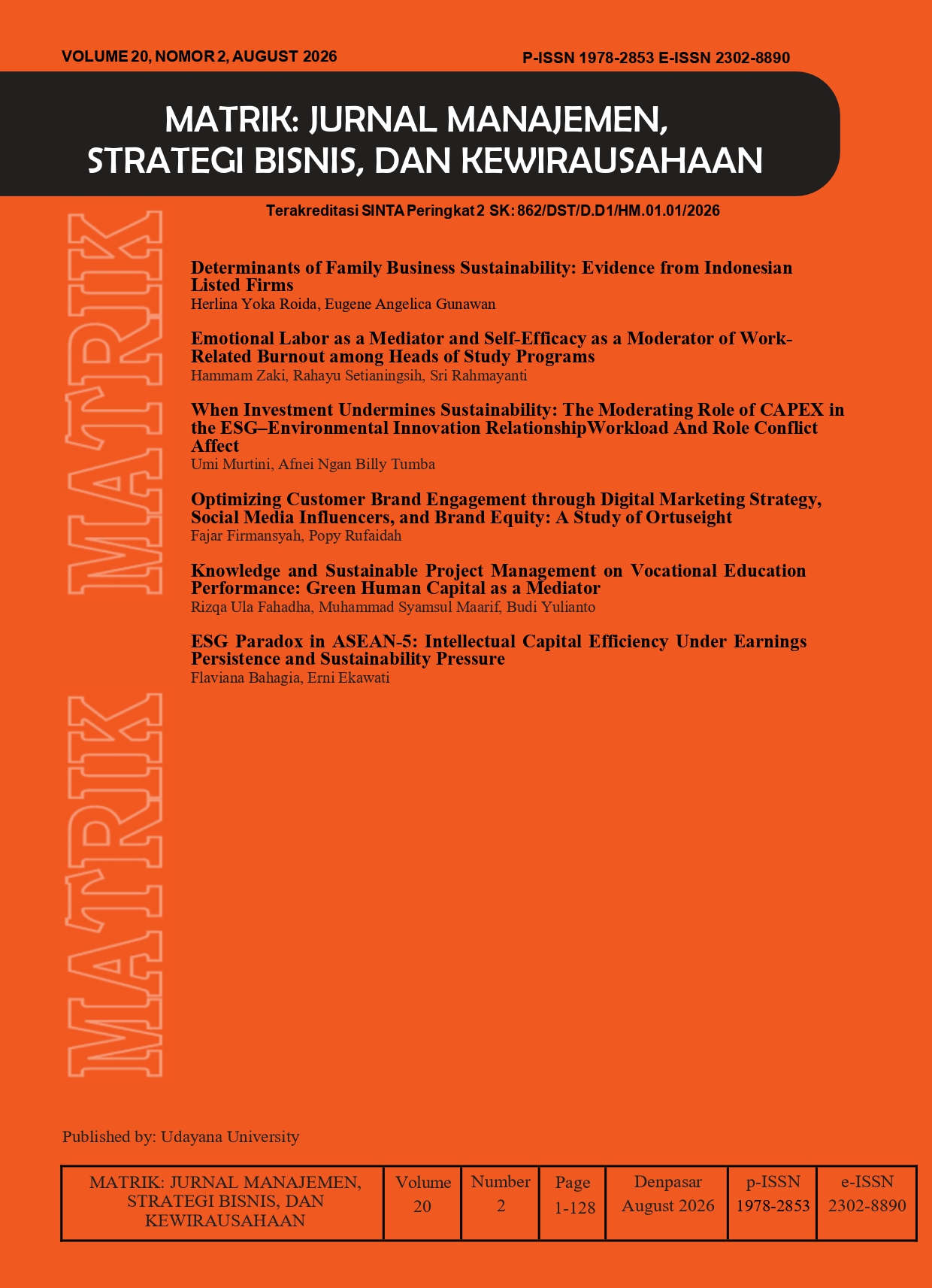
Emotional Labor as Mediator and Self-Efficacy as Moderator in Work-Related Burnout Among Heads of Study Programs
DOI:
https://doi.org/10.24843/MATRIK:JMBK.2026.v20.i02.p02Keywords:
job demands; self-efficacy; emotional intelligence; emotional labor; work-related burnout.Abstract
Work- related burnout among Heads of Study Programs is an increasing concern due to growing academic, administrative, and managerial responsibilities in higher education. Although burnout has been widely examined among lecturers and other professionals, evidence focusing on Heads of Study Programs remains limited, particularly regarding the mediating role of emotional labor and the moderating role of self-efficacy. This study examines the effects of job demands and emotional intelligence on work-related burnout, with emotional labor as a mediator and self-efficacy as a moderator. Data were collected from 249 Heads of Study Programs at Muhammadiyah universities in Indonesia established less than ten years ago and analyzed using Partial Least Squares Structural Equation Modeling (PLS-SEM) with SmartPLS 4.0. The findings show that job demands increase work-related burnout, while emotional intelligence influences emotional labor. Emotional labor increases burnout and mediates the relationship between emotional intelligence and burnout. However, selfefficacy does not moderate the relationship between job demands and burnout. These findings extend the Job Demands–Resources (JD-R) perspective by identifying emotional labor as an important psychological mechanism and highlighting the need for organizational support to reduce burnout and promote sustainable academic leadership.
Downloads
References
A'yunin, Q., Fatmaningrum, W., & Soetjipto, S. (2023). Gambaran Burnout Akademik Mahasiswa Kedokteran Universitas Airlangga Angkatan 2021. Jurnal Ilmiah Universitas Batanghari Jambi, 23(3), 3083-3086.
Ardanty, A. A., Sari, R. E., & Putrianti, F. G. (2023). Relationship between emotional labor and burnout at Umskey goat milk factory employees. International Conference on Indigenous Psychology and Culture,
Bakker, A. B., & Demerouti, E. (2017). Job demands–resources theory: Taking stock and looking forward. Journal of occupational health psychology, 22(3), 273.
Bakker, A. B., Demerouti, E., & Sanz-Vergel, A. (2023). Job demands–resources theory: Ten years later. Annual review of organizational psychology and organizational behavior, 10(1), 25-53. https://doi.org/https://doi.org/10.1146/annurev-orgpsych-120920-053933
Bowo, A. B. P., & Hendro, J. (2023). Analisis Pengaruh Pengembangan SDM, Lingkungan Kerja, Komitmen Organisasi dan Motivasi Terhadap Kinerja Karyawan: Literatur Review. JEMSI (Jurnal Ekonomi, Manajemen, dan Akuntansi), 9(1), 10-18.
Burns, K. E., Pattani, R., Lorens, E., Straus, S. E., & Hawker, G. A. (2021). The impact of organizational culture on professional fulfillment and burnout in an academic department of medicine. PLoS One, 16(6), e0252778.
Choi, H.-M., Mohammad, A. A., & Kim, W. G. (2019). Understanding hotel frontline employees’ emotional intelligence, emotional labor, job stress, coping strategies and burnout. International Journal of Hospitality Management, 82, 199-208.
Consiglio, C., Massa, N., Sommovigo, V., & Fusco, L. (2023). Techno-stress creators, burnout and psychological health among remote workers during the pandemic: The moderating role of E-work self-efficacy. International journal of environmental research and public health, 20(22), 7051.
Davis, R. S., & Stazyk, E. C. (2022). Ambiguity, appraisal, and affect: Examining the connections between goal perceptions, emotional labour, and exhaustion. Public Management Review, 24(10), 1499-1520.
Ekore, J. O., Allui, A., Al Shareef, S., & Zawawi, R. (2020). A cross-sectional investigation of prevalence of occupational burnout in Saudi aviation industry. International Journal of Engineering Business Management, 12, 1847979020946919.
Extremera, N., Mérida-López, S., Sánchez-Álvarez, N., & Quintana-Orts, C. (2018). How does emotional intelligence make one feel better at work? The mediational role of work engagement. International journal of environmental research and public health, 15(9), 1909.
Ezekiel, J. S., & Nanfa, K. D. (2023). Customers emotional intelligence and satisfaction: The mediation of bankers emotional labour. Annals of Human Resource Management Research, 3(2), 115-127.
Fouquereau, E., Morin, A. J., Lapointe, É., Mokounkolo, R., & Gillet, N. (2019). Emotional labour profiles: Associations with key predictors and outcomes. Work & Stress, 33(3), 268-294.
Frintner, M. P., Kaelber, D. C., Kirkendall, E. S., Lourie, E. M., Somberg, C. A., & Lehmann, C. U. (2021). The effect of electronic health record burden on pediatricians' work–life balance and career satisfaction. Applied clinical informatics, 12(03), 697-707.
Fteiha, M., & Awwad, N. (2020). Emotional intelligence and its relationship with stress coping style. Health psychology open, 7(2), 2055102920970416.
Geng, F., Zhou, N., & Yu, S. (2025). Exploring the Effect of L2 Writing Teachers' Emotional Intelligence on Their Professional Well‐Being: The Mediating Role of Emotional Labour Strategies. European Journal of Education, 60(1), e12850.
Ghamrawi, N., Ghamrawi, N. A., & Shal, T. (2025). Leading or managing in the middle: Exploring the identities of head of departments in higher education using dynamic systems model. Higher Education Quarterly, 79(3), e70037.
Golu, F., Cotel, A., Sava, N. I., Oprea, B., & Condrea, S. (2022). The link between job demands, burnout, and the self-undermining of healthcare employees during the COVID-19 pandemic: an underestimated threat? Healthcare,
Grandey, A. A., & Melloy, R. C. (2017). The state of the heart: Emotional labor as emotion regulation reviewed and revised. Journal of occupational health psychology, 22(3), 407.
Hair, J. F., Hult, G. T. M., Ringle, C. M., Sarstedt, M., & Thiele, K. O. (2017). Mirror, mirror on the wall: a comparative evaluation of composite-based structural equation modeling methods. Journal of the academy of marketing science, 45(5), 616-632.
Hair Jr, J., Hair Jr, J. F., Sarstedt, M., Ringle, C. M., & Gudergan, S. P. (2023). Advanced issues in partial least squares structural equation modeling. saGe publications.
Han, W., Kim, J., Park, J., & Lee, M. (2022). Influential effects of emotional intelligence on the relationship between job stress and burnout among general hospital administrative staff. Healthcare,
Hochschild Arlie, R. (1983). The managed heart: Commercialization of human feeling. The Production of reality: Essays and readings on social interaction.
Hong, E., & Lee, Y. S. (2016). The mediating effect of emotional intelligence between emotional labour, job stress, burnout and nurses' turnover intention. International journal of nursing practice, 22(6), 625-632.
Humphrey, N. M. (2023). Emotional labor and employee outcomes: A meta‐analysis. Public Administration, 101(2), 422-446.
Igartua, J.-J., & Hayes, A. F. (2021). Mediation, moderation, and conditional process analysis: Concepts, computations, and some common confusions. The Spanish journal of psychology, 24, e49.
Islam, M. S., Fujimoto, Y., Haque, A., & Uddin, M. J. (2025). Responsible leadership in higher education in developing countries. Higher Education, 89(2), 465-485.
Jeung, D.-Y., & Chang, S.-J. (2021). Moderating effects of organizational climate on the relationship between emotional labor and burnout among Korean firefighters. International journal of environmental research and public health, 18(3), 914.
Knežević, M. N., Petrović, M. D., Kovačić, S., Mijatov, M., Vuković, D. B., & Kennell, J. (2021). Acting the part: Emotional intelligence and job satisfaction as predictors of emotional labor in travel agencies. Tourism and Hospitality Research, 21(2), 183-201.
Koster, M., & McHenry, K. (2023). Areas of work-life that contribute to burnout among higher education health science faculty and perception of institutional support. International journal of qualitative studies on health and well-being, 18(1), 2235129.
Kurniadewi, Y. I., Hubeis, M., & Slamet, A. S. (2022). Peran Gaya Kepemimpinan, Budaya Organisasi, Perubahan Organisasi, Terhadap Kinerja Sumber Daya Manusia (Studi Kasus pada Lembaga Ilmu Pengetahuan Indonesia). MANAJEMEN IKM: Jurnal Manajemen Pengembangan Industri Kecil Menengah, 16(1).
Mandefro, E., Semela, T., & Bezabih, A. (2025). Unravelling the leadership role of higher education leaders in quality imperatives: Implications for quality culture development. Higher Education Quarterly, 79(4), e70072.
Mayer, J. D., Caruso, D. R., & Salovey, P. (2016). The ability model of emotional intelligence: Principles and updates. Emotion review, 8(4), 290-300.
Membrive-Jiménez, M. J., Pradas-Hernández, L., Suleiman-Martos, N., Vargas-Román, K., Cañadas-De la Fuente, G. A., Gomez-Urquiza, J. L., & De la Fuente-Solana, E. I. (2020). Burnout in nursing managers: a systematic review and meta-analysis of related factors, levels and prevalence. International journal of environmental research and public health, 17(11), 3983.
Naidoo-Chetty, M., & Du Plessis, M. (2021). Job demands and job resources of academics in higher education. Frontiers in psychology, 12, 631171.
Nam, T., & Kabutey, R. (2021). How does social media use influence the relationship between emotional labor and burnout?: the case of public employees in Ghana. Journal of Global Information Management (JGIM), 29(4), 32-52.
Nurochim, Mahmudiono, T., Chupradit, S., Smolentsev, V. M., Chupradit, P. W., Komariah, A., Iswanto, A. H., Istomina, O. B., & Shalaby, M. N. (2022). Investigating the relationship between spiritual intelligence, emotional regulation and stress coping strategies in the Russian education industry. International Journal of Work Organisation and Emotion, 13(3), 212-229.
Rinfret, S. R., McCandless, S., & McDonald III, B. D. (2025). Learning from public administration faculty: emotional labour, burnout, and solutions. Public Management Review, 1-22.
Salvagioni, D. A. J., Melanda, F. N., Mesas, A. E., González, A. D., Gabani, F. L., & De Andrade, S. M. (2017). Physical, psychological and occupational consequences of job burnout: A systematic review of prospective studies. PLoS One, 12(10), e0185781.
Shoji, K., Cieslak, R., Smoktunowicz, E., Rogala, A., Benight, C. C., & Luszczynska, A. (2016). Associations between job burnout and self-efficacy: A meta-analysis. Anxiety, Stress, & Coping, 29(4), 367-386.
Sugiyono, P. (2011). Metodologi penelitian kuantitatif kualitatif dan R&D. Alpabeta, Bandung, 62, 70.
Vander Elst, T., Cavents, C., Daneels, K., Johannik, K., Baillien, E., Van den Broeck, A., & Godderis, L. (2016). Job demands–resources predicting burnout and work engagement among Belgian home health care nurses: A cross-sectional study. Nursing outlook, 64(6), 542-556.
Wang, Q., Collet, J.-P., Liu, W., Lang, X., Feng, D., Ding, F., & Huang, S. (2023). Work-related stress and stress management practice among Chinese hospital staff working night shifts: A mixed-methods study. International Journal of Stress Management, 30(3), 274.
Weber, C., Golding, S. E., Yarker, J., Teoh, K., Lewis, R., Ratcliffe, E., Munir, F., Wheele, T., & Windlinger, L. (2023). Work fatigue during COVID-19 lockdown teleworking: the role of psychosocial, environmental, and social working conditions. Frontiers in psychology, 14, 1155118.
Yin, Y., Sun, S., Song, L., Jin, C., & Wang, Y. (2023). Emotional labour strategies and job burnout: A meta‐analysis of Chinese employees. Asian Journal of Social Psychology, 26(2), 219-237.
Bakker, A. B., & Demerouti, E. (2017). Job demands–resources theory: Taking stock and looking forward. Journal of occupational health psychology, 22(3), 273.
Yasin, N. H. M., Razak, R. C., Abdullah, F. A., Nordin, N., Nordin, N. N., & Ghazali, M. S. (2023). Investigating the Role of Job Demands and Job Resources in Predicting Burnout Among Nursing Home Nurses. In Finance, Accounting and Law in the Digital Age: The Impact of Technology and Innovation in the Financial Services Sector (pp. 663-673). Springer.
Downloads
Published
Issue
Section
License
 This work is licensed under a Creative Commons Attribution-ShareAlike 4.0 International License.