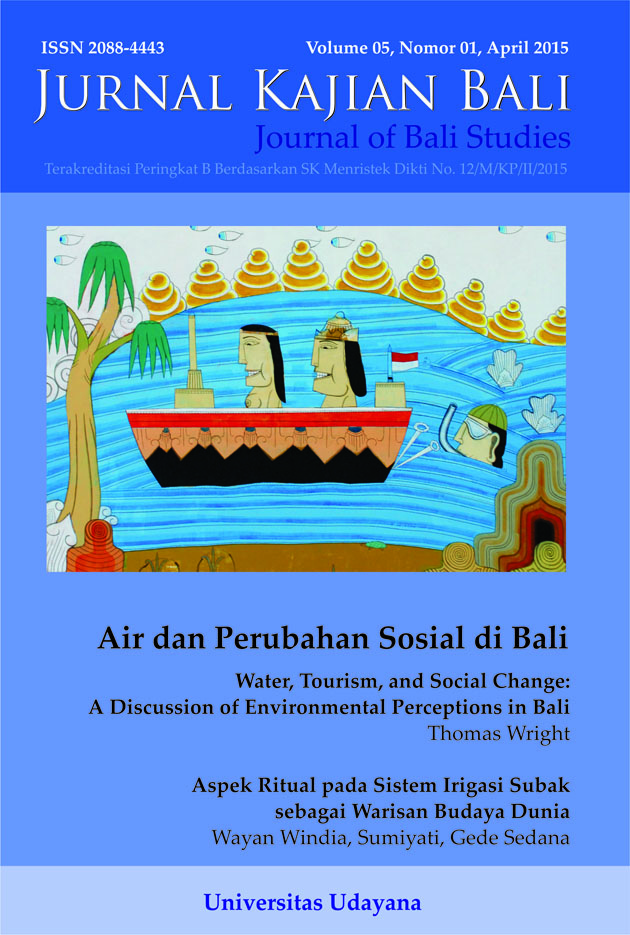
Water, Tourism, and Social Change: A Discussion of Environmental Perceptions in Bali
DOI:
https://doi.org/10.24843/JKB.2015.v05.i01.p01Keywords:
Bali, air, lingkungan laut, pariwisataAbstract
Water plays an important role in Balinese society. Not only
is it commonly featured in Balinese Hindu rituals, but
its use and management also enables prosperity through rice cultivation. While these aspects of water have been
discussed in many academic and non-academic publications,
qualitative understandings of relations to seawater remain
somewhat unexplored in the literature. The aim of this paper
is to present a preliminary review of existing literature on
water and marine environments in Bali, and argue the need
for further qualitative social scientific understanding of
contemporary Balinese relations to seawater. A discussion
of existing research on ocean-centred communities and
continued tourism development in Bali’s coastal areas is
intended to add to current research in Balinese studies. By
presenting literature on Balinese concepts of environment,
water and the ocean, this paper seeks to highlight the
benefits of continued research on perceptions of environment
to discussions of pollution, water scarcity and resource
management. Although maritime attractions such as the
temples at Tanah Lot and Uluwatu as well as several popular
beach communities play a significant role in the tourism
industry, this paper suggests the need to further investigate
the importance of these attractions to tourists and Balinese as
well as the social interpretations associated with them.
Downloads
References
Acheson, J. M.. 1981. Anthropology of Fishing. Annual Review of
Anthropology 10(1): 275-316.
Alberti, B., 2014, How does water mean? Archaeological Dialogues 21(2):
165-174.
Bali Advertiser. 2015. No water, no Bali. Bali Advertiser, Retrieved from
http://www.baliadvertiser.biz/articles/feature/2015/no_water.
html
Barber, M. 2012. Nothing Ever Changes’: Historical ecology, causality
and climate change in Arnhem Land, Australia. In Musharbash,
Y. ed. Ethnography & the production of Anthropological knowledge :
Essays in honour of Nicolas Peterson. Canberra: ANU E Press.
Belo, J. 1960. Trance in Bali. New York: Columbia University Press.
Berger, A. A. 2013. Bali tourism. New York: Haworth Press.
Brown, S., Fox, S., & Jacquet, A. 2007. Conference Overview: ‘On the
Beach: Liminal Spaces in Historical and Cultural Contexts.
Liminal: A Journal of Historical and Cultural Studies.
Casey, E. 1996. How to get from space to place in a fairly short stretch
of time: Phenomenological Prolegomena. In Feld, S., & Basso, K.
H. eds. Senses of place. Seattle; Santa Fe, N.M: School of American
Research Press.
Cole, S. 2012. A political ecology of water equity and tourism: A Case
Study From Bali. Annals of Tourism Research 39(2): 1221-1241.
Cole, S. and Browne M. 2015. Tourism and Water Inequity in Bali: A
Social-Ecological Systems Analysis. Human Ecology 43(3):439-
450.
Davies, M. 2014. Don’t water down your theory. Why we should all
embrace materiality but not material determinism. Archaeological
Dialogues 21(2): 165-174.
DelGuidice, D. M., 1994, The symbolic landscape of Bali. Dissertation/
Thesis, ProQuest, UMI Dissertations Publishing.
Dinas Pariwisata. 2015. Top 10 Visit to Place of Interest in Bali 2008-2012.
Accessed 19/02/2015. Retrieved from http://www.disparda.
baliprov.go.id/en/Statistics2
Dobson, R. 2007. Beaches and Breaches: Articulations and Negotiations
of Identity, Ethnicity and Cosmopolitanism in Mauritius–‘The
Most Cosmopolitan Island Under the Sun’. Liminal: a Journal of
Historical and Cultural Studies.
Geertz, C. 1972. The wet and the dry: Traditional irrigation in Bali and
Morocco. Human Ecology 1(1): 23-39.
Hauser-Schäublin, B. 2011. Land Donations and the Gift of Water. On
Temple Landlordism and Irrigation Agriculture in Pre-Colonial
Bali. Human Ecology 39(1): 43-53.
Hefner, R. W. 1986. The Three Worlds of Bali. J. Stephen Lansing.
American Anthropologist 88(2): 487-488.
Helmreich, S. 2011. Nature/Culture/Seawater. American Anthropologist
113(1): 132-144.
----. 2014. Waves: An anthropology of scientific things (The 2014 Lewis
Henry Morgan Lecture). HAU: Journal of Ethnographic Theory 4(3):
265-284.
Hobart, A. Ramseyer, U., & Leemann, A. 1996. The peoples of Bali.
Cambridge, MA: Blackwell Publishers.
Howe, L. 2005. The changing world of Bali: Religion, society and tourism.
New York: Routledge.
Indonesia. 2011. The Ministry of Culture and Tourism of the Republic of
Indonesia and The Government of Bali Province. Cultural Landscape of
Bali Province. Paper presented at the Nomination for inscription
on The UNESCO World Heritage List. Accessed: 30/04/2015.
Retrieved from http://whc.unesco.org/en/list/1194/documents/
Ingold, T. 2000. The perception of the environment: Essays on livelihood,
dwelling & skill. New York: Routledge.
Jha, N., & Schoenfelder, J. W. 2011. Studies of the Subak: New Directions,
New Challenges. Human Ecology 39(1): 3-10.
Kencanca, M.A. 2010. Six tourist beaches in Bali are polluted, lab test
shows. Jakarta Globe. Retrieved from http://thejakartaglobe.
beritasatu.com/archive/six-tourist-beaches-in-bali-are-pollutedlab-
tests-show/388495/
King, T.J. 2005. Crisis of Meanings: Divergent Experiences and
Perceptions of the Marine Environment in Victoria, Australia.
The Australian Journal of Anthropology 16(3): 350-365.
----. 2007. “Bad Habits and Prosthetic Performances: Negotiation of
Individuality and Embodiment of Social Status in Australian
Shark Fishing.” Journal of Anthropological Research [H.W. Wilson
- SSA] 63(4): 537.
----. 2011. The “Skipper Effect”: Riddles of Luck and Rhetorics of
Individualism. Human Organisation 70(4): 387-396.
Kopnina, H., & Shoreman-Ouimet, E. 2011. Environmental anthropology today. New York: Routledge.
Lansing, J. S. 1987. Balinese “Water Temples” and the Management of
Irrigation. American Anthropologist 89 (2): 326-341.
----. 1991. Priests and programmers: Technologies of power in the engineered
landscape of Bali. Princeton, N.J: Princeton University Press.
----. 2012. Perfect Order: Recognizing Complexity in Bali. Princeton
University Press.
Lorenzen, R.. 2015. Disintegration, Formalisation or Reinvention?
Contemplating the Future of Balinese Irrigated Rice Societies.
The Asia Pacific Journal of Anthropology 16(2): 176-193.
Lorenzen, R., & Lorenzen, S. 2011. Changing Realities—Perspectives on
Balinese Rice Cultivation. Human Ecology 39(1): 29-42.
Lorenzen, R., & Roth, D. 2015. Paradise Contested: Culture, Politics and
Changing Land and Water Use in Bali. The Asia Pacific Journal of
Anthropology 6(2): 99-105.
MacRae, G. S., & Arthawiguna, I. W. A. 2011. Sustainable Agricultural
Development in Bali: Is the Subak an Obstacle, an Agent or
Subject? Human Ecology 39(1): 11-20.
Malinowski, B. 1922. Argonauts of the western pacific: An account of native
enterprise and adventure in the archipelagoes of melanesian New
Guinea. London: Routledge and Kegan.
McKean, P. F. 1983. The Three Worlds of Bali. American Anthropologist
85(3): 750-751.
Oestigaard, T. 2014. Holy water. The universal and the particular.
Archaeological Dialogues 21(2): 165-174.
Orlove, B., & Caton, S. C. 2010. Water Sustainability: Anthropological
Approaches and Prospects. Annual Review of Anthropology 39:
401-415.
Peace, A., Connor, L. H., & Trigger, D. 2012. Environmentalism, Culture,
Ethnography. Oceania 82(3): 217-227.
Picard, M. 1990. “Cultural Tourism” in Bali: Cultural Performances as
Tourist Attraction. Indonesia, 49(49): 37-74.
----. 1996. Bali: Cultural tourism and touristic culture. Singapore:
Archipelago Press.
----. 1999. The Discourse of Kebalian: Transcultural Constructions of
Balinese Identity. In R. Rubinstein & L. H. Connor eds. Staying
Local in the Global Village - Bali in the Twentieth Century pp. 15-49.
University of Hawaii Press.
Putra, I. N. D. 2014. Bali: Between Cultural and Marine Tourism. Jurnal
Kajian Bali, Volume 04, Nomor 01, April 2014, pp. 15-30.
Rappaport, R. A. 1968. Pigs for the ancestors: Ritual in the ecology of a New
Guinea people. Yale: Yale University.
Reuter, T. 2002. Custodians of the sacred mountains: Culture and society in the
highlands of Bali. Honolulu, HI: University of Hawai’i Press.
Roth, D., & Sedana, G.. 2015. Reframing Tri Hita Karana: From ‘Balinese
Culture’ to Politics. The Asia Pacific Journal of Anthropology 16(2):
157-175.
Schulte Nordholt, H. 2007. Bali, an open fortress, 1995-2005: Regional
autonomy, electoral democracy and entrenched identities. Singapore:
NUS Press.
----. 2011. Dams and Dynasty, and the Colonial Transformation of
Balinese Irrigation Management. Human Ecology 39(1): 21-27.
Sobocinska, A. 2013. Innocence lost and paradise regained: Tourism
to Bali and Australian perceptions of Asia. History Australia 8(2):
199-222.
Strang, V.. 2005. Common Senses: Water, Sensory Experience and the
Generation of Meaning. Journal of Material Culture 10(1): 92-120.
----. 2014. Contributaries. From confusion to confluence in the matter of
water and agency. Archaeological Dialogues 21(2): 165-174.
Strauß, S.. 2015. Alliances Across Ideologies: Networking with NGOs
in a Tourism Dispute in Northern Bali. The Asia Pacific Journal of
Anthropology 16(2): 123-140.
----. 2011. Water Conflicts among Different User Groups in South Bali,
Indonesia. Human Ecology 39(1): 69-79.
Townsend, P. K. 2000. Environmental anthropology: From pigs to policies.
Prospect Heights, Ill: Waveland Press.
Vickers, A. 1989. Bali, a paradise created. Berkeley. CA: Periplus Editions, Inc.
Wardana, A. 2015. Debating Spatial Governance in the Pluralistic
Institutional and Legal Setting of Bali. The Asia Pacific Journal of
Anthropology 16(2): 106-122.
Warren, C.. 1993. Disrupted Death Ceremonies: Popular Culture and
the Ethnography of Bali. Oceania 64(1): 36-56.
----. 2012. Risk and the Sacred: Environment, Media and Public Opinion
in Bali. Oceania 82(3): 294-307.
Yamashita, S. 2003. Bali and beyond: Explorations in the anthropology of
tourism. New York: Berghahn Books.