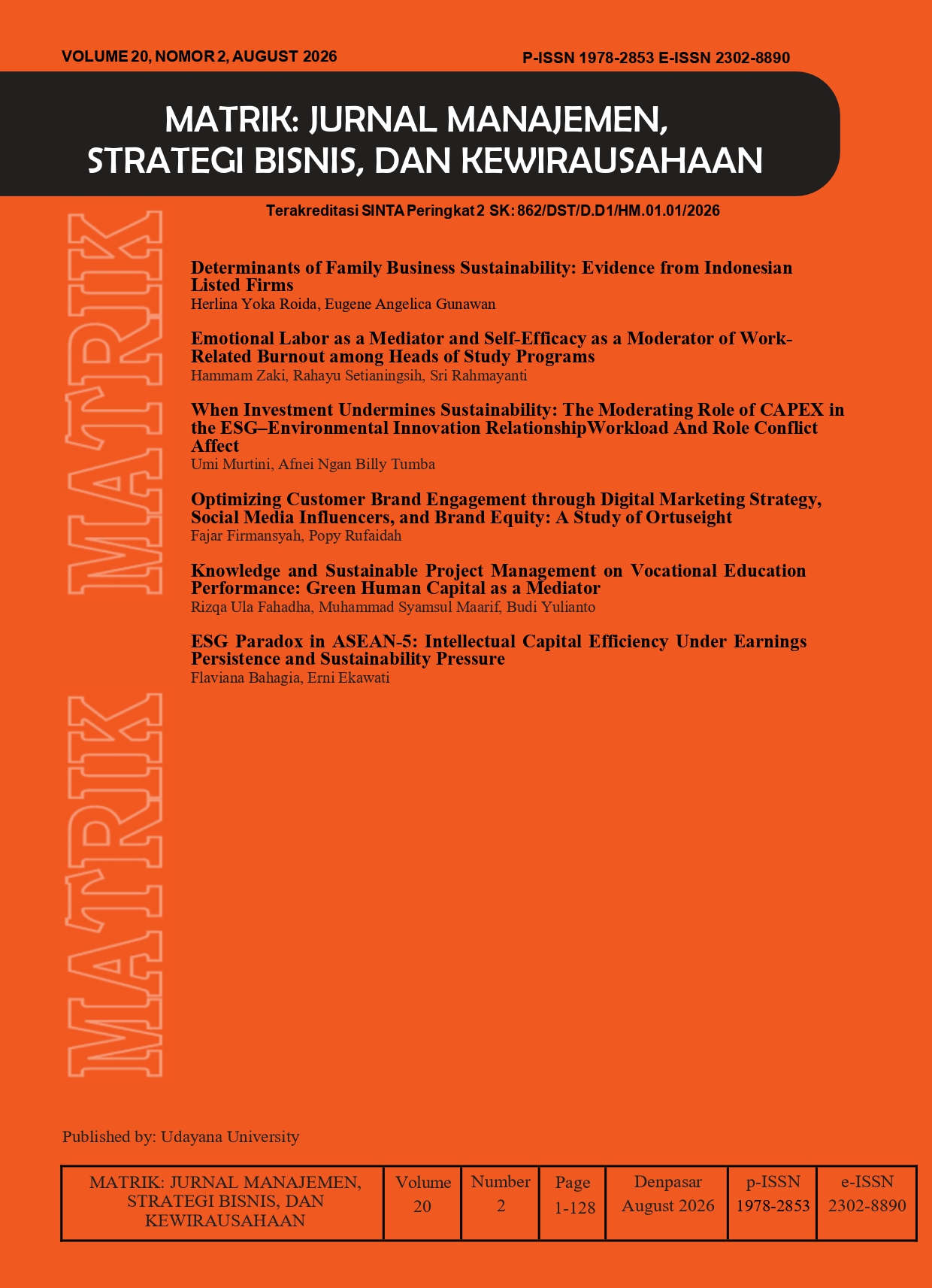
Revealing The ESG Paradox in 5-ASEAN Countries: Intellectual Capital Efficiency under Earnings Persistence and Sustainability Pressure
DOI:
https://doi.org/10.24843/MATRIK:JMBK.2026.v20.i02.p06Keywords:
ESG; intellectual capital; earnings persistence; sustainable development score.Abstract
This study is motivated by inconsistent findings about ESG implementation on Intellectual Capital (IC) in developing countries. Several studies show the benefits of ESG on increasing intangible asset value, but other studies reveal that ESG creates costs without increasing internal efficiency. This study aims to examine the effect of ESG on IC-efficiency by considering two moderating variables: Earnings Persistence (EP) proxing an earnings predictability of companies’ financial reporting, and Sustainable Development Score (SDS) as an external pressure of sustainable implementation within the countries. This study using secondary panel data in ASEAN5 countries on non-financial companies from 2015 to 2023. The results show that ESG has a negative impact on two dimensions of IC, namely Structural Capital Efficiency (SCE) and Cost of good sold-based Relational Capital Efficiency (RCECOGS), but not significant on Human Capital Efficiency (HCE). The EP and SDS as moderating variables show significant negative effects, indicating that companies with high earnings predictability and high sustainability pressures countries tend to experience the negative impacts of ESG on ICefficiency. These findings have important implications for corporate managers and policymakers in designing adaptive ESG strategies and policies in developing countries.
Downloads
References
Awad Bakry, A. E. (2022). Does intellectual capital efficiency improve the corporate social responsibility of Egyptian firms? Journal of Financial Reporting and Accounting, 20(3/4), 693–711. https://doi.org/10.1108/JFRA-09-2020-0269
Beretta, V., Demartini, C., & Trucco, S. (2019). Does environmental, social and governance performance influence intellectual capital disclosure tone in integrated reporting? Journal of Intellectual Capital, 20(1), 100–124. https://doi.org/10.1108/JIC-02-2018-0049
Bernini, F., & La Rosa, F. (2024). Research in the greenwashing field: concepts, theories, and potential impacts on economic and social value. Journal of Management and Governance, 28(2), 405–444. https://doi.org/10.1007/s10997-023-09686-5
Bhatia, A., & Tuli, S. (2018). Sustainability reporting: an empirical evaluation of emerging and developed economies. Journal of Global Responsibility, 9(2), 207–234. https://doi.org/10.1108/JGR-01-2018-0003
Canina, L., & Potter, G. (2019). Determinants of Earnings Persistence and Predictability for Lodging Properties. Cornell Hospitality Quarterly, 60(1), 40–51. https://doi.org/10.1177/1938965518791729
Chen, M., Cheng, S., & Hwang, Y. (2005). An empirical investigation of the relationship between intellectual capital and firms’ market value and financial performance. Journal of Intellectual Capital, 6(2), 159–176. https://doi.org/10.1108/14691930510592771
Cheng, M., & Li, T. (2024). A Study on the Impact of Corporate ESG Ratings on Employment Output from the Configurational Perspective. Advances in Economics, Management and Political Sciences, 132(1), 62–69. https://doi.org/10.54254/2754-1169/2024.18444
Cho, C. H., Laine, M., Roberts, R. W., & Rodrigue, M. (2015). Organized hypocrisy, organizational façades, and sustainability reporting. Accounting, Organizations and Society, 40, 78–94. https://doi.org/10.1016/j.aos.2014.12.003
de Freitas Netto, S. V., Sobral, M. F. F., Ribeiro, A. R. B., & Soares, G. R. da L. (2020). Concepts and forms of greenwashing: a systematic review. Environmental Sciences Europe, 32(1), 19. https://doi.org/10.1186/s12302-020-0300-3
D’Ecclesia, R. L., Levantesi, S., & Stefanelli, K. (2025). Esg commitment and compliance: sustainability and risk exposure. Quality & Quantity. https://doi.org/10.1007/s11135-025-02175-x
Ding, H., & Wang, Z. (2025). The Influence of Institutional Pressures on Environmental, Social, and Governance Responsibility Fulfillment: Insights from Chinese Listed Firms. Sustainability, 17(9), 3982. https://doi.org/10.3390/su17093982
DO, N. H., PHAM, N. V. T., TRAN, D. M., & LE, T. T. (2020). Sustainable Earnings and Its Forecast: The Case of Vietnam. The Journal of Asian Finance, Economics and Business, 7(3), 73–85. https://doi.org/10.13106/jafeb.2020.vol7.no3.73
Dorfleitner, G., & Utz, S. (2024). Green, green, it’s green they say: a conceptual framework for measuring greenwashing on firm level. Review of Managerial Science, 18(12), 3463–3486. https://doi.org/10.1007/s11846-023-00718-w
Fatma, N., & Hidayat, W. (2019). Earnings persistence, earnings power, and equity valuation in consumer goods firms. Asian Journal of Accounting Research, 5(1), 3–13. https://doi.org/10.1108/AJAR-05-2019-0041
Flammer, C. (2021). Corporate green bonds. Journal of Financial Economics, 142(2), 499–516. https://doi.org/10.1016/j.jfineco.2021.01.010
Friede, G., Busch, T., & Bassen, A. (2015). ESG and financial performance: aggregated evidence from more than 2000 empirical studies. Journal of Sustainable Finance & Investment, 5(4), 210–233. https://doi.org/10.1080/20430795.2015.1118917
Galeazzo, A., Miandar, T., & Carraro, M. (2024). SDGs in corporate responsibility reporting: a longitudinal investigation of institutional determinants and financial performance. Journal of Management and Governance, 28(1), 113–136. https://doi.org/10.1007/s10997-023-09671-y
García‐Sánchez, I., Hussain, N., Martínez‐Ferrero, J., & Ruiz‐Barbadillo, E. (2019). Impact of disclosure and assurance quality of corporate sustainability reports on access to finance. Corporate Social Responsibility and Environmental Management, 26(4), 832–848. https://doi.org/10.1002/csr.1724
Glavas, A. (2016). Corporate Social Responsibility and Organizational Psychology: An Integrative Review. Frontiers in Psychology, 7. https://doi.org/10.3389/fpsyg.2016.00144
Gorovaia, N., & Makrominas, M. (2025). Identifying greenwashing in corporate‐social responsibility reports using natural‐language processing. European Financial Management, 31(1), 427–462. https://doi.org/10.1111/eufm.12509
Hejase, H. J., Hejase, A. J., Tabsh, H., & Chalak, H. C. (2016). Intellectual Capital: An Exploratory Study from Lebanon. Open Journal of Business and Management, 04(04), 571–605. https://doi.org/10.4236/ojbm.2016.44061
Khan, M., Serafeim, G., & Yoon, A. (2015). Corporate Sustainability: First Evidence on Materiality. SSRN Electronic Journal. https://doi.org/10.2139/ssrn.2575912
Khrisna Ariyudha, P. P., & Rokhim, R. (2024). Corporate Resilience During the Covid-19 Pandemic: the Role of ESG Performance and Financial Flexibility. Matrik : Jurnal Manajemen, Strategi Bisnis Dan Kewirausahaan, 1. https://doi.org/10.24843/matrik:jmbk.2024.v18.i01.p01
Kotsantonis, S., & Serafeim, G. (n.d.). Four Things No One Will Tell You About ESG Data. https://ssrn.com/abstract=3420297
Krüger, P. (2015). Corporate goodness and shareholder wealth. Journal of Financial Economics, 115(2), 304–329. https://doi.org/10.1016/j.jfineco.2014.09.008
Kudłak, R. (2025). Greenwashing or Striving to Persist: An Alternative Explanation of a Loose Coupling Between Corporate Environmental Commitments and Outcomes. Journal of Business Ethics, 197(2), 355–370. https://doi.org/10.1007/s10551-024-05778-w
Kweh, Q. L., Ting, I. W. K., Lu, W.-M., Asif, J., & Le, H. T. M. (2025). Nonlinear relationship between ESG factors and firm efficiency among unity software’s affiliates. Eurasian Business Review, 15(2), 481–515. https://doi.org/10.1007/s40821-025-00307-9
Lanzalonga, F., Oppioli, M., Calandra, D., & Secinaro, S. (2025). The impact of ESG performance on intangible assets and intellectual capital in the food and beverage industry. Management Decision, 63(2), 423–442. https://doi.org/10.1108/MD-09-2023-1664
Li, W., & Liu, Z. (2023). Social, Environmental, and Governance Factors on Supply-Chain Performance with Mediating Technology Adoption. Sustainability, 15(14), 10865. https://doi.org/10.3390/su151410865
LINS, K. V., SERVAES, H., & TAMAYO, A. (2017). Social Capital, Trust, and Firm Performance: The Value of Corporate Social Responsibility during the Financial Crisis. The Journal of Finance, 72(4), 1785–1824. https://doi.org/10.1111/jofi.12505
Liu, Z., Li, W., Hao, C., & Liu, H. (2021). Corporate environmental performance and financing constraints: An empirical study in the Chinese context. Corporate Social Responsibility and Environmental Management, 28(2), 616–629. https://doi.org/10.1002/csr.2073
Nguyen, H. C., & Duong, H. K. (2025). The extent and determinants of SDG disclosures in Vietnamese listed firms. Meditari Accountancy Research, 33(1), 335–364. https://doi.org/10.1108/MEDAR-08-2024-2605
Paramaratri, H., Setyorini, C. T., & Suparlinah, I. (2023). Earnings persistence determinants in Indonesia’s consumer goods companies. Jurnal Akuntansi Dan Auditing Indonesia, 27(1), 2023. https://doi.org/10.20885/jaai.vol27.iss1
Pham, C.-V., Liu, S.-F., & Chen, S.-H. (2024). Corporate ESG performance and intellectual capital: International evidence. Asia Pacific Management Review, 29(3), 306–346. https://doi.org/10.1016/j.apmrv.2023.12.003
Plastun, A., Makarenko, I., Khomutenko, L., Osetrova, O., & Shcherbakov, P. (2020). SDGs and ESG disclosure regulation: is there an impact? Evidence from Top-50 world economies. Problems and Perspectives in Management, 18(2), 231–245. https://doi.org/10.21511/ppm.18(2).2020.20
Poiriazi, E., Zournatzidou, G., Konteos, G., & Sariannidis, N. (2025). Analyzing the Interconnection Between Environmental, Social, and Governance (ESG) Criteria and Corporate Corruption: Revealing the Significant Impact of Greenwashing. Administrative Sciences, 15(3), 100. https://doi.org/10.3390/admsci15030100
Postiglione, M., Carini, C., & Falini, A. (2024). ESG and firm value: A hybrid literature review on cost of capital implications from Scopus database. Corporate Social Responsibility and Environmental Management, 31(6), 6457–6480. https://doi.org/10.1002/csr.2940
Qisa’i, A. (2020). Sustainable Development Goals (SDGs) and Challenges of Policy Reform on Asset Recovery in Indonesia. Indonesian Journal of International Law, 17(2). https://doi.org/10.17304/ijil.vol17.2.785
Reboredo, J. C., & Sowaity, S. M. A. (2021). Environmental, Social, and Governance Information Disclosure and Intellectual Capital Efficiency in Jordanian Listed Firms. Sustainability, 14(1), 115. https://doi.org/10.3390/su14010115
Renita, K., Prapdopo, P., Hasanah, A. N., & Wulansari, K. (2025). Frugal Innovation: a Bibliometric Study of the Conceptual Foundations and Future Research Directions. Matrik : Jurnal Manajemen, Strategi Bisnis Dan Kewirausahaan, 9. https://doi.org/10.24843/matrik:jmbk.2025.v19.i01.p02
Sachs, J. D., Lafortune, G., Fuller, G., & Drumm, E. (2023). Implementing the SDG Stimulus. Sustainable Development Report 2023.
Sachs, J., Kroll, C., Lafortune, G., Fuller, G., & Woelm, F. (2022). Sustainable Development Report 2022. Cambridge University Press. https://doi.org/10.1017/9781009210058
Saha, S., Hasan, A. R., Islam, K. R., & Priom, M. A. I. (2024). Sustainable Development Goals (SDGs) practices and firms’ financial performance: Moderating role of country governance. Green Finance, 6(1), 162–198. https://doi.org/10.3934/GF.2024007
Shahzad, F., Baig, M. H., Rehman, I. U., Saeed, A., & Asim, G. A. (2022a). Does intellectual capital efficiency explain corporate social responsibility engagement-firm performance relationship? Evidence from environmental, social and governance performance of US listed firms. Borsa Istanbul Review, 22(2), 295–305. https://doi.org/10.1016/j.bir.2021.05.003
Shahzad, F., Baig, M. H., Rehman, I. U., Saeed, A., & Asim, G. A. (2022b). Does intellectual capital efficiency explain corporate social responsibility engagement-firm performance relationship? Evidence from environmental, social and governance performance of US listed firms. Borsa Istanbul Review, 22(2), 295–305. https://doi.org/10.1016/j.bir.2021.05.003
Soelaiman, L., & Sariutami, C. (2024). Impact of Green Entrepreneurial Orientation and Entrepreneurial Education on Green Entrepreneurial Intention Through Environmental Awareness. Matrik : Jurnal Manajemen, Strategi Bisnis Dan Kewirausahaan, 104. https://doi.org/10.24843/matrik:jmbk.2024.v18.i02.p01
Spaniol, M. J., Danilova-Jensen, E., Nielsen, M., Rosdahl, C. G., & Schmidt, C. J. (2024). Defining Greenwashing: A Concept Analysis. Sustainability, 16(20), 9055. https://doi.org/10.3390/su16209055
Subramaniam, N., Akbar, S., Situ, H., Ji, S., & Parikh, N. (2023). Sustainable development goal reporting: Contrasting effects of institutional and organisational factors. Journal of Cleaner Production, 411, 137339. https://doi.org/10.1016/j.jclepro.2023.137339
Tee, C. M., & Rasiah, P. (2020). Earnings persistence, institutional investors monitoring and types of political connections. Asian Review of Accounting, 28(3), 309–327. https://doi.org/10.1108/ARA-05-2019-0112
Tirumala, R. D., & Tiwari, P. (2022). Importance of Land in SDG Policy Instruments: A Study of ASEAN Developing Countries. Land, 11(2), 218. https://doi.org/10.3390/land11020218
Tran, M., & Beddewela, E. (2020). Does context matter for sustainability disclosure? Institutional factors in Southeast Asia. Business Ethics: A European Review, 29(2), 282–302. https://doi.org/10.1111/beer.12265
Wahyuni, P. D. (2025). The Role of IFRS S1 and S2 in Enhancing Transparency and Accountability of ESG Reports: A Systematic Review. Asian Journal of Economics, Business and Accounting, 25(1), 1–12. https://doi.org/10.9734/ajeba/2025/v25i11628
Wijaya, W., & Wedari, L. K. (2023). Effect of ESG Disclosure and Intellectual Capital on Earnings Persistence: Evidence from Indonesia. Hong Kong Journal of Social Sciences, 61. https://doi.org/10.55463/hkjss.issn.1021-3619.61.43
Downloads
Published
Issue
Section
License
 This work is licensed under a Creative Commons Attribution-ShareAlike 4.0 International License.